There’s a long-standing idea that blind and visually impaired people make up for their lack of vision with some form of superpowered hearing, being able to pick up on the slightest of sounds and orient themselves supernaturally with human sonar.
Take legendary musicians Ray Charles and Stevie Wonder, for instance, both blind from a young age, yet able to master their instruments in ways very few people ever manage. Figures like these, alongside fictional characters such as the blind crime-fighting superhero, Daredevil, further solidify this idea that people lacking one sense have finely tuned their others to experience the world in ways that are just as detailed as those who still have sight.
To find out what’s really going on, we need to look at what’s happening inside the brains of sighted and VI or blind individuals.
In sighted individuals, visual processing is handled by the occipital lobe at the very back of the brain, whereas the temporal lobes on either side of the brain process sound. Despite the difference in location, the audio and visual sections of the brain often work together, with the visual cortex showing signs of activity during sound processing and vice versa, creating a unified sensory experience that helps us navigate the complex world around us.
As you’d expect, the occipital (seeing) lobe in blind people stops receiving visual signals from the eyes, but rather incredibly, remains active rather than sitting dormant. Instead of shutting down, the brain adapts by incorporating the processing of other senses, such as hearing and touch, as well as language processing, leading to improved long-term verbal memory. In some individuals, this can lead to a greater awareness of these other senses, with more areas of the brain dedicated to their comprehension.
This also means that it’s not just the extra practice with these senses that heightens them for a blind or visually impaired individual, but also because parts of the visual cortex can become involved in processing sound or touch, which may improve performance in specific tasks. This might not mean echolocation or Daredevil-esque powers, but real adaptations of the brain that can help with navigating the world, touch reading braille, and picking up subtle differences in sounds. With all this in mind, it’s also important to note that these changes are not universal. Many blind or visually impaired people do not experience a heightened sense of hearing or touch, and there is no guaranteed sensory trade-off for losing sight.
These adaptations of the brain are referred to as neuroplasticity. Think of the brain as a soft ball of clay rather than a concrete object; its malleability allows it to reshape itself to perform as efficiently as possible depending on its circumstances. But, just as a ball of clay dries out and hardens over time, so does the neuroplasticity of our brains, meaning that adults who go blind later in life might experience less of these adaptations than those who experience blindness earlier on in life.
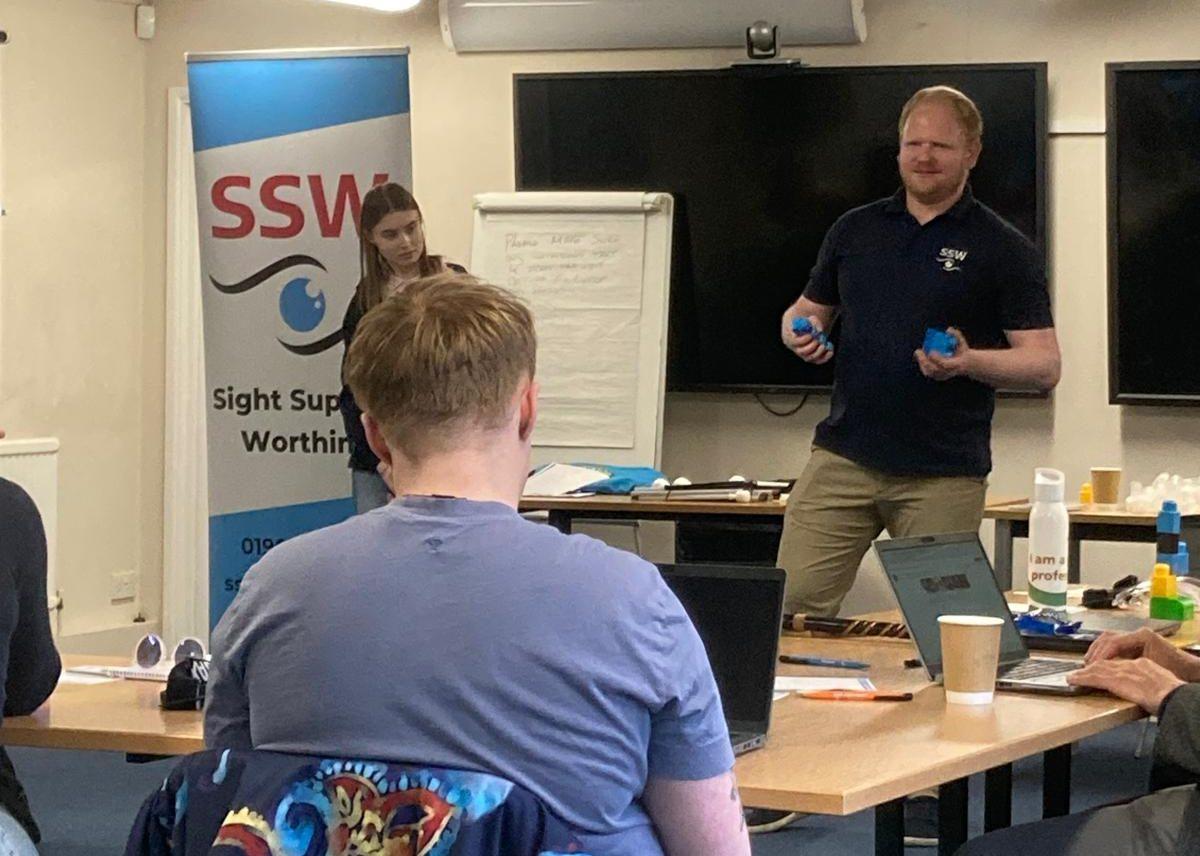
Looking at an example closer to home, SSW apprentice, Susannah, aged 19, has Chiara I brain malformation, which significantly affects her vision – but research suggests it could have raised her auditory acuity.
“My hearing gives me more information about my environment than my sight. I know when someone is walking into a room, and I’m very good at recognising things like the identity of someone based on the sound of their walking pattern,” says Susannah.
“I notice things like whether people have put their seatbelts on based on sounds alone, and will often notice subtle background noises that other people are unaware of.”
Susannah’s experience helps illustrate how neuroplasticity can influence the way some people with sight loss interpret and rely on non-visual information, even though these changes can vary from person to person.
Overall, the research shows that when we lose ability in one of our senses, our brains adapt to their circumstances via a phenomenon called neuroplasticity. Instead of simply shutting down, the pathways through the brain become flexible, allowing areas that would normally handle sight or hearing to take on other processes that the individual does experience.
Looking back at our apprentice, Susannah, for instance, whose experience reflects the kinds of brain adaptations researchers have observed in people with reduced vision. Her extra practice, combined with more areas of her brain processing sound, might have contributed to the greater sensitivity and awareness of sounds that help her identify people and activities around her without using her sight. However, it’s important to note that not every blind or visually impaired person reports experiencing heightened senses, despite the process of neuroplasticity likely taking place.
There’s been a lot of research into this subject in recent years, and if you’d like to learn more, this article by the University of Washington is a great place to start delving deeper into this fascinating topic.