Run the Worthing 10k on behalf of SSW!
SSW is excited to be offering places for runners (and guide runners) in 2026’s Worthing 10k run on Sunday 7th June. Places are £26, with complimentary places for all guide runners.
All runners get a free SSW t-shirt, a goody bag, and lots of support from our staff, members and volunteers! You’ll also have access to our specialist sports masseur Ingrid Sbongk-Sonderfeld.
We ask runners to aim to raise at least £50 in sponsorship, which will help us continue supporting people affected by sight loss in our local community.
Lack of vision should never be a barrier to getting active and joining in, and the Worthing 10K is the perfect opportunity to take part in a fun and inclusive event! Whether you’re an experienced runner or trying something new we’d love your support.
There’s also a shorter course for children, with guides available so that everyone, regardless of ability or age, can enjoy the experience.
Stuart Withers, a dedicated VI guide and runner from Littlehampton, knows first-hand how running can boost both mental and physical well-being. Through his work with Littlehampton Prom parkrun and his training sessions for new VI guides, Stuart has helped make running more accessible for all.
“You don’t have to be the fastest or run the furthest—it’s about getting out there, feeling included, and having a great time,” says Stuart. “Running is for everyone.” Read more about Stuart and guide running here.
If you have any questions please email or call Myra at SSW. She is available either on myra@sswcharity.org.uk or call 01903 235782.
We look forward to welcoming you to our team!
We’re excited to invite you to One Night in Vegas, a spectacular fundraising evening in support of Sight Support Worthing.
For one night only, we’re bringing a touch of Vegas glamour to Worthing for an evening packed with entertainment, laughter and fundraising fun.
📅 Friday 11th September 2026
⏰ 6:30pm – 11:30pm
📍 The Charmandean Centre, Worthing
Your ticket includes:
📸 Red carpet arrival photo
🍸 Welcome drink
🎰 Roulette table
🎩 Live magician
🍽️ Three-course dinner
🎤 Tribute acts celebrating Tom Jones, Shania Twain and Elvis Presley
🎁 Silent auction and raffle
Tickets are £70pp, or book a table of 10 for £650.
Whether you come with friends, family or colleagues, we’d love you to join us for what promises to be a fantastic evening.
Most importantly, every pound raised helps us continue supporting people living with sight loss across Worthing and the surrounding areas.
Buy your tickets here.
We now have an improved Alexa feature to help you hear about upcoming events.
In the past, our Alexa skill could only read out one week of events and needed regular updates. We have now improved it so it is easier to use and can give you more options.
You will no longer be able to access the skill by asking for ‘SSW Event Reader’ and instead will have to ask Alexa for ‘Sight Support Hub’. For example: ‘Alexa, open Sight Support Hub’
You can now ask Alexa to tell you:
- Tomorrow’s events
- This week’s events
- Next week’s events
- This month’s events
How to use it
If you have never used it before, for the first use say:
“Alexa, enable Sight Support Hub.”
If you have already used it before, say:
“Alexa, open Sight Support Hub.”
Alexa will then ask what you would like to hear.
When she finishes speaking, simply say your choice (you do not need to say “Alexa” again for this part).
For example, you can say:
- “Tomorrow”
- “This week”
- “Next week”
- “This Month”
Alexa will then read out the events for you.
When the list has finished, the skill will close automatically.
If you would like help setting this up, or if you are interested in trying one of our Alexa devices, please get in touch — we are happy to help.
What is an Alexa Skill?
Similar to how the services and programs you might use on your phone or computer are referred to as ‘Apps’ or ‘Applications’, Alexa devices have their own version of this called skills!
Help develop players in one of the UK’s fastest-growing inclusive sports.
Sussex Spitfires Showdown Club, run by Sight Support Worthing (SSW), is seeking a Volunteer Coach to support the continued development of our players. Showdown is a fast-paced, table-top sport designed for visually impaired players and playable by all, combining elements of table tennis and air hockey.
Formed in 2024, the Spitfires already include national and international-level players. As the sport grows rapidly across the UK, we are keen to further strengthen our competitive presence and we welcome coaches at different stages of their coaching journey.
Role: Showdown Coach
Reporting to: Volunteer Coordinator
Location: Sight Support Worthing, Rowlands Road
Hours/days: At least one 2 hour session per week (preferably Monday evenings)
Role Description
The Volunteer Showdown Coach will support players with varying levels of vision and experience. This role suits someone with a background in sport or sports psychology who is enthusiastic about inclusive coaching and open to learning a new sport.
Volunteers who are newer to coaching or Showdown will be supported by club leads to develop training plans, exercises, and session structures.
What You Will Be Doing
- Attend at least one weekly training session (additional sessions optional)
- Plan and deliver training sessions, with support and guidance where needed
- Develop engaging exercises to build technical, physical, and mental skills
- Offer advice on additional training that players can undertake independently
- Provide clear, personalised instruction suited to individual players
- Learn about and stay up to date with national and international Showdown developments
Skills & Experience
Essential:
- Background in sport, coaching, teaching, or sports psychology (study or experience)
- Willingness to learn and engage with a developing sport
- Ability to give objective feedback while remaining mindful of players’ emotional wellbeing
- Commitment to fostering a welcoming and inclusive environment
Desirable (but not essential):
- Coaching experience in competitive sport
- Experience working with visually impaired people
Support & Development
- Guidance and mentoring from club leads on session planning and delivery
- Support in adapting exercises for players with different levels of vision
- Training from SSW on visual impairment and inclusive practice
What You’ll Gain
- A key role in developing one of the UK’s leading Showdown teams
- Experience coaching in a diverse and inclusive sporting environment
- Opportunities to attend national and international competitions in a coaching capacity
- Increased understanding of visual impairment through SSW training
- The option to compete in Showdown at national level, if desired
Think this could be the role for you? Join our friendly team of volunteers and help make a difference for people affected by sight loss in our community. Get in touch to find out more: email info@sswcharity.org.uk or call 01903 235782. We look forward to hearing from you!
Use your interest in tech to support independence.
Sight Support Worthing (SSW) is looking for Tech Support Volunteers to help blind and partially sighted people get the most from their devices. Whether it’s setting up accessibility features, troubleshooting an app, or installing a smart speaker, your support can make everyday tasks easier and more empowering.
This is a great opportunity to build experience in assistive technology or charity work while making a meaningful difference in the community.
Role: Tech Support Volunteer
Reporting to: Tech Advisors
Hours/Days: To be agreed
Location: Sight Support Worthing, Rowlands Road, and home visits (company vehicle available if required).
Role Description
Tech Support Volunteers provide one-to-one support to clients with their phones, tablets, computers, and other devices. Support may take place during tech drop-in sessions at our centre or via pre-arranged home visits for those unable to travel or using non-portable devices. The hours and time commitments are flexible depending on your availability, but we require volunteers to commit to a minimum of 3 sessions of 1 hour per month.
Full training and equipment are provided, and reasonable travel expenses will be reimbursed.
What You Will Be Doing
- Giving basic advice and support at tech support drop-in sessions
- Visiting clients at their homes
- Advising on assistive devices, apps, and accessibility features
- Troubleshooting basic issues with devices or connectivity
- Setting up smart speakers and other simple devices
Skills & Qualities
We’re looking for volunteers who are:
- Friendly, patient, and enthusiastic
- Flexible and willing to adapt to individual needs
- Confident communicating in ways tailored to each client
Technical Skills
- Good general knowledge of phones, tablets, or computers
- Willingness to learn new apps and devices
- Interest in accessibility and inclusive technology
Desirable (not essential):
- Experience working with people with a visual impairment or sensory impairment
- Personal or professional experience with assistive technology
What You’ll Gain
- Training in assistive technology, safeguarding, and first aid
- Practical experience to strengthen your CV
- The opportunity to be part of a supportive and community-focused charity
- Invitations to volunteer and charity social events
- A reference for future employment
Think this could be the role for you? Join our friendly team of volunteers and help make a difference for people affected by sight loss in our community. Get in touch to find out more: email info@sswcharity.org.uk or call 01903 235782. We look forward to hearing from you!
There’s a long-standing idea that blind and visually impaired people make up for their lack of vision with some form of superpowered hearing, being able to pick up on the slightest of sounds and orient themselves supernaturally with human sonar.
Take legendary musicians Ray Charles and Stevie Wonder, for instance, both blind from a young age, yet able to master their instruments in ways very few people ever manage. Figures like these, alongside fictional characters such as the blind crime-fighting superhero, Daredevil, further solidify this idea that people lacking one sense have finely tuned their others to experience the world in ways that are just as detailed as those who still have sight.
To find out what’s really going on, we need to look at what’s happening inside the brains of sighted and VI or blind individuals.
In sighted individuals, visual processing is handled by the occipital lobe at the very back of the brain, whereas the temporal lobes on either side of the brain process sound. Despite the difference in location, the audio and visual sections of the brain often work together, with the visual cortex showing signs of activity during sound processing and vice versa, creating a unified sensory experience that helps us navigate the complex world around us.
As you’d expect, the occipital (seeing) lobe in blind people stops receiving visual signals from the eyes, but rather incredibly, remains active rather than sitting dormant. Instead of shutting down, the brain adapts by incorporating the processing of other senses, such as hearing and touch, as well as language processing, leading to improved long-term verbal memory. In some individuals, this can lead to a greater awareness of these other senses, with more areas of the brain dedicated to their comprehension.
This also means that it’s not just the extra practice with these senses that heightens them for a blind or visually impaired individual, but also because parts of the visual cortex can become involved in processing sound or touch, which may improve performance in specific tasks. This might not mean echolocation or Daredevil-esque powers, but real adaptations of the brain that can help with navigating the world, touch reading braille, and picking up subtle differences in sounds. With all this in mind, it’s also important to note that these changes are not universal. Many blind or visually impaired people do not experience a heightened sense of hearing or touch, and there is no guaranteed sensory trade-off for losing sight.
These adaptations of the brain are referred to as neuroplasticity. Think of the brain as a soft ball of clay rather than a concrete object; its malleability allows it to reshape itself to perform as efficiently as possible depending on its circumstances. But, just as a ball of clay dries out and hardens over time, so does the neuroplasticity of our brains, meaning that adults who go blind later in life might experience less of these adaptations than those who experience blindness earlier on in life.
Looking at an example closer to home, SSW apprentice, Susannah, aged 19, has Chiara I brain malformation, which significantly affects her vision – but research suggests it could have raised her auditory acuity.
“My hearing gives me more information about my environment than my sight. I know when someone is walking into a room, and I’m very good at recognising things like the identity of someone based on the sound of their walking pattern,” says Susannah.
“I notice things like whether people have put their seatbelts on based on sounds alone, and will often notice subtle background noises that other people are unaware of.”
Susannah’s experience helps illustrate how neuroplasticity can influence the way some people with sight loss interpret and rely on non-visual information, even though these changes can vary from person to person.
Overall, the research shows that when we lose ability in one of our senses, our brains adapt to their circumstances via a phenomenon called neuroplasticity. Instead of simply shutting down, the pathways through the brain become flexible, allowing areas that would normally handle sight or hearing to take on other processes that the individual does experience.
Looking back at our apprentice, Susannah, for instance, whose experience reflects the kinds of brain adaptations researchers have observed in people with reduced vision. Her extra practice, combined with more areas of her brain processing sound, might have contributed to the greater sensitivity and awareness of sounds that help her identify people and activities around her without using her sight. However, it’s important to note that not every blind or visually impaired person reports experiencing heightened senses, despite the process of neuroplasticity likely taking place.
There’s been a lot of research into this subject in recent years, and if you’d like to learn more, this article by the University of Washington is a great place to start delving deeper into this fascinating topic.
We’re incredibly proud to introduce our team of six runners who are gearing up to take on the London Landmarks Half Marathon on Sunday 12th April 2026; a unique and iconic 13.1-mile challenge through the heart of the capital. Our team consists of Carol, Adam, Gary, Evan, SSW Member Kombo and Guide Runner Warwick.
This isn’t just any half marathon – the route winds past some of London’s most famous sights, from Big Ben, St Paul’s Cathedral and the Tower of London to the London Eye and The Shard, offering runners a view of the city’s skyline like no other.
For our runners, this experience is about more than personal achievement; it’s an opportunity to raise vital funds and awareness for Sight Support Worthing and the work we do supporting people affected by sight loss across our community.
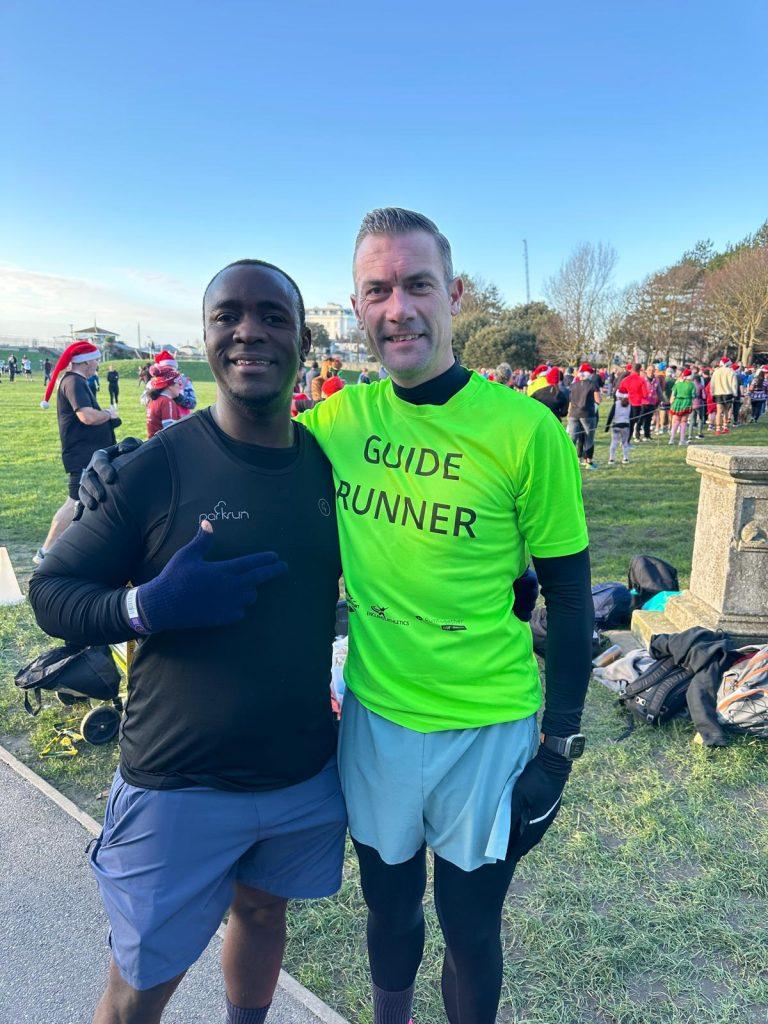
Why our runners are taking part
Each member of Team SSW has their own reason for signing up, from personal fitness goals to fundraising for a cause close to their heart. What unites them is a shared desire to make a difference and support others.
As they train in the run-up to race day, they need your support. Sponsorship helps cover the cost of their race places and ensures every pound raised goes further towards the services we deliver each week, from social connection and practical support to wellbeing activities that reduce isolation and build confidence.
Support our team: make every mile count
We’re asking members of the SSW family – supporters, volunteers, friends and local businesses – to back our runners by sponsoring them via our GivenGain page. Your donation, big or small, will contribute to making a real impact. You can find the SSW team’s fundraising page here: https://www.givengain.com/campaign/ssw–llhm.
Whether it’s a pound per mile or a one-off gift, your support will encourage our runners as they take on this special event and help ensure our charity can continue to be there for people living with sight loss.
Thank you!
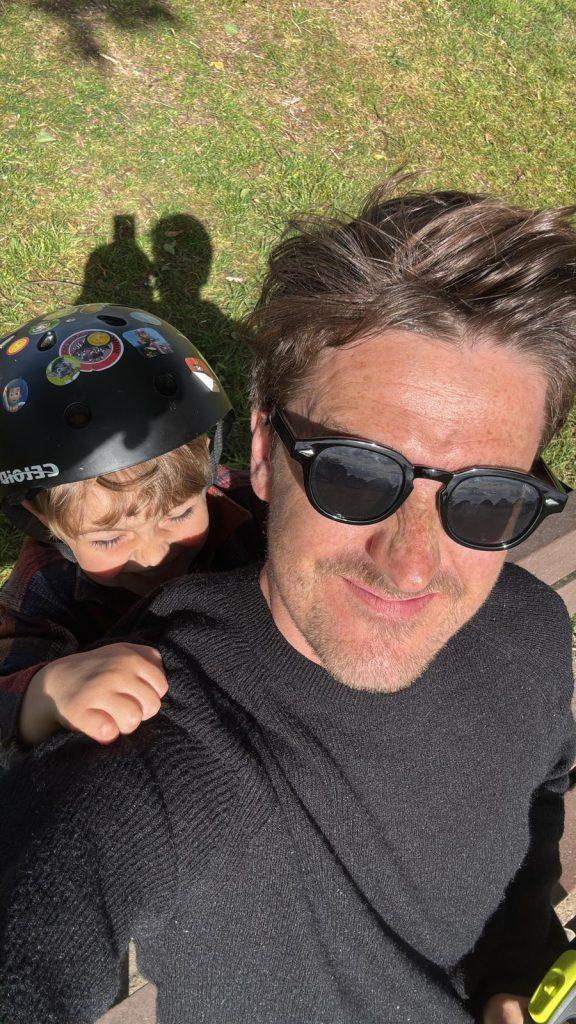
SSW is launching an online shop and we’re looking for eCommerce Volunteers to help bring it to life. You’ll support us in selling donated goods through platforms like eBay, Vinted, and Facebook Marketplace, helping raise essential funds for our work with blind and partially sighted people.
If you enjoy organisation, photography, or online selling, and want to make a real difference, this could be the perfect role for you.
Role Description
eCommerce Volunteers help manage donated and purchased stock for SSW’s online sales platforms. Your support will directly contribute to raising funds for services, activities, and projects that benefit blind and partially sighted people and the wider community.
What You Will Be Doing
- Selecting, sorting, and pricing donated and bought stock
- Photographing items for online listings
- Writing clear and accurate descriptions of items
- Uploading and managing listings on platforms such as eBay, Vinted, or Facebook Marketplace
- Preparing sold items for postage and dispatch
- Occasionally lifting and moving boxes of stock
Skills & Qualities
You don’t need previous experience, we’ll support you to learn. The following will be helpful:
- Happy to work as part of a team
- Willingness to learn new skills
- Basic IT skills
- Good organisational skills and attention to detail
What You’ll Gain
- Expenses covered (subject to agreement)
- Access to training and development opportunities
- A friendly, supportive team environment
- Flexible volunteering to fit your lifestyle
- Valuable work experience and a reference for future employers
Think this could be the role for you? Join our friendly team of volunteers and help make a difference for people affected by sight loss in our community. Get in touch to find out more: email info@sswcharity.org.uk or call 01903 235782. We look forward to hearing from you!
SSW is seeking enthusiastic Volunteer Grant Writers to support our fundraising work. In this role, you’ll help secure funding that enables SSW to deliver projects to benefit blind and partially sighted people.
This role would suit someone with an interest in research and writing, as well as being involved in the local community. If you’d like to gain professional experience for your own career, or you have some spare time and would like to get involved in fun and fulfilling projects, we’d love to hear from you. Training and support will be provided.
Role: Volunteer Grant Writer
Reporting to: Head of Fundraising
Volunteer Grant Writers will work closely with the Head of Fundraising, who will assign suitable grant opportunities of varying values to apply for. These grants will support projects that improve inclusion, independence, and wellbeing for people with sight loss.
Key Responsibilities
- Research and identify relevant grant opportunities
- Write clear, compelling grant applications tailored to funder requirements
- Work to agreed deadlines and application guidelines
- Collaborate with the Head of Fundraising to refine proposals
- Support funding bids for time-limited charitable projects
Skills & Experience
- Strong written communication skills
- Good attention to detail and ability to follow guidelines
- Research skills and an organised approach to work
- Previous grant writing experience is welcome but not essential
What You’ll Gain
- Practical experience in grant writing and fundraising
- Insight into how charities develop and fund community projects
- Flexible volunteering that fits around your availability
Think this could be the role for you? Join our friendly team of volunteers and help make a difference for people affected by sight loss in our community. Get in touch to find out more: email info@sswcharity.org.uk or call 01903 235782. We look forward to hearing from you!
We would be very grateful if you could click this link and nominate Sight Support Worthing to potentially win a £1,000 donation from the Benefact Group’s Movement for Good programme.
Movement for Good is Benefact’s annual programme of giving that anyone can get involved in, and this year they’ll be donating over £1 million to charities and good causes nominated by you.
Obviously you can nominate any charity of your choosing but we would love it if you could nominate us!
Movement for Good also has £5,000 special draws for specific categories of charity. Later this year (in May) the category is ‘health’ so we’ll be back in touch to ask you to nominate us for an even bigger potential donation!
Thank you from all of us here at SSW.
Date: Monday 22nd December
Time: 10.30am – 4.00pm
Location: SSW, 48 Rowlands Road, Worthing, BN11 3JT
We’re excited to invite you and your family for a festive, feel-good day at our annual Christmas Cracker event, a warm, welcoming celebration for everyone in our community.
Here’s what you can expect:
- A magical Santa’s Grotto for children: booking essential. Each child will receive a gift, some reindeer-food and enjoy fun Christmas crafts. Tickets are £7.50 each and can be booked here.
- Free entry for everyone else to join in the fun: carol singing, festive games and welcoming refreshments throughout the day.
- Plus: mulled wine, festive hot chocolate, and plenty of cakes, mince pies and snacks.
- Entertainment: we’re delighted to confirm that we’ll have a special performance by SSW Trustee and popular local singer Kelly O’Haire, who will perform alongside her sister. We’re in conversation with other local groups too so watch this space for announcements!
What makes our Christmas Cracker special…
At Sight Support Worthing we believe that Christmas is best enjoyed when shared. This event is our chance to bring together people of all generations: children meeting Santa, adults socialising, families enjoying the decorations and music, all in a friendly, inclusive and accessible space.
By coming along, you also support our mission: to improve independence and wellbeing for people with visual impairments in and around the Worthing area.
How to get involved
- Bring the children: book grotto tickets for a memorable experience with Santa, as well as a gift.
- Invite friends, family and neighbours: everyone’s welcome… drop by, stay for 10 minutes or settle in for the whole day!
- Volunteer or perform: if you or your group would like to entertain (carols, music, crafts) or help on the day, please get in touch – we’d love your support.
- Donate a cake or baked item: if you’re a keen baker and would like to bring a contribution, let us know. We’ll be very grateful!
Save the date, book your place for Santa’s grotto and join us for a day of joy, community and holiday spirit. We can’t wait to see you!
The Skill Share Initiative allows volunteers the opportunity to contribute their skills, talents, or experience in new and flexible ways. It’s designed to help volunteers share what they enjoy and expand their involvement with SSW, whether through one-off projects or ongoing contributions.
Volunteers might offer a single piece of support, such as creating a poster, designing an advert, or providing photography at an event, or take on a semi-regular or regular activity, such as helping with communications or leading a group or class.
This initiative is open and adaptable; participation will vary depending on each volunteer’s interests, skills, and availability. It’s a great way to make a meaningful impact and explore new ways to support SSW’s members and services.
Examples of Contributions
- Creating materials e.g. adverts, posters, or newsletters
- Providing photography or creative content for events
- Leading or assisting with a group, class, or session
Clubs and Groups Volunteers support the regular activities run by SSW. They play an important role in helping sessions run smoothly, offering practical support and building a good understanding of the activity and the needs of those taking part.
Friendly, reliable, and engaged, these volunteers may have existing skills or an interest in learning more about the activity they support. As these roles involve ongoing sessions, regular attendance and commitment are essential to provide continuity and maintain a welcoming, supportive environment for members.
Typical Duties:
- Assisting with setup and pack-down of sessions
- Providing hospitality and refreshments
- Supporting the smooth running of activities
- Guiding and assisting members as needed
- Following direction from the Group Lead or Event Lead
General Operational Support Volunteers assist with a wide range of tasks that help SSW run smoothly day to day. Their support is vital to the efficient operation of our services and the ongoing engagement of our members.
Adaptable, reliable, and organised, these volunteers contribute in many different ways, from preparing newsletters and maintaining the garden to helping contact members or supporting administrative tasks.
Typical Duties
- Assisting with newsletter preparation and general
- communications
- Helping with light maintenance tasks, such as garden
- upkeep
- Contacting members by phone or email to share updates
- or gather feedback
- Providing general administrative or practical support as needed
Member Support Volunteers provide social or practical assistance to SSW members outside of SSW events, helping them stay connected and independent. The role is flexible and responsive, offering support based on each member’s needs and the type of activity involved.
Friendly, reliable, and supportive, volunteers help members with everyday tasks or companionship, always maintaining clear boundaries. This role is purely supportive and does not include any personal care responsibilities.
Typical Duties
- Providing social contact and companionship to SSW members
- Offering practical help, such as reading mail or running simple errands
- Supporting members to access community activities
- Communicating regularly with SSW staff about visits and support provided
One-to-One Drivers provide vital transport for SSW members, helping them attend medical appointments and maintain their independence. Reliable and understanding, our volunteers ensure members feel supported throughout their journey.
Drivers must hold a full UK driving licence and use their own insured vehicle. Volunteers should inform their insurer that they drive on a voluntary basis for no financial gain; SSW will cover any cost for required policy adjustments. SSW members cover mileage at 50p per mile, plus parking or toll fees.
Typical Duties
- Driving members to and from medical appointments
- Waiting with members as needed
- Guiding and assisting members as required
- Keeping clear communication with SSW staff and members
Volunteer Leads help coordinate volunteers during events, ensuring activities run smoothly and safely. Approachable, reliable, and professional, they act as a first point of contact for volunteers, providing guidance, encouragement, and clear communication while working closely with SSW staff to create a positive and well-organised environment.
They also support new volunteers through the SSW Buddy System, sharing knowledge, promoting confidence, and modelling SSW’s values of respect and inclusion.
Typical Duties
- Coordinating volunteer tasks and event setup
- Guiding and supporting volunteers during activities
- Acting as a Buddy to new volunteers
- Communicating effectively with Event Leads and staff
- Promoting teamwork and positive volunteer practice
Service Support Volunteers use their knowledge, skills, and experience to assist SSW Service Leads in delivering high-quality support to members. Services include assistive technology advice, benefits guidance, wellbeing support, events and activities, and fundraising.
Reliable, knowledgeable, and proactive, these volunteers contribute their expertise to enhance service delivery and improve the experience of SSW members. They work collaboratively with staff and other volunteers to ensure that services run smoothly and effectively.
Typical Duties
- Supporting Service Leads in the planning and delivery of activities
- Sharing knowledge and practical skills within relevant service areas
- Assisting with information, guidance, or administrative tasks as required
Minibus Drivers play a key role in supporting SSW trips and visits, helping members travel safely and comfortably to and from activities and events. They contribute to creating enjoyable, well-organised outings and help members feel confident and supported throughout the journey.
Friendly, reliable, and safety-conscious, our Minibus Drivers represent SSW with professionalism and care. They must hold a full UK driving licence with Category D1 entitlement, enabling them to drive the SSW minibus safely and responsibly.
Typical Duties
- Driving the SSW minibus for trips and group activities
- Assisting members during the trip/activity
- Supporting the Event Lead as required
- Carrying out basic vehicle checks before and after trips
Fundraising Events Volunteers support the planning and delivery of activities that help raise vital funds for SSW. They bring enthusiasm, confidence, and a strong understanding of the charity’s work, helping to engage the public and represent SSW in a positive and professional way.
Knowledgeable, friendly, and proactive, our Fundraising Assistants have regular experience supporting our member events and use this experience to inform the information they share with the public, ensuring that communications about SSW are accurate, engaging, and inspiring.
Typical Duties
- Assisting with stalls, collections, and fundraising events
- Engaging with the public and sharing information about SSW
- Supporting fundraising promotions and activities
- General assistance as directed by the Event Lead and/or Fundraising Coordinator.
Trips and Visits Volunteers are key to helping our outings and excursions run safely, smoothly, and enjoyably for all participants. They bring reliability, good communication,
and a friendly presence to support both members and staff throughout the day.
Confident, approachable, and supportive, our Events Assistants for Trips and Visits are familiar with SSW’s activities and can assist the Event Lead in ensuring that every journey and visit is well-organised and welcoming.
Typical Duties
- Minibus assistance
- Guiding members as necessary
- Supporting members with an activity
- General assistance as directed by the Event Lead.
General Events Volunteers play a key role in ensuring the smooth and successful delivery of our events and activities.
They bring enthusiasm, teamwork, and strong communication skills to every occasion, supporting both participants and fellow volunteers.
Friendly, approachable, and proactive, our Events Assistants are familiar with SSW’s events and can confidently support the Event Lead to create a welcoming and well-organised experience for all.
Typical Duties
- Assisting with event setup and pack-down
- Providing hospitality and serving refreshments
- Welcoming and guiding members or guests as needed
- General assistance as directed by the Event Lead
- Minibus Assistance as required
For my bronze Duke of Edinburgh Award I volunteered at SSW. SSW is a charity aiming to promote inclusivity and advocate for rights for the visually impaired people. Before I could serve the charity I had to go through training on how to properly assist a visually impaired person. This included a slideshow presentation on different types of visual impairment and what they see, and an activity simulating walking a blind person around a street using blindfolds. After finishing all necessary training, I was awarded a certificate.
While I was at the charity I had to help with a game called Showdown they host every Friday. The aim of the game is to bat the ball off the side wall, along the table, under the centre wall and into the opponent’s goal. To help I would referee games played between the people at the charity, eg keeping track of points and fouls. I also, when needed, played against them or helped them practice. It took me a while to learn the rules or even get good at the sport and while I have improved they still beat me even when I’m not blindfolded!
Overall my experience at SSW was very positive. The people there were friendly and very good at Showdown. I enjoyed and learnt a lot about the sport and was happy to have volunteered there for my Duke of Edinburgh Award.
SSW has committed to Net Zero 2040 and, over the past two years, we have attended Net Zero conferences, joined local sustainability networking group People, Planet, Pint, and won funding from Sussex Community Foundation for energy audits, sustainable windows and solar panels. We have also joined Clean Growth UK, encouraged the use of emails over paper, implemented soft plastic recycling, installed food waste bins and composters, and switched to green web hosting, reducing our CO2 emissions by almost a third.
In 2024, as part of the Adur and Worthing Council Business Support Programme, we attended a workshop and applied for their sustainability match funding grant to change our aged lighting system to more efficient LED units, reducing our electricity consumption.
At this meeting we met another attendee: James Botley, from DW Energy. We talked through our sustainability alterations and ideas with James, and a plan was formed. DW Energy was a perfect match: local and similarly committed to their sustainability journey. James and his colleague Simon Youngman from DW Energy visited SSW and went to incredible lengths to ensure the safeguarding of our visually impaired community whilst making our planned sustainability improvements throughout.
James and Simon have appreciated the struggles and limitations of fundraising and have worked with Sight Support Worthing to make each job achievable.
James and Simon went above and beyond and hatched a plan to complete the South Coast Ultra Challenge – 100k in 24 hours – to raise funds for SSW. Walking from Eastbourne to Arundel in 24 hours, the challenge took strategic planning, as they both work long hours and have families to consider. However, their determination won the day and they gave up hours of their lives to train and compete, so they were in the best physical and mental condition to take on such a mammoth walk. The walk took place in mid-September and DW Energy have now raised more than £2,000 for Sight Support Worthing.
Thank you, James, Simon, and DW Energy!
Role Overview:
SSW’s Chess sessions have been a popular and regular part of our events program for the past two years. We will be welcoming a new group of beginner and novice players on Thursday afternoons from Thursday 26th February, and need volunteers to help create a supportive, inclusive, and enjoyable environment.
Reporting to the Events Coordinator, Volunteers will help participants engage with the game using accessible adaptations, including tactile boards and verbal communication of moves using the grid system.
What You Will Be Doing
- Assisting with setting up the room and equipment
- Supporting players during games, helping ensure moves are clearly communicated and understood
- Encouraging a friendly and relaxed atmosphere
- Over time, helping to oversee games between members as confidence grows
Skills & Qualities
You do not need to be a chess expert — training and guidance will be provided.
We’re looking for volunteers who are:
- Friendly and approachable
- Patient and supportive
- Comfortable having conversations and building rapport
- Flexible and willing to help where needed
- Able to adapt their communication style to meet the needs of different people
What You’ll Gain
- Experience supporting inclusive recreational activities
- An understanding of accessible adaptations for blind and partially sighted players
- The chance to be part of a welcoming and sociable group
- Flexible volunteering in a relaxed, enjoyable setting
Think this could be the role for you? Join our friendly team of volunteers and help make a difference for people affected by sight loss in our community. Get in touch to find out more: email info@sswcharity.org.uk or call 01903 235782. We look forward to hearing from you!
I’m Poornima (or Moon: this is what the members of SSW call me now). I am a year 12 student from Sir Robert Woodard Academy. When I first heard about SSW, I thought for work experience all I am going to do is probably help the members with something general or the refreshments. By the time I did start, I had a rough expectation of what was happening as Jackie had sent me a rough schedule, following my first visit to SSW. The timetable was actually more packed than expected with a variety of events and activities. I was quite uncertain if I would fit in or if it might be boring perhaps (which didn’t happen; in fact my week at SSW was one of the most entertaining weeks of my life).
Day 1 started with a coffee morning. I just helped around with refreshments and – not going to lie – it was nerve wracking as I didn’t know how to approach the members and have a chat with them. After the initial nervousness, it was actually quite natural to talk to the members; it almost felt like they were my actual family at times. After the busy morning, Myra, SSW’s Head of Fundraising Events, assigned me and Susannah to make some small and cute goody bags for Worthing Summer Fete. Although it got exhausting towards the end, it was definitely worth it. It was almost like Myra was making two little elves wrap presents for Christmas! I ended my day by watching an intense match of Showdown in the activity room.
Day 2 was quite relaxed. I helped with the art session run by Fiona and Pat. The art pieces that came out of that session were far better than what I can ever do! In the afternoon, I made an itinerary flyer for the SSW Open Day.
On Day 3 Jackie ran through the process that is involved with fundraising, and went over her and Myra’s lovely fundraising whiteboard. I carried on making more posters about the different visual impairments. This helped me to learn and understand a lot of visual impairments that I had no clue of before this work experience.
Day 4 was more involved with technology, at the tech drop in. This is where the members of SSW can come in and our expert Ali will assist with all sorts of issues from suggesting the best reading lamp or magnification lens to any sort of assistance with technology to make it accessible for oneself. I quite enjoyed assisting Ali. During the afternoon, I had a session run by Ali with Susannah assisting. Ali went through the various visual impairments, the medical and social model and more theory stuff. Later on we did a more practical side of the session, such as an activity involving building blocks, trying on some goggles / glasses modified by Susannah to replicate how people with various visual impairments see things around them, and also the training for becoming a sight guide.
This was the day where I realised the harsh reality and stigma around visual impairment, and how oblivious our eyes are and how we can’t figure out if a person has some sort of visual impairment or not with a single glance.
Day 5 was more of all the stuff in one day, where I assisted more with the prep for the Steyne Garden Summer Fete, helped with the art session and also interviewed a few of the staff for my work experience journal.
Technically not day 6, but I popped in and helped with the Summer Fete for an hour or so.
Overall, I had a wonderful experience with SSW. Thanks to the lovely and brilliant SSW crew and the sweet members of SSW.
Thanks to this wonderful experience I had with SSW, I have decided to be a volunteer at SSW over the summer.
Signing off
Your Moon 🙂
Our CPD certified, interactive workshop will challenge your perceptions of sight loss and enable you to offer appropriate assistance with confidence.
Run by our in-house trainers with lived experience – James and Alison – this is a fun, friendly and informative session to enhance your understanding of the social model of disability. Join us on Wednesday 13th August at our Centre at 48, Rowlands Road, Worthing.
In our 3 hour workshop we cover:
- An introduction to visual impairment and guiding
- Communication, accessibility and problem solving
- Equality, diversity & inclusion
- Social, legal and practical considerations
Places are £30. Book yours here.
Alternatively, if you are looking to train a team of people, we offer bespoke workshops for organisations of all types. Do get in touch to find out how we can work together.


This is Sharon Newby who is a relatively new addition to our steadfast team of volunteers. Like all our volunteers, Sharon has her own reasons for volunteering which you can find out more about now…
What is your volunteer role?
I am a sighted guide volunteer for outings and an assistant for activities such as chess and Boccia, and in-centre events like the coffee morning and celebration days.
How long have you been volunteering?
10 months.
Why did you want to volunteer?
I had worked as a Community Nurse for 40 years, which I left so that I could care for my husband who had a rare brain disease with early onset dementia in 2020. He passed away in 2023, and I wanted to fill a big void in my life after my carer needs stopped.
What interested you in volunteering?
I wanted to do something to help others and meet new people. I wanted to be part of a positive environment.
What does your volunteer role involve?
I attend the weekly coffee mornings and it’s nice to be able to sit and chat with the members that come in. Many live alone, so it is nice to learn more about them and have a good chat.
I assist with weekly chess sessions in the Centre, navigating the grid board and assisting members when learning the game. I also assist on the minibus as a sighted guide volunteer, to bring people to the Centre, or take them out on trips out and about in the community.
Did you have any concerns or worries about volunteering?
No.
How has volunteering helped you?
It has given me structure to my week, and the feeling of being needed. When I come to do my volunteering role, I feel comfortable, and it feels like family. I feel lifted.
What have you shared with the organisation during your volunteering for example any skills, experience, knowledge, hobbies, interests?
I have been able to use transferrable skills such as caring for people, which was a huge part of my career as a Community Nurse.
What have you learnt through your volunteering?
Volunteering is continuous learning, about people and how to adapt to situations. It keeps you developing as a person. I have been able to mix with a variety of age ranges and life experiences.
What do you enjoy about volunteering with your organisation/group?
I enjoy the variety of people that I get to meet and joining the different activities. I like the feeling that I have made a difference.
Has there been any outstanding moments that you wish to share?
The events in the Centre like the Burns Night and St George’s Day celebrations have been really uplifting and positive days.
If you could describe volunteering in a sentence or in one word, what would it be?
Rewarding!
If someone was thinking about being a volunteer but wasn’t sure, what would you say to them?
Definitely do it!
On that note, we will say ‘thank you’ Sharon, both for your volunteering and for the insightful interview.
If you would like to find out more about volunteering with SSW, we’d love to hear from you! Please contact Katie on 01903 235 782 or email her at katie@sswcharity.org.uk.
Stephen has been part of the SSW volunteer team for almost eight years, and has been a vital part of our service. He’s a seasoned volunteer, who brings a great deal of skills to his role.
What is your volunteer role?
Minibus driver and sighted guide volunteer
How long have you been volunteering?
Almost 8 years now!
Why did you want to volunteer?
My day job was solitary, so volunteering enabled me to work with people, learn new skillsets, and boost my confidence when working with groups of people, as well as present me with new challenges.
What interested you in volunteering?
My first volunteer role was in 2006 at Chichester Canal as a volunteer working on the boats, which was a big interest of mine. My volunteer role enabled me to go out regularly on the boats on the beautiful setting of the canal and meet new people.
I then joined Sight Support Worthing in 2017 following an experience with someone in my life with sight issues. I had more time available, and I wanted to offer my help.
What does your volunteer role involve?
I drive the charity minibus on a weekly basis to collect our members from their homes and bring them to the Centre for activities and social events. I also assist with events in the Centre, and out and about as a sighted guide volunteer, and anything else that is needed!
Did you have any concerns or worries about volunteering?
I wanted to volunteer to do something that I enjoy, which led me to the boats at the canal. With SSW, I feel that I am making a difference in a more caring environment, which I really value.
How has volunteering helped you?
Volunteering has boosted my confidence and has filled up free time with a variety of interesting experiences.
My journey with SSW started when I was looking for more voluntary work to fill my time, and the kindness that I was shown at the charity at that time, has changed my life for the better.
What have you shared with the organisation during your volunteering for example any skills, experience, knowledge, hobbies, interests?
My job before retiring was in upholstery, and I was able to help the charity by bringing new life to the chairs in the centre!
I have been able to share interests such as aviation with the SSW members, by assisting with trips out like flying planes. Sharing a passion for something with another person is a great connection.
What have you learnt through your volunteering?
Don’t be scared of having a go, getting involved, and taking on challenges.
What do you enjoy about volunteering with your organisation/group?
The opportunities with SSW have been unbelievable experiences. I have been axe throwing, sailing, driving cars at Brands Hatch, flying planes, going to the theatre, and going out for pub lunches, to name but a few!
Has there been any outstanding moments that you wish to share?
Being a passenger in a plane that was piloted by a person with a visual impairment. Incredible!
If you could describe volunteering in a sentence or in one word, what would it be?
REWARDING
If someone was thinking about being a volunteer but wasn’t sure, what would you say to them?
Give it a go! There is so much out there to do and experience.
We can’t guarantee all our volunteers will get to fly in a plane with a SSW member but we do offer rewarding roles with lots of fun added in! If you’d like to volunteer with SSW please do get in touch with us. Call Katie on 01903 235 782 or email her: katie@sswcharity.org.uk
We have lots of great people giving their valuable and valued time to help us deliver our services to our members. Here we meet Naomi who has been part of our volunteer team for 2 and a half years now. Find out more about Naomi, her background and her motivation for volunteering:
Why did you want to volunteer?
I was going through a rough patch, and I wanted to think about something else and in the process give something back.
What interested you in volunteering?
I have managed volunteers in my professional life for 20 years, so I’ve always been very positive about volunteering and the benefits it gives to the people receiving the support and the volunteers themselves.
What does your volunteer role involve?
I help with newsletter each month – folding and stuffing envelopes. I help on trips out and I help with events at SSW such as wreath making.
Did you have any concerns or worries about volunteering?
No
How has volunteering helped you?
It’s made me think less about my worries by keeping busy plus I feel inspired by the people we support – their positive attitude in the face of adversity/challenge is amazing. I also feel it’s good for me to be at SSW as it keeps me in touch with the working world (I WFH now) and gets me out of the house!!!
What have you shared with the organisation during your volunteering for example any skills, experience, knowledge, hobbies, interests?
As I am a Volunteer Co-ordinator by trade (!), I sometimes offer suggestions in relation to procedures, which has always been received in the spirit it’s meant. It was agreed with Katie (SSW’s Volunteer Co-ordinator) that I’d suggest things, but that she knows I always respect her role and how things are done at SSW.
What have you learnt through your volunteering?
Generally, through the years I’ve volunteered at various organisations I always look at my future self and try to learn lessons from those older and definitely wiser than me. Especially – the more you do, the more you can do. Keeping positive, confident, and having a sense of humour is so important.
What do you enjoy about volunteering with your organisation/group?
I like having a laugh with the members, volunteers, and staff (probably a bit too much !!!) and I like going out to places I’ve not been before. It’s also nice when members thank you for your support as it makes me feel I’ve really done something to make someone’s day better.
Have there been any outstanding moments that you wish to share?
I absolutely love doing the crafts at SSW an especially seeing how people with sight impairment navigate the tasks and get on with them with such confidence.
If you could describe volunteering in a sentence or in one word, what would it be?
Rewarding
If someone was thinking about being a volunteer but wasn’t sure, what would you say to them?
I would say always carefully consider you can make the time commitment requested of you. Start small – you can usually take on more as time progresses (see my first point), don’t be apprehensive or nervous, there will be others in the same boat as you – new volunteers and members.
Go for it: you will meet new people and get a new outlook on life!
Thank you Naomi both for your volunteering efforts and the insights in to why you volunteer and what you get from it.
If you’d like to find out more about the range of volunteer roles we have here at SSW, please get in touch with Katie either by email (katie@sswcharity.org.uk) or call her on 01903 235 782
By Kate Confrey
At Sight Support Worthing, we believe mental health isn’t just about what services we offer, it’s about people, relationships, and the strength we build together.
This Mental Health Awareness Week, we’re reflecting on what wellbeing really means for our community. For us, mental health support is woven into everything we do; from a warm welcome at our coffee mornings, to the trust built in a one-to-one conversation, to the way we work in partnership with others to reach and uplift those who need it, at the time they need it.
Over the years, we’ve learned that mental health support doesn’t always look like formal counselling: sometimes it looks like knowing you’re not alone, or it’s information shared at the right moment, it’s a space where people feel seen, heard, and understood.
We’re proud to be part of a local network of organisations and professionals who care deeply about making our community a kinder, more connected place. Together, we’re building strong foundations for wellbeing, foundations that last beyond any one project or funding stream.
Because ultimately, good mental health is something we build together, not just this Mental Health Awareness week, but every day.
If you’d like to find out more about our wellbeing support – including our specialist counselling – please do get in touch. All enquiries are treated as confidential. You can talk to Kate on 01903 235 782 or email her at kate@sswcharity.org.uk.
We have lots of amazing volunteers here at SSW; Sadie is one of them and, when she’s not help us out, she is undertaking PhD research at the University of Brighton. She’s currently looking for people with visual impairments to assist with her research… perhaps you can help?

“Hi everyone – I’m Sadie, a sighted guide volunteer with Sight Support Worthing.
“I may have joined you for past activities like sailing, kayaking, archery, rambling, or maybe even one of the super yummy pub trips!
“I’m also a PhD researcher at the University of Brighton, working on a project that explores how people with visual impairments experience and connect with blue spaces like the sea, lakes, and rivers. While natural water is increasingly recognised as important for wellbeing, we still know very little about how these places are experienced by VI individuals, especially during in-water activities.
“This research is all about co-creating understanding through lived experience. Whether you’re a regular sea swimmer, love a paddle, or just enjoy being near the water, I’d love to hear from you.
“You can take part however feels comfortable – we could go for a walk along the beach, a sit by the water’s edge, or even a swim in the sea if you’re up for it. I’m arranging one-to-one chats and swim-along interviews throughout July to September, all based in or around Worthing – although I’m happy to go further if you’d like to try somewhere specific.
“If you’d like to know more or are curious about taking part, feel free to drop me an email at: s.rockliffe1@uni.brighton.ac.uk
“We’re also in the process of building an accessible website for the project, which I’ll share as soon as it’s live.
Thanks so much – hope to hear from you soon!“
If you can help Sadie, please drop her a line on the email above or catch her when she’s at the Centre.

We are excited to be hosting a charity Golf Day at the fabulous Worthing Golf Club on Thursday 16th October. You’ll be part of a team of four, and there’s prizes for the winning team as well as nearest the pin, and hole in one. Enjoy a bacon roll and tea/coffee on arrival, followed by a round of 18 holes.
Also included in the day is a delicious two-course lunch, beer buggy, auction, raffle, bottle putting and more!
Tickets are just £85pp; book your Golf Day ticket here.
We also have sponsorship opportunities available. Take a read of our Sponsor Packages brochure, or get in touch with Myra on 01903 235782 or myra@sswcharity.org.uk to find out more.
In 2024 SSW was chosen by British Blind Sport to launch our own Showdown club.
Showdown, a dynamic sport originally designed for those with visual impairment, is open to everyone. Players use flat, paddle-type bats on a specially designed table, aiming to score points by hitting the ball off the side wall, along the table, under the centre screen, and into the opponent’s goal. The first to reach eleven points, leading by two or more, wins. Each player serves twice in a row, and scoring involves goals and penalties. Join us for an inclusive and thrilling showdown experience!
We have our Showdown table, funded by British Blind Sport. We have regular Showdown slots here at the Centre on Monday from 5-7pm and on Friday from 2-4pm. We also hold other one-off events. If you are interested in finding out more contact James at the Centre.

Since establishing our Showdown team – the Sussex Spitfires – SSW team member James, member Sam and others, have taken part in various Showdown tournaments. Sam, in particular, has done very well in competitions and has now won several medals and represented Team GB overseas.
Sam has shared his experience of Showdown with us:
“It’s great to be able to play a sport specifically designed for those with a visual impairment, not merely adapted or simplified. Showdown is accessible to everyone, yet it boasts a high skill ceiling that challenges me to push myself and compete with others.
“I never imagined I would be participating in tournaments, but it has given me something to aim for and put my time into. Initially, the fast pace and reactionary nature of the game drew me in, but I’m discovering that it also has a significant tactical side to it as well. This, combined with the social aspect of spending time with friends, keeps me coming back every week.”
Our Sussex Spitfires team recently enjoyed a friendly Showdown match against the Coventry Comets, with more friendly matches and competition entries planned. If you would like to try out Showdown, please do come along to our free open sessions as detailed above, or give James a call on 01903 235 782.

SSW is run by a team of dedicated staff, committed trustees and dynamic volunteers all of whom believe in the transformative power of collaboration. Our greatest results happen when we work together and with outside stakeholders such as local and national businesses and organisations. By working with us, your business or organisation has the chance to be a beacon of change, leaving a legacy that extends beyond the workplace.
Why work with SSW?
- Social responsibility redefined
Demonstrate your commitment to social responsibility by aligning with SSW. We offer a platform to highlight important societal issues and contribute to meaningful change. Lend your support to issues that make a difference to the quality of life for the blind and sight impaired in your local community.
- Community engagement
Forge strong connections with the community by getting involved in our services and campaigns that directly impact lives. Your support will be highly appreciated by those who need it most, and recognised by the community at large.
- Brand visibility
Work with us to showcase your corporate values and commitment to making a difference. Partnering with SSW amplifies your brand message, attracting socially conscious clients, customers and employees.
- Tailored partnerships
Our team works closely with corporate partners to create customised engagement strategies. Whether it’s cause-related marketing, employee volunteer projects or strategic alliances, we tailor our approach to meet your specific goals.
- Measurable impact
Join us in the journey of creating quantifiable change. We provide transparent reporting and impact assessments (you can read our latest Impact Report here), allowing you to witness the tangible results of your corporate support.
Ways to support
- Financial contributions or sponsorship
Every contribution, regardless of amount, fuels our initiatives and drives sustainable change. Whether you’d like to support us financially on an ongoing basis or sponsor a specific project or event we can work with you to find the most mutually beneficial arrangement. One easy way to support us is through the use of payroll giving, where employees can donate via their salary, before tax is paid. There’s more information on payroll giving on the gov.uk website.
We offer a choice of sponsorship opportunities for our fundraising events. To find out what current opportunities are available, please contact Myra (01903 235782 / myra@sswcharity.org.uk).
- Employee engagement projects
Foster a sense of purpose among your team by organising volunteering opportunities, fundraising events or skill-based initiatives. Together, we can create a positive workplace culture while making a difference. We have previously worked with local businesses on revamping the flowerbeds at Steyne Gardens in Worthing and undertaking a litter pick on Worthing beach.
- Strategic partnerships
Collaborate with SSW on long-term initiatives that align with your corporate goals. Our team is ready to work hand-in-hand to develop impactful and advantageous partnerships.
- Cause-related marketing
Leverage the power of your brand to raise awareness and funds for us! A cause-related marketing campaign not only showcases your commitment but also generates positive publicity for SSW.
We would love for you to join us in the journey to make a lasting impact, however you might be able to support us. Together, we can turn compassion into action and create a world where every individual has the opportunity to thrive.
Contact Jackie Brownlee, Head of Fundraising, today to explore how your organisation can work with us to become a force for positive change. Call her on 01903 235782 or email jackie@sswcharity.org.uk
by David Best, SSW Counsellor
Firstly we want to thank The National Lottery Community Fund for agreeing to continue funding our Wellbeing and Counselling Service at SSW. Without the money they have provided, these essential services would not have been (or continue to be) possible. The past two years have demonstrated how valuable specialist sight loss counselling is for our members.
I also want to thank my colleagues for their ongoing support and encouragement. I am truly privileged to be part of such an amazing team of such genuine individuals. Last, but not least, I want to thank all the members who have engaged with the Wellbeing and Counselling Service and for all your valuable feedback. This helps us understand your needs and enables us to continue providing the most appropriate support.
We are now starting to expand our current services to include the provision of support groups for members and their families; we have identified various issues and topics that many of our members have in common. We also recognize that there are minority groups that have experiences that are unique to them. We want to provide people with the opportunity to explore their issues, experiences and ideas in a group setting in a safe and supportive environment.
If you are interested in finding out more about our Wellbeing and Counselling Services please do get in touch. David can be emailed at david@sswcharity.org.uk or call him at the office on 01903 235782 or his mobile on 07479 762954.
Finding reliable and accessible transport can be challenging, but there are several services available to help those who struggle with public transport or need additional support. Whether it’s for a medical appointment, shopping trip or social outing, these options ensure you can stay mobile and independent.
Arun Community Transport (ACT)
A volunteer-run service providing transport for individuals who have difficulty accessing public transport.
Services offered:
Medical appointments – doctors, hospitals, dentists
Social inclusion trips – clubs, shopping, hairdressers, visiting friends & family
Area covered:
Angmering to Bognor Regis.
How to use:
Register as a client (£5 annual fee). You can do that online here.
Booking Line: 01903 792110 (Mon–Fri, 9:00 am–12:40 pm)
Dial-a-Ride
A door-to-door transport service for people who find public transport difficult due to a disability.
Area covered:
The Worthing depot covers journeys between Portslade to Littlehampton. However there are other depots in Mid-Sussex, Crawley, Chichester and Horsham.
Features:
Specially adapted vehicles with lift platforms for wheelchair users
Carers can accompany passengers
Journeys available beyond Adur and Worthing on request
How to use:
You can register on their website here (at the foot of the page).
Contact them on 01903 530053 or email enquiries@darss.org.uk
Booking hours: Mon–Fri, 9:30am–3:30pm (24-hour notice required)
Royal Voluntary Service (RVS) – Community Transport
Volunteer drivers help older adults who are less mobile get to where they need to go, including medical appointments, shopping and social events.
How to use:
Call them on 01903 851558, email adur.cct@royalvoluntaryservice.org.uk or fill in this online form.
Booking hours: Mon–Fri, 9:30 am – 12:30 pm
Local Taxi & Ride-Sharing Services
For flexible, on-demand transport local taxis and Uber provide additional options.
Arrow Taxis
Book online here, call 01903 212121 or email enquiries@arrowtaxigroup.co.uk
Uber & Ride-Sharing
Book via the Uber app. You can download the iOS app here and the Android app here.
Uber Assist & WAV (Wheelchair Accessible Vehicles) may be available.
My name is Stuart Withers and I live in Littlehampton, although I am originally from Belfast.
I have been running for about seven years and, although I may not be the fastest or run the furthest, I run as I find it really helps with my mental as much as my physical health. It is “me time” where I can get out there and clear my head.
I can be found most Saturdays at Littlehampton Prom parkrun. I have been there since it started in 2019. I am one of the Run Directors so can be found volunteering more than running.
I have always found the inclusivity of parkrun to be one of its greatest things. It doesn’t matter what your ability or disability is, everyone is welcome at parkrun. I had always looked for ways to help more and VI guide running seemed the next step. Covid meant that plans were put on hold but once things opened up again, I took the English Athletics (EA) sight awareness course and qualified as a guide. I have been doing this at parkrun since. Not as often as I may like, but always when I can. A guide needs to be able to run faster than the person they are guiding and we always seemed to get speedy runners looking for help! Last summer I decided it was time to do something about that.
Anyone can be a guide; you don’t have to have an EA qualification. I thought it would be great to see if there was any interest in guide running and so I put a post out on the Prom parkrun Facebook page, hoping that I would get a few people interested. I was overwhelmed by the demand and I ended up holding four courses in August 2024, and took 28 people through the basics of how to be a guide.
Worthing Striders running club also approached me as one of their members was a VI runner and they wanted to help. I took another 12 members there through the course.


VI guides need runners as much as VI runners need guides. This is where the local sight loss charities and groups are key. I know where the guides are and they know their members. I approached a few local groups from Bognor Regis to Brighton and it was Sight Support Worthing that showed the most interest.
They held an interest day at Worthing parkrun with staff and members in attendance promoting their work and advertising their place as one of the charity partners at this year’s Worthing 10k event on 8th June (more info about that here!). Worthing have a few regular VI runners, two of whom are currently going strong with their marathon training plans: one for London and one for Brighton.
This led to requests from Worthing based runners and I have just completed two more courses and another 12 runners have had their basic introduction to VI guiding. Hopefully I will be doing another course next month for another local club. If you are interested in becoming a guide runner, please do drop me an email, check out the Facebook pages for the various parkruns or check in with your running group.
If you are a visually impaired person who would like to try parkrun, then please do reach out to your local parkrun. Bognor Regis, Littlehampton, Worthing, Hove Prom and Horsham all have guides that I am aware of; there may be more out there. There are guides available for a wide range of paces so don’t be afraid to give it a go. There is no such thing as too slow at parkrun.
If you have any questions, please do feel free to get in touch with us here at SSW. If you’d like to sign up to the Worthing 10k in June as part of the SSW team (whether as a solo runner, with a guide runner or as a guide runner), we’d love to have you join us!
The Worthing 10k takes place on Sunday 8th June. Places are £25, with complimentary places for all guide runners. All runners get a free SSW t-shirt or vest, a goody bag, and lots of support from our staff, members and volunteers!
You can sign up here. If you have any questions please email or call Myra at SSW. She is available either on myra@sswcharity.org.uk or call 01903 235782.
For many people living with disabilities, Personal Independence Payment (PIP) is a crucial source of financial support that can make a significant difference to daily life. However, there is often a stigma associated with claiming benefits. It’s important to challenge this stigma and recognise that PIP is not just about financial help, it’s about empowering individuals to live more independently and improving overall health and wellbeing.
What is Personal Independence Payment (PIP)?
Personal Independence Payment (PIP) is a benefit for people aged 16 to 64 who have a long-term illness or disability that impacts their daily life. Unlike other benefits, PIP is designed to help with the extra costs of living with a disability, rather than replacing income.
It is split into two components: the Daily Living component (for people who need help with everyday activities) and the Mobility component (for people who need help getting around).
The amount you receive depends on how your condition affects you, rather than the condition itself.
New rates coming in April 2025
In April 2025, the rates for PIP are set to increase, The new rates will be:
Daily Living Component
Standard Rate: £68.10 per week (up from £67.30)
Enhanced Rate: £101.75 per week (up from £100.85)
Mobility Component
Standard Rate: £27.55 per week (up from £27.00)
Enhanced Rate: £73.60 per week (up from £72.75)
The link between financial security and wellbeing
Financial security is vital for both mental and physical health. Studies show that people who feel financially secure experience lower stress and anxiety, contributing to better overall wellbeing. For those with disabilities, PIP helps alleviate the financial strain of additional expenses like travel and healthcare, reducing stress and allowing individuals to focus on their health.
The Mental Health Foundation reports that financial worries are a leading cause of stress in the UK, with 40% of people citing money as a major source of anxiety.
Financial security also allows individuals to invest in their health—whether through specialist equipment, therapies, or home modifications, which improves quality of life and supports greater independence.
Encouraging independence
At its core, PIP is about empowering individuals with disabilities to live with dignity and choice. It provides the financial means to make decisions that improve quality of life, whether it’s getting out more easily, managing personal care, or living comfortably at home.
The support PIP offers is essential for independence and wellbeing. It allows individuals to control their lives, participate in fulfilling activities, and reduce barriers caused by disability. By challenging the stigma surrounding benefits, we can create a society where everyone, regardless of their circumstances, has the opportunity to thrive.
If you’d like help applying for your PIP, get in touch with us today.
Get your thinking caps on and join Sight Support Worthing for a fabulous quiz evening, with a delicious fish and chip supper to fuel your brain! The quiz takes place at Merriman Grange Care Home on Warren Road, Worthing, on Wednesday 19th March 2025. We’ll welcome you with a drink at 6.30pm.
Each team will be made up of six people – form your own team or let us match you up with others. Places are £15pp which includes a welcome drink and your meal.
We’re being generously hosted and sponsored by Merriman Grange Care Home, at their new facility in Worthing.
This is one of our exciting and new fundraising events! In January we have our (now sold out) Curry and Elvis night, and in February you can spend the afternoon in the company of a former policeman who will entertain you with unbelievable stories, while you enjoy a fabulous cream tea at the Ardington Hotel. There’s more information on our Cream Tea and Crime event here, and you can buy tickets too.
If you’re a keen runner (or hope to be!), we’d love for you to represent us in the Worthing 10k on the 8th June. Places are £25 (free for guide runners) and we will equip you with an event tshirt, goodie bag and access to a masseur on the day. Book your space here or contact Myra (myra@sswcharity.org.uk) for more info.
When it comes to accessibility, video games might seem like a tricky bridge to cross. With video in the title, the need for sight to interact with the game seems like a given. But, with out-of-the-box accessibility options becoming the norm and more games flooding the market than ever, are there games out there that can played without any need for sighted assistance?
Well, the answer’s a resounding yes.
Not only are some of the most engaging, highly-rated games playable unassisted by the visually impaired but there are hundreds of audio and text-based games on the market that could help you unwind after a hard day or whisk you away into their gripping story.
Stick with us as we run through five of our favourite accessible games on the market right now, where you can pick them up, and our top tips for getting the most out of your experience!
The Last of Us: Part 1 & 2
Triple-A developers, Naughty Dog, blew the door to accessibility wide open with the release of The Last of Us: Part 1 & 2. Quickly becoming one of the most popular games in decades, The Last of Us found itself at number one of Empire’s top 100 video games of all time alongside winning Game of the Year from the game awards.
Together, the games boast an average rating of 9/10 from accessibility-focused review site, Can I Play That, noting, “The Last of Us is a testament to what can be achieved when accessibility is considered from the ground up and is extremely close to being flawless.”
With its use of well-thought-out audio cues and a fully narrated menu, button prompts, and tutorials, The Last of Us effortlessly transforms into an audio-only game that is 100% accessible to blind gamers from start to finish and with zero need for sighted help. Not only that but the games PS4 trophies are also entirely completable without assistance.
One slight setback we noticed is that the game opens without text-to-speech (TTS) enabled, but it’s an easy fix once you know how. When the game first loads, press down once on the D-Pad to select the TTS setting and hear the audio description for the first time. Next, press right on the D-Pad to turn the setting on and you’re ready to start freely navigating the menus with TTS enabled.
Set in a freshly apocalyptic world infested by spore zombies, it’s no surprise that the game’s story features mature themes throughout and might not be suitable for all audiences. If that’s something you can handle though, you won’t be disappointed. Strap yourself in and get ready for a cinematic gaming experience that took the world by storm.
The Last of Us: Parts 1 & 2 are available for purchase on the PlayStation Online Store for PS4 and PS5, or on Steam for PC.
Lost and Hound
Have you ever wondered what it would be like to have the finely tuned senses of man’s best friend? Meet Biscuit, the canine detective using her superpowered senses to make the world a better place.
Solve mysteries, track down criminals and help make the city safer in this casual adventure game designed to be played by blind and sighted gamers alike. Pause for a moment to hear in a straight line over a long distance, start moving and you’ll hear what’s around you in sharp detail. A low, pleasant hum represents Biscuit’s sense of smell, revealing invisible information to the naked eye.
Use your newly acquired super senses to guide your way as a K9 tracker in the Swiss Alps, track down missing people by the sound of their heartbeat, or work in a hospital to assist with detecting seizures amongst patients.
Lost and Hound is a friendly, heart-warming indie game with some moderately challenging puzzles suitable for the whole family. Having won a multitude of awards for accessibility in gaming and excellence in design, this unique experience will be a surefire hit with anyone with a soft spot for dogs or a love for puzzles and investigation.
Lost and Hound can be purchased via digital download for £16 on Steam for PC and features controller support.
Hearthstone: Access
You might’ve already heard of Hearthstone, the digital card game by video game giants Blizzard Entertainment that’s gripped a passionate fanbase since its release in 2014.
With easy-to-pick-up but hard-to-master mechanics, stunning artwork, and the ability to play without ever paying a penny, it’s easy to see why this game remains so popular. Unfortunately though, out of the box, Hearthstone leaves a lot to be desired regarding accessibility – but that’s exactly where Hearthstone: Access comes into play.
Independently developed by the community and released free of charge, Hearthstone: Access is a mod that enables the game to work with screen-readers, allowing the game to be enjoyed without needing visual information. Quality text-to-speech makes such a difference here with each card having unique rules and effects when played, making it crucial to know what’s in your hand to plan your next move.
As a community-developed mod, a few features remain yet to be implemented, but when playing the mod through we found this didn’t affect our experience in the slightest. Nearly every game mode is available to play and as a whole, it really does feel indistinguishable from any official add-on – it just works!
The mod page for Hearthstone: Access can be found here alongside installation instructions, its full list of features, and an extensive list of FAQs
The Vale: Shadow of the Crown
The Vale: Shadow of the Crown was created out of the desire to tell big stories without the need to worry about going over budget. Lucky for us, it just so happened that this came with the added side effect of being playable from start to finish without the need for sight.
You play as Alexandra, a blind princess in a fantasy setting, trained in combat by her Uncle and desperate to return home to the lands her brother rules. There are almost no visuals, only menus that are also read aloud to the player, meaning you’ll have to find your way around using the soundscape of the world around you. When engaged in combat, you’ll also need to rely on audio cues to identify the direction of incoming attacks and effectively parry them.
Being an audio-based game from the start, accessibility wasn’t an afterthought for developers Falling Squirrel. The game’s immersive 3D audio and story are only enhanced by the fact that players have to concentrate on the sounds around them and react when necessary, creating some uniquely captivating gameplay for sighted and non-sighted players alike.
Seek out allies and discover some startling truths about your family’s past in over five hours of engaging gameplay and story – just remember to bring headphones for the optimal experience.
The Vale: Shadow of the Crown is available for digital download on PC, Xbox One, PlayStation 4, PlayStation 5, and Nintendo Switch.
BROK the InvestiGator
BROK the Investi-Gator is a nostalgic 2D side-scrolling adventure developed by CowCat Games. Hunt for clues, uncover new evidence and bring the bad guys to justice in this point-and-click experience built from the ground up for accessibility.
Inspired by a combination of 90s Disney Animation, punch-em-up arcade machines and classic point-and-click adventures, BROK the Investi-Gator was created by solo developer CowCat Games after being crowdfunded in just 17 hours.
In a futuristic world where animals have replaced humans, join Brok the Gator and his stepson as they make a living as private investigators after the mysterious death of his wife some years ago. With three different modes of difficulty, use your brain or brawn to make your way through this polluted city overwhelmed by corruption and finally shed some light on the mysterious circumstances surrounding your wife’s passing.
Featuring a combination of a fully voice-acted story, all text narrated through quality text-to-speech, and a comprehensive list of accessibility settings allow you to tailor the experience to your own specific needs. The developer here clearly put a lot of thought into adding accessibility without taking away from gameplay, with notable options such as high-contrast characters, positional audio, simplified room layouts, and audio-based puzzle options making it a dream for visually impaired gamers.
The game’s prologue is available as a free-to-play demo on Steam, where it’s received an “Extremely Positive” rating, allowing players to try the game and assess its accessibility features before purchasing. The full game, priced at around £18, offers a massive 15 to 20 hours of puzzles, action, and investigation, and can be found on most gaming platforms.
And more…
Still looking for more? There are hundreds of free-to-play audio-based games on the internet right now at websites like Audio Games where you can play until your heart’s content.
Accessible gaming has made tremendous strides towards ensuring that everyone, regardless of their visual ability, can enjoy the magic of video games. Hopefully, through this list, we’ve demonstrated that with thoughtful design and community support, gaming can continue to be an ever more inclusive place for all of us.
By embracing these accessibility options, you’ll immerse yourself in captivating stories, solve intriguing puzzles, and experience the thrill of gaming without barriers. Whether you’re a seasoned gamer or new to the scene, there’s a wealth of games out there waiting for you.
We hope these recommendations inspire you to explore the diverse and innovative experiences accessible gaming has to offer. Happy gaming!
If you receive an unexpected letter, phone call, email or visit, be cautious: it could be a scam. Scam attempts typically start with someone making contact ‘out of the blue’. The fraudsters can be extremely convincing; their aim is to catch you ’off guard’, win your trust, and to take your money.
Fraudsters will often:
- Send letters falsely claiming you have won a lottery or prize draw.
- Offer bogus investment opportunities.
- Pose as individuals seeking romance.
- Send official looking emails containing false web links.
- Claim to be calling from an internet provider or Microsoft.
- Claim to be trusted officials such as police officers or bank security staff.
- Claim to be from trusted agencies such as HMRC.
The hallmarks of a scam include:
- Pressure to act quickly or keep their contact a secret.
- Attempts to obtain confidential information such as PIN numbers.
- Requests to transfer money or hand over bank cards or cash.
- Offers that sound too good to be true.
Remember:
- Never disclose security details, such as your PIN or full password.
- Don’t assume the person contacting you is genuine.
- Take your time to stop and think and don’t be rushed.
- Always listen to your instincts.
- Stay in control.
How to report:
To report suspicious activity you can call the following numbers:
Action Fraud: 0300 123 2040
Non emergency police: 101
To speak to your bank, you can call 159, which will connect you with your bank.
Always ensure your phone line is secure after receiving a scam call. Ideally you should use a different phone to make the call as scammers are known to remain on the line, and could trick you. This principally applies to landlines (rather than mobile phones). You could call a friend first or perhaps the SSW office if you know we are open; calling someone you know personally means you know that the line has returned to its normal use rather than being connected to someone who may pretend to be something else, such as a bank or government department.
Suspicious text messages you can forward to: 7726
Suspicious emails you can forward to: report@phishing.gov.uk
Remember to delete text messages and emails after reporting and do not interact with them by clicking links, for example.
If you need help or advice, please do get in touch with our Tech Team who will be happy to help.
What3Words is a simple, precise way to identify any location in the world using just three unique words. It divides the globe into 3×3 metre squares, with each square assigned a unique combination of three words, like “apple.banana.orange.”
Here’s how to use it:
Finding a Location: Enter a three-word address in the What3Words app or website to view its precise spot on the map.
Sharing Your Location: Open the app, find your three-word location, and share it with others for easy navigation—even in remote areas.
Navigating: If you have a three-word address, type it into the app or compatible GPS to get directions straight to that exact spot.
Why Use It? Whether for meeting up, finding specific locations, or emergency assistance, What3Words makes sharing and locating places simple, especially in hard-to-find areas.
This app is compatible with Voiceover, TalkBack, Siri and many other accessibility options, to find out more contact the tech team.
(This app is dependent on the accuracy of of GPS)
Our Sussex Spitfires team recently enjoyed a friendly Showdown match against the Coventry Comets! Members Sam, Ellie, Zehra and staff member James took part in an exciting competition, with Sam and Ellie making it to the final round. Sam came out on top, though Ellie gave him a real challenge with her resilience and skill. The whole team had a great time, making it a memorable day for all.
We’re also thrilled to announce that Sam has been selected to represent Team GB at the Showdown Championships in Poland this November! We’ll be streaming the competition live at the SSW Centre from November 28th to 29th—come and cheer him on with us.
It’s been fantastic to see so many members getting involved with Showdown at SSW, taking on this new sport and already competing on national and international stages. Best of luck to Sam—we’re all behind you!
In 1948, the first-ever Stoke Mandeville Games were held as a way of rehabilitating injured service men and women who had been paralysed during the Second World War. Twelve years later, these games evolved into the inaugural Paralympic Games, marking a significant milestone in our journey towards inclusivity. This transformation paved the way for athletes of all abilities to participate and excel, setting the stage for the global movement we see today.

Accessibility in sports has always been a powerful tool for breaking down societal barriers and enhancing the well-being of those who get involved. From football to swimming, many sports are evolving with specialised rules, equipment, and training to become more inclusive; ensuring that as many of us as possible can get active, socialise, and take pride in our achievements.
In this article, we’re going to dive into how some of the biggest sports are making room for athletes with sight loss. We’ll look at the unique adaptations they’ve made, the skills needed to compete, and what leagues and competitions are out there.
Blind Football
Known as the world’s most popular sport, it’s unsurprising that Blind Football was a forerunner of accessibility. The game’s simplicity, requiring only a ball and a space to play in, has traditionally made it accessible to people from all walks of life, breaking down social, economic, and now physical barriers for those who enjoy it.

Although outfield players in blind football must be classified as B1 (completely blind), they’re required to wear eyeshades and patches that ensure total darkness. This is because, despite the B1 classification, some players may still have minimal visual perception, such as detecting hand movements close to their faces. To maintain fairness and ensure an even playing field, these eyeshades and patches are worn to eliminate any residual vision.
Each team also contains three fully-sighted players. The first is the goalkeeper, restricted to a small area in front of the goal and acting as a crucial guide for organising the team’s defence. The other two sighted players are positioned off-pitch, one behind the attacking goal and another to the side of the halfway line. Similarly to the goalie, these players act as verbal guides in constant communication with their team to lead them through the match.
The game is played on a 40m long rectangular pitch, with its boundaries enclosed by angled boards along the sidelines helping keep the ball in play and providing players with a reference point to their position on the pitch. The ball has also been slightly modified with bells or other noise-making devices to allow players to locate it as it whips around the field.
Maybe the most striking difference between the traditional game and Blind Football is that spectators must stay silent during play to allow the players to hear their guides, the balls, and the other players around them. But that doesn’t mean fans won’t be celebrating once the ball’s out of play!
If you’d like to find out more about Blind Football or get involved yourself, check out the FA’s official page here.
Visually Impaired Archery
With its first competition held in 1583, archery has long been admired for its mix of strength, focus, and precision.
Today, archery has evolved into an inclusive sport that welcomes athletes of all abilities. Visually Impaired Archery, in particular, showcases its adaptability, allowing visually impaired athletes to both compete and excel in an area where sight is commonly seen as a necessity.
Visually impaired archers use a variety of adaptations to participate in the sport, with one of the most widely used being specially-made tactile sights. The devices – often in the form of a pin or rod – are attached to a stand and provide a physical point of reference for the archer to touch. After a little practice, competitors can consistently aim at the target by feeling the tactical sight with their bow hand.
In addition to tactile sights, visually impaired archers also rely on a spotter to provide verbal feedback on where the arrows land allowing them to make necessary adjustments for their subsequent shots. As well as sighted spotters, some visually impaired archers have been known to place objects like milk cartons in front of the bullseye to provide them with instant feedback if their shot lands correctly.
Foot locators are another essential tool used to adapt the sport. The devices are placed on the shooting line to help archers maintain a consistent stance and alignment with the target without having to be assisted by others. They also ensure the archer’s feet are positioned correctly each time they shoot, providing a stable and repeatable shooting posture vital for accuracy and allowing the archer to focus solely on technique.
Archery is more than just hitting the target; it’s about personal challenges and triumphs. The sport offers a unique blend of physical and mental benefits, enhancing focus, coordination, and confidence with competitions held at various levels, including national and international events, providing a platform for these athletes to showcase their skills and determination.
If Archery sounds like it’s the one for you, find out more about how to get involved at the British Blind Sport website here.
Tandem Cycling
For visually impaired athletes, Tandem Cycling offers a unique way to participate in the sport both recreationally and in high-level competitions such as the Paralympics.
Tandem Cycling couples someone visually impaired, the stoker, with a sighted pilot who takes charge of steering and navigation. Together, the two form a cohesive unit, pedalling in unison as the stoker relies on the pilot to describe terrain, upcoming turns, and any obstacles they might encounter. This harmony between stoker and pilot allows the visually impaired to experience the freedom and speed that cycling can bring, whilst also fostering a deep sense of camaraderie and mutual reliance between them.

The bikes themselves are specially adapted for tandem riders, including the frame, wheels and spokes being reinforced with additional tubing to handle the stress caused by the extra weight. These adaptations work great on flat ground but do lead to even more added weight that can make it difficult when cycling up steep ground. On the flip side though, this just means you’ll be getting an even better workout!
Another adaptation of tandem bikes is their eccentric bottom brackets or EBBs. This neat bit of kit allows for easy adjustment of the timing chain, which connects the pedals of both riders, by adjusting its tension. This fine-tuning of the chain allows both participants to work in sync as a unit, ensuring optimal pedalling efficiency and preventing slack especially when one rider is significantly taller.
These unique adjustments to the sport allow riders to compete to their full capability at national contests like the Paralympics or simply able to have a leisurely ride around their community with their pilot. Similarly to other disciplines of cycling, Great Britain has traditionally excelled in this sport, with seven out of the nine world records in the 200m indoor track being held by British athletes.
There are lots of great opportunities out there to get involved in Tandem Cycling, with organisations like The Tandem Club and British Cycling having a ton of helpful information and events for anyone wanting to get involved, stay fit, and make some lifelong friends.
Visually Impaired Tennis
Visually Impaired Tennis, or VI Tennis, is one of the leading sports for blind and partially sighted people in the UK. Having been created in Japan in 1984 it’s since gained popularity worldwide.
Players are classified based on their level of sight, ranging from B1 (no sight) to B5 (partial sight). Depending on their classification, participants are allowed different numbers of bounces before they must return the ball. For instance, a B1 player can have up to three bounces before returning, whilst B4 and B5 players are allowed only allowed one.
The game not only emphasises physical skill but also auditory awareness and strategic play as participants rely heavily on their sense of hearing to track the ball whilst having the spatial awareness to navigate the court. Spotters and guides can also assist by providing verbal cues during play, and players must verbally announce when they are about to make a serve, waiting for their opponent to respond that they are ready before beginning the game.
To aid the players’ awareness on the court, several key adaptations have been made to ensure the game is still playable. A VI Tennis court is smaller than average measuring 12m by 6m, with the net lower than that of a standard tennis court making it easier to clear. For players in the B1 category, tactile lines are also used to mark the court so they can feel the boundaries, whilst in the B2-B5 category extra wide tape is used instead to improve visibility. The ball itself is also audible and equipped with bells or other noise-making devices to allow players to track the ball by hearing it bounce or be hit.
VI Tennis has seen a growing presence in the sports community over the past decade, with both national and international competitions, including the International Blind Tennis Association’s Championships, seeing some incredible athletes and tough competition. The sport’s inclusivity and lack of major boundaries have made it a favourite amongst many visually impaired, offering both recreational and competitive opportunities to stay active and get involved.
If Visually Impaired Tennis seems like something you might want to get involved with, or if it’s just something you wish to learn more about, the Lawn Tennis Association has a fantastic leaflet on the sport and a webpage detailing all the places you can start.
Conclusion
From the early days of the Stoke Mandeville Games to the diverse and adaptive sports we see today, the evolution of accessible sports has been remarkable. Whether it’s the precision of visually impaired archery, the teamwork of tandem cycling, the strategy of blind football, or the agility of VI tennis, each sport has found ways to break down barriers and welcome athletes of all abilities.
These adaptations not only make sport accessible, but also foster a sense of community, promote physical and mental well-being, and celebrate the diverse talents and determination of the athletes that participate. As we continue to make sport more accessible, we also make the places we live a more inclusive and inspiring place for all.
If you’d still like to find out more about sports for the visually impaired, you can check out British Blind Sports website here for a whole range of useful information, events, and fundraising.
At Sight Support Worthing, we believe that everyone deserves the opportunity to work in a supportive and inclusive environment. That’s why we’re thrilled to announce that we have achieved Level 2: Disability Confident Employer status!
What does this mean?
This accreditation, awarded by the Government’s Disability Confident scheme, recognises our commitment to inclusive employment practices. It shows that we not only welcome applications from people with disabilities but also actively support them throughout their employment journey. Achieving this Level 2 status means we are taking practical steps to ensure that people with disabilities are treated fairly and given opportunities to develop and progress within our organisation.
Why is this important?
Being a Disability Confident Employer is about much more than ticking boxes; it’s about creating a workplace where everyone feels valued and empowered to achieve their full potential. We are dedicated to providing a welcoming and accessible environment for all our employees, including those with visual impairments and other disabilities. This accreditation is a testament to our ongoing efforts to break down barriers and make a positive impact in our community.
Joining forces with local leaders
As a member of the Worthing and Adur Chamber of Commerce, we’re in great company! We’re proud to be part of a local network that is leading the way in promoting inclusivity. Several other Chamber members have also been recognized under the Disability Confident scheme, including Constructive Marketing, Bird & Blend Tea Co, FermionX and South Downs Leisure. Together, we are working to create a more inclusive and accessible business community in Worthing and Adur.
What’s next?
We are committed to maintaining the high standards required by the Disability Confident scheme and continually improving our approach to inclusivity. We will continue to support and advocate for disability inclusion, not just within our own organisation but also by encouraging other local businesses to do the same. We offer training to organisations who are keen to improve their awareness and understanding of visual impairment, particularly in relation to the workplace.
We’re excited to continue our journey as a Disability Confident Employer and look forward to making even more positive changes in the future. Thank you for supporting us in our mission to make Worthing a more inclusive place for everyone!
SSW team member James and member Sam headed off to a Showdown tournament recently. They both did very well, with their final match being the best of three sets. Sam took the first two, 12-10 and 7-11, and came home with the bronze! James was close behind in fourth. It was hard fought and well deserved. With 16 players in all, coming 3rd and 4th on their first attempt was a pretty impressive outcome!
Sam has shared his experience of Showdown with us:
“It’s great to be able to play a sport specifically designed for those with a visual impairment, not merely adapted or simplified. Showdown is accessible to everyone, yet it boasts a high skill ceiling that challenges me to push myself and compete with others.
“I never imagined I would be participating in tournaments, but it has given me something to aim for and put my time into. Initially, the fast pace and reactionary nature of the game drew me in, but I’m discovering that it also has a significant tactical side to it as well. This, combined with the social aspect of spending time with friends, keeps me coming back every week.”
As you may be aware, SSW is lucky enough to have its own Showdown table which we play on regularly, and all members are welcome to try (SSW membership is free; if you’re new you can jon us when you come to play). If you are keen to try out this dynamic sport we have regular sessions on Mondays and Fridays. Contact James on 01903 235 782 or email him at james@sswcharity.org.uk for further details.
SSW was lucky to have a work experience placement recently when Chloe joined us for the week. Here’s what Chloe thought of her time with SSW, including some enlightening moments!
“When I first chose to spend my work experience with SSW, I wasn’t quite sure what to expect. I didn’t have many visually impaired people in my life, so I assumed that visual impairments would make daily and social activities very challenging, requiring heavy dependence on others. However, my time at SSW has completely changed these perceptions!
“When Sonia sent me my timetable for the week, I was surprised to see a variety of activities (including trips, art classes, chess and sports) that I imagined to be quite inaccessible to SSW members. However, this was entirely not the case! Each activity brought a buzz of excitement and participation, with everyone being very welcoming to me and each other.
One of my favourite activities was the Tuesday art class. I am really interested in art, but imagined it to be quite inaccessible to visually impaired people. Again, I was completely wrong! Fuelled by tea and biscuits, members of all abilities were lightly guided by an art teacher to create some really impressive work (putting my own work to shame!). In fact, the enjoyment and creativity I witnessed has inspired me to try my own art club at my local library!
Another highlight was on my fourth day at SSW, when I spent the sunny morning with a lovely group of SSW members and volunteers visiting the gardens of the Old Vicarage, which we all found absolutely incredible! I had imagined getting out and about would be quite frustrating for visually impaired people, yet trips on the minibus allows members to get to places that aren’t otherwise reachable. These trips are thoroughly enjoyed by both members and volunteers, who frequently reminisce about them and eagerly anticipate the next outing.

I would also like to shout out to the chess club – I’m definitely returning for a rematch next week!
The most impactful part of my week was the sense of community I found at SSW. It was so warm, and the vibrant social lives of the members contradicted the isolation I had imagined visually impaired people might experience. The friendly atmosphere at all activities stands out as extremely special.
Overall, my week with Sight Support has completely changed how I think about visual impairments. I’ve chatted with so many lovely and interesting people, who are leading very rich lives alongside any visual impairments. I’ve had such a great time. SSW is such an important charity to so many people, and I’m hoping to return and volunteer here in the future!”
Thank you for the time you spent with us Chloe; we very much enjoyed having you as part of our team! If you are interested in work experience or volunteering with us, or perhaps you or a family member have a visual impairment, do get in touch with us; we’d love to welcome you to the SSW community.
Be My Eyes is a free smartphone app that connects blind and low-vision users with sighted volunteers for visual assistance through live video calls.
Here’s how it works:
- User Requests Help: The blind or low-vision user opens the Be My Eyes app and selects “Call first available volunteer.”
- Volunteer Alert: The app sends a notification to several volunteers in the user’s language and time zone.
- Volunteer Connects: The first volunteer to answer the call is connected to the user.
- Live Video Feed: The user’s phone camera transmits a live video feed to the volunteer’s phone.
- Audio Communication: The user and volunteer can talk through the app, allowing the user to describe their situation and the volunteer to provide assistance.
- Visual Tasks: The volunteer uses the video feed to help the user with various tasks, such as checking expiry dates on food labels, identifying clothing colours, or reading text aloud.
You can download the app from the Apple store here.
You can download the app from the Google Play store here.
by Ali Bates, Tech Advisor
July is Disability Pride Month, a time for us in the disabled community to celebrate self-acceptance and embrace our disabilities. This month is not just about pride in spite of our challenges, but about the powerful impact we can make when we share our experiences and use our voices to educate and empower others.
For a long time, I struggled with the meaning of this month because I felt uncertain about expressing pride in my disability. I am certain that I am proud of myself, and my disability is a large part of who I am. I’ve come to understand that Disability Pride Month is about much more than individual achievements. It’s about sparking conversations, raising awareness, and inspiring people outside of the disabled community to become better allies.
I have had the privilege to use my voice and my experiences with my disability to educate and empower others. By sharing my journey, I have helped to make the future more inclusive and accessible, allowing those with disabilities to thrive. This month gives us, as disabled individuals, a platform for increased visibility and an opportunity to demonstrate our capabilities, creativity, and resilience.
The Disability Pride flag, designed by Ann Magill in 2017 and updated in 2021, beautifully encapsulates the essence of our community. Each element of the flag symbolizes a different aspect of our experiences:
- The charcoal background represents those in our community who have faced ableist violence and symbolizes our ongoing protests.
- The “band/road” shape illustrates the barriers we navigate in our lives.
- The different colours within the shape celebrate our creativity in overcoming challenges and breaking free from limitations.
Each colour signifies different experiences and needs within the community:
- Green for sensory disabilities
- Blue for mental illness
- White for invisible disabilities
- Yellow for developmental disabilities
- Red for physical disabilities
Happy Disability Pride Month! Let’s continue to raise our voices, share our stories, and create a world where inclusivity and accessibility are the norms, not the exceptions.

Ali with her daughters Niamh and Siobhan at a Pink concert
On Saturday, 29 June, the Royal National College of the Blind (RNC) and West Brom competed against each other in this year’s action-packed final of the FA Blind Cup.
Both teams came out in top form with RNC’s Azeem Amir setting things in motion by scoring a phenomenal set piece from just outside the penalty arc, beating the wall and West Brom’s fully-sighted keeper to place the ball firmly in the back of the net.
Whilst teams must consist of four outfield players who classify as B1 (completely blind) or B1b (too blind for partially sighted football, but not entirely B1), the goalkeepers of both teams are able-sighted – restricted to a small area in front of the goal and operating as a vocal guide for defenders when the ball crosses into their half.
As well as able-sighted goalkeepers, each team also features two non-playing guides – one standing behind goal and the other covering the midfield section of the pitch – who act as verbal guides for the player’s positioning and surroundings.
It didn’t take long for West Brom to respond with a goal of their own, however, with Player of the Match Paul Iyobo drilling the ball into the corner of the net with just 4 minutes left of the first 15-minute half.
Just moments later RNC Substitute Efe Shimwell made a break down the side of the pitch, taking the ball to the edge of the D before firing off a shot that unfortunately swung wide past the goal and took both teams into half-time level pegging.
Teams are made up of four outfield players and one goalkeeper, playing on a pitch measuring 40m x 20m with slanted boards running down the side of the pitch to negate the need for throw-ins and to keep the game flowing. Not only this, but the slanted boards help the players by bouncing sound back into the arena and providing them with a reference point to where they are on the pitch.
The ball itself is also adapted to the sport, with panels stitched in that contain metal shards to create noise as it rolls across the playing surface for the players to hear and locate. This reliance on sound also leads to another unique feature of Blind Football, as spectators must remain silent during play to allow players to hear the ball and their able-sighted guides clearly as they move around the playing area.
Back on the pitch, RNC’s Azeem Amir wasted no time kicking things off with another astounding strike that cut across the goalkeeper to find the back of the net.
West Brom weren’t just going to hang around for the result though and sprung into action to get themselves the crucial equaliser as Paul Iyobo slipped another one past the keeper’s left to bring the score up to 2-2.
With just five minutes left on the clock, Iyobo the dangerman was again on at goal before being taken to the ground by a foul by RNC’s defence. Winning the penalty, Iyobo stepped up to the spot but unfortunately couldn’t take advantage and fired over the bar.
Not one to give up so easily, Iyobo was back on the spot just minutes later after West Brom were awarded another spot-kick. Burying the shot straight down the middle of the goal, the late play by Iyobo took the team 3-2 up.
Whilst RNC put on a brilliant showing, it was West Brom who ended the match triumphant as super-star Paul Iyobo lifted the 2024 Cup with his teammates.
Held as part of the FA’s 2024 Disability Cup and one of the largest of its kind, the Blind Cup is one of six formats played alongside Amputee, Cerebral Palsy, Deaf, Partially Sighted and Powerchair football. Established just 8 years ago in 2016, the competition has become a major event in the English footballing calendar, providing disabled players the opportunity to compete at the highest level at St. George’s Park.
Blind Football is an open and accessible game that encourages anyone (classified B1 or B1b) to get involved, have fun keeping fit, learn new skills, and make some great friends at the same time.
“Being part of an inclusive development squad has introduced me to other people who are also blind, making us feel valued and equal,” said Alison Bates, one of Sight Support’s own and member of Brighton’s Blind Mixed Development Squad.
“The Foundation exemplifies what equality, diversity, and inclusion should look like in sports. By providing opportunities for visually impaired individuals to engage in football, they challenge societal barriers and create an environment where everyone can thrive regardless of their abilities.”
If you’ve been inspired to try out Blind Football for yourself, the Brighton and Hove Foundation is currently recruiting new players for the next season as they currently stand a player short of a full team – you can get in touch at the link here.
Or, if you just want to find out more about the sport and keep up to date with Brighton’s progress, you can find all their latest news here.
Role Overview:
Volunteer Drivers provide a vital transport service for SSW members. This role supports people to attend medical appointments safely and confidently.
What You Will Be Doing
Depending on your availability and experience, you may:
- Drive members to medical appointments in and around West Sussex, and Brighton and Hove
- Wait with members during their appointments to ensure you are available when they finish
- Drive members safely back home
- Occasionally provide support during appointments, such as note taking, if appropriate and agreed
Skills & Qualities
We’re looking for volunteers who are:
- Friendly, conversational, and helpful
- Flexible and willing to support members and the wider team
- Respectful of confidentiality
- Sensitive to the needs of people with visual impairments
Organisation & Practical Skills
- Able to manage time well and prioritise journeys
- Confident with route planning and punctuality
Requirements
- Full, clean driving licence
- Access to your own vehicle suitable for transporting visually impaired passengers, including those with limited mobility
- Willing to claim fuel and parking/toll costs from members at 50p per mile (in line with UK Government guidance)
What You’ll Gain
- The opportunity to make a direct and meaningful difference to someone’s independence
- Experience supporting people with sight loss
- Flexible volunteering that fits around your schedule
- Being part of a supportive and community-focused charity
Think this could be the role for you? Join our friendly team of volunteers and help make a difference for people affected by sight loss in our community. Get in touch to find out more: email info@sswcharity.org.uk or call 01903 235782. We look forward to hearing from you!
Roll up, roll up: the SSW Open Day is taking place on Saturday 17th August and promises to be stacks of fun! We’ve games, activities, stalls, food, drink and a visit from RepTylers. We’ll also be showing off our Showdown table; come and find out how to play this brilliant game, and have a go yourself!
Starting at 11am, we’ll be here at our Centre (48 Rowlands Road, Worthing, BN11 3JT) until 4pm, with something for everyone. Whether you’re VI yourself, have a VI family member or friend, or just want to find out more about our thriving charity, we’d love to see you there!
Apple Pay and Google Pay are generally considered more secure than traditional contactless or card payments for a few reasons:
Tokenization: they don’t transmit your actual credit card number to the merchant. Instead, they use a unique token that represents your card. Even if someone intercepts this token, it’s useless without additional information.
Encryption: your phone uses strong encryption to secure the transaction data.
Fingerprint or Face ID: you need to verify the transaction with your fingerprint or face scan, adding another layer of security.
While no system is foolproof, these features make Apple Pay and Google Pay strong options for secure contactless payments. If you’ve got more questions or you’d like help to set up either of these on your phone, either come along to our Thursday morning drop in (10.30am-12pm) or make an appointment with Ali or Tom in the Tech Team.
The European Accessibility Act (EAA) was legislation enacted in April 2019 intending to improve accessibility, benefit those with disabilities, and provide businesses operating in or for the EU market with clear and consistent rules. As per the EAA, these accessibility measures must be enacted in EU member states by June 2025.
But What Exactly Does This Legislation Entail and How Does It Affect Us in the UK?
Focusing on the elderly and those with disabilities, the EAA establishes a list of accessibility requirements for several vital products and services while eliminating country-specific rules. These products and services include ATMs, websites, computers and operating systems, check-in machines, smartphones and TV equipment, telephony and banking services.
Whilst it doesn’t affect us in the UK directly, it does mean that businesses intending to operate in or for the EU market must follow this list of requirements or risk being penalised. However, these rules do not apply to companies employing less than 10 people with an annual turnover not exceeding 2 million Euros.
What Benefits Will the EAA Provide?
At its most simplistic, the EAA legislation hopes to shape a more inclusive and accessible society across the EU and align it with the UN’s Convention on the Rights of Persons with Disabilities. It also officially recognises that the demand for accessible products and services is high, intending to grow the market for companies providing these products. Companies that prioritise accessibility also tend to create better products, as making them easier to navigate and use makes them more attractive to everyone.
By standardising these accessibility requirements across the EU, businesses will also benefit from simplified cross-border trade as they no longer have to follow a litany of country-specific rules that can cost money and put a hold on further expansion. As more of these businesses enter the cross-border market, competitive prices may emerge, job opportunities could increase, and savings could be passed onto the consumer.
With these new standards in place, the EU will become a more accessible place for those with disabilities. This could encourage a greater level of accessible tourism and in turn, provide another economic boost. For example, with the knowledge that check-in machines, ATMs and other points of contact will have to abide by familiar accessibility rules, people will have greater confidence moving around the EU states and choosing them as a tourist destination.
How Can I Ensure My Products and Services Meet These New EU Rules?
Whilst the EAA legislation only covers EU member states, it does require non-EU businesses with over 10 employees to adhere to the rules whilst operating in the EU market. If you already pay attention to accessibility requirements, it’s likely you already comply with the majority of the legislation.
To ensure you are ready for the deadline, the EAA can be broken down into four main points:
Being Perceivable:
Information and user interface components must be presentable to users in ways that anyone with senses can perceive.
For example, a ticket machine with audio description for the blind must also feature some kind of braille or touch technology for those hard in sight and hearing. This ensures the best chance of accessibility for anyone hoping to use the service.
Being Operable:
User interface components and navigation must also be operable by those with disabilities, meaning that the interface cannot require interaction that a user cannot perform.
For example, any functionality that would usually be provided through a mouse should also be able to be accessed through the use of a keyboard or some form of voice command.
Being Understandable:
Both the information displayed and the operation of the interface must be understandable for the vast majority of people.
This means the information should be presented in the clearest, simplest way possible in both an audio and visual form to help minimise confusion even by those with cognitive disabilities or who may have minimal experience with technology.
And Being Robust:
Focusing more on the digital space, content and services must be robust enough that they can be interpreted reliably by a wide variety of user agents such as assistive technologies.
This means designing your website and content with screen readers and other assistive technologies in mind. For example, only using text where necessary, having a clear consistent user experience and staying away from excessive emoji use to avoid confusing screen readers.
Wrapping Up the EAA
In conclusion, the European Accessibility Act (EAA) represents a significant step forward in the EU’s commitment to creating an inclusive society where accessibility is not an afterthought but a fundamental aspect of product and service design. While the UK may no longer be part of the EU, the global movement towards accessibility and inclusion continues to gain momentum, and the EAA serves as a benchmark for best practices in accessibility.
For businesses, the EAA is not just a set of regulations to comply with but an opportunity to innovate and lead in the creation of products and services that are inherently accessible to all. This approach not only meets legal requirements but also resonates with a broader consumer base, enhancing user experience and satisfaction.
For individuals with disabilities, the EAA promises a future where barriers are continuously identified and dismantled, allowing for greater participation in all aspects of life, from the digital realm to the physical world. It is a future where accessibility is the norm, ensuring that everyone, regardless of their abilities, can enjoy the same opportunities for engagement, interaction, and independence.
SSW is able to offer many of its activities and services due to our team of amazing volunteers; perhaps you’d like to join them?
We currently have a selection of volunteer roles that we are keen to recruit for. Each of the role descriptions are listed below; click on the title of the one you’re interested in for more details (opens as a PDF).
To find out more or to apply for any of the listed volunteer roles, please get in touch with Katie either by emailing her at katie@sswcharity.org.uk or by calling her on 01903 235 782.
Over 500 people have benefited from our impactful visual impairment awareness training in the last 18 months! This new program, spearheaded by James and Ali who themselves have experience with low vision and sight loss, has fostered a more inclusive community by educating a wide range of participants.
From students in schools and Scouts to medical professionals and staff at activity centres, the training has reached a diverse audience. Even our own dedicated staff and volunteers have participated!
This training goes beyond information. It dispels misconceptions and equips participants with practical skills to effectively support those with sight loss. This creates a stronger and more welcoming environment for everyone. James and Ali’s lived experience adds a powerful dimension to the training, making it both educational and impactful.
To build on this success we are offering this training to businesses and other organisations to increase our engagement and as a funding revenue to future proof our wonderful charity. If you would like to find out more about our awareness training for your business or organisation, give us a call or email info@sswcharity.org.uk
Our app of the month for May is EasyReader by Dolphin. This is a free to download app that is available on most smartphones and tablets. As the name implies, it’s designed to give you increased and enhanced access to both ebooks and audiobooks:
- Access ebooks and audiobooks: Connect to over 40 libraries and bookstores worldwide, including RNIB Reading Services. This gives you access to a vast collection of accessible ebooks and audiobooks.
- Customizable reading experience: Adjust text size, color schemes, and fonts to suit your reading preferences. EasyReader also offers dyslexia-friendly features and synchronized text highlighting for audiobooks.
- Multiple reading methods: Read with magnified text, listen to audiobooks, or combine both (text gets highlighted as it’s read aloud). Braille displays are also supported.
To find out more, contact Tom or Ali in the Tech Team, or you can download it yourself and start using it:
Click here for iOS (Apple) phones and tablets
Click here for Android phones and tablets
We all know how important it is for companies to have an engaging website and eye-catching emails, but without basic accessibility standards, you could be missing out on a huge proportion of your customer base.
Over two million of us in the UK suffer from visual impairment, ranging from partial and full blindness to colour blindness. A further 15% of the population has a learning disability, impacting comprehension levels of reading, writing, and spelling. And 1 in 6 adults are affected by hearing loss, leading them to be even more reliant on Internet services rather than ones telephone-based or face-to-face.
When looking at the numbers, it quickly becomes obvious that this is too large of an audience to simply just ignore. And with accessibility standards becoming easier to implement by the day, it’s a no-brainer to bring your company’s website and communications up to modern standards.
Below, we’ll go over a few easy-to-implement tips on how to make your business content more accessible and help you grow your customer base with minimal effort.
Inclusive User Experience Design
Creating flashy, eye-catching pages and extensive menus can be tempting, but is it really serving its purpose if it alienates large numbers of your potential customers?
Inclusive design allows everyone, regardless of age, disability or background to engage with and understand your website and communications. It’s free to do and just requires some thought and research on how best to deliver your message and brand. The WCAG website is a great place to start this research, as it hosts a huge amount of guidelines detailing the best accessibility practices.
Think of it this way, “when inclusive design is the process, accessibility is the outcome.”
According to equality charity, SCOPE, one of the best ways to keep your design inclusive is by keeping everything as simple as possible. The busier the screen is and the more steps a user has to take to get to their end goal, the harder it will be for them to understand and use. This means using widely understood interfaces, cutting out non-essential features, and keeping a simple, clean aesthetic.
The charity also stresses the need for feedback. As a designer, it’s impossible to have thought of every possible user’s needs, but being open to feedback provides the opportunity to strengthen your knowledge and positively implement these changes. Again, broadening your potential customer base whilst gaining a positive reputation.
Brand Accessibility
Brand accessibility is all about the image you put across to your audience and the way you communicate with them. If your customers come away having had a stress-free, positive experience, they’re much more likely to think of your business when they require your services.
Clear communication and empathetic design are big points here, ensuring that your message gets across in an easy-to-digest and pain-free way. The WebAIM guides are a great place to start your research, providing a comprehensive list of accessible fonts and typesetting to use in your communications.
The Business Disability Forum says that “being accessible means offering all information in a consistent and open format, ensuring access to everyone and making sure your brand is responsive and reachable to all of society.”
This means using WCAG’s accessible fonts and colours, easily understandable language, and clearly sign-posted methods of contact ranging from email and web forms to freely accessible phone numbers. By doing this, you’ll be opening the doors and welcoming customers to converse with you as a considerate and compassionate brand.
Assisting the Assistive Technology
New technology has been one of the biggest forces behind accessibility. From futuristic tech-like screenreaders to more simplistic features like toggleable colour palettes, these innovations are an easy and effective way for the less abled to access your website and content.
This assistive technology can be hindered by poorly thought-out design, but with a little planning and research, you can ensure engaging with your business is a breeze no matter what the users need.
The difference between a hard-to-use, and an easily accessible website can be as simple as using regular headings to section off large blocks of text and allow those using assistive technology to quickly find what they need. At the same time, avoid the use of pop-ups and extensive animations that can disrupt assistive technology and become confusing for those with difficulties reading and writing.
You should also be aware of customers using text-to-speech software to digest your web pages and content. To allow people using this tech to get the most from your website: add image descriptions to your photos, capitalise each word in a hashtag (#JustLikeThis) so they are read out as a sentence, don’t overuse emojis, and make sure to include subtitles with video whenever possible.
You’ll want to signpost your web pages and content as clearly as you can to allow those with visual and reading disabilities to find their way around effectively. This means being consistent with link and button functions, including descriptive error and success messages when performing actions, visual orientation cues like using background colours to differentiate content and providing an up-to-date sitemap.
Conclusion
In the digital age, accessibility is not just a legal requirement but a moral obligation and a business opportunity. By embracing inclusive design, clear communication, and assistive technology, businesses can ensure that their digital platforms are accessible to all, regardless of age, disability, or background. This not only broadens the potential customer base but also enhances the brand’s reputation as a considerate and compassionate one.
As we move forward it will be ever more important for businesses to adapt and innovate in their accessibility practices, ensuring that as many people can engage with their services and products with ease. Remember, “when inclusive design is the process, accessibility is the outcome.”
We are super excited to have been chosen to be the Charity Partner for this year’s Worthing Scout and Guide Gang Show!
Gang Shows have taken place in Worthing since the 1960s so many of you may have either been involved or been to see one. This year’s show takes place at the fabulous Worthing Pavilion Theatre with a choice of shows taking place between the 10th-13th April. You can buy tickets to the show here.
The 2024 show is set to be the biggest cast yet, with almost 100 young people aged from 7 to 25 years performing! This light-hearted, family-friendly production is guaranteed to put a smile on your face and a spring in your step.
SSW will be there at each show with a stand featuring information on all our services and the chance to speak with volunteers and staff members. We look forward to seeing you there!
We are collecting your used printer cartridges (not laser), so that they can be recycled. As a charity, we can earn money per cartridge so this is a simple and effective way of fundraising. You can either give them to us, or send them direct.
To send them direct you will need to register and print your free postage label which you can do here.
As many of you will be aware, our wonderful charity has run for many years funded by the generous donations of members past and present. We do not receive and have never received any money from the Government or the RNIB or any other larger sight loss charities. It won’t be any surprise that the economic crisis has impacted us financially, similarly to many other charities and public services. Therefore, we will be increasing our fundraising efforts as well as regularly reviewing areas of expenditure.
There are no plans to stop any events or services, but we are obligated to manage our finances in a way that means we can continue providing them for many years into the future. So, from time to time, we may make further increases to amounts we charge for some things.
As of 1st April, clubs, classes, and events will increase in cost.
Our regular art classes will increase from £3 per class to £5.
We will ask for £1 for a hot drink at drop-in mornings.
Thank you for your continued support!
We’ve been chosen by British Blind Sport to launch our own showdown club.
Showdown, a dynamic sport originally designed for those with visual impairment, is open to everyone. Players use flat, paddle-type bats on a specially designed table, aiming to score points by hitting the ball off the side wall, along the table, under the centre screen, and into the opponent’s goal. The first to reach eleven points, leading by two or more, wins. Each player serves twice in a row, and scoring involves goals and penalties. Join us for an inclusive and thrilling showdown experience!
We now have our Showdown table, funded by British Blind Sport. We have a regular Showdown slot here at the Centre from 2-4pm on Fridays, and also hold other one-off events. If you are interested in finding out more contact James at the Centre.
A password manager is like a virtual vault for your online credentials. It’s a secure and convenient solution designed to alleviate the hassle of remembering multiple complex passwords for different websites and services. Instead of juggling countless passwords, a password manager helps you store and organize them all in one encrypted space.
How Does It Work?
When you use a password manager, you create one strong master password that unlocks access to your vault. The manager generates and stores complex, unique passwords for each of your online accounts. These passwords are typically a string of random characters, making them far more secure than the average person could create and remember. You no longer need to rely on easily guessable passwords or reuse them across multiple sites, reducing the risk of a security breach.
Benefits of Using a Password Manager:
- Enhanced Security: Your passwords are encrypted and protected by advanced security measures, significantly reducing the risk of unauthorized access.
- Convenience: With a password manager, you only need to recall one master password.
- Time Savings: Your password manager stores and fills in your credentials automatically.
- Cross-Platform Accessibility: Access your passwords securely from various devices, ensuring a seamless and secure online experience
Many devices have inbuilt password managers, if you are interested in finding out more then contact Ali or Tom in the tech team.
In an era where cybersecurity threats loom large, adopting a password manager is a simple yet powerful step towards safeguarding your digital identity. It’s the key to a more secure and stress-free online experience, allowing you to navigate the digital landscape with confidence.
Here’s a list of some popular Password Managers:
Nordpass: Supported platforms: Windows, macOS, Linux, Android, iOS
Dashlane: Supported platforms: Android, iOS, Apple Watch
Bitwarden: Supported platforms: Windows, macOS, Linux, Android, iOS, Apple Watch, F-Droid
1Password: Supported platforms: Windows, macOS, Linux, Android, iOS, Apple Watch
SSW has been lucky enough to be awarded a special grant from the Rampion Community Benefit Fund and Sussex Community Foundation to enable us to improve our sustainability. We know that this journey is a long and continuous one, but we hope that 2024 will see us implementing significant changes that will give our sustainability credentials an ongoing boost.
Why is sustainability important for charities?
Sustainability is not just about the environment, it is also consideration as to how a charity can continue to provide services long term in a way that is operationally efficient, responsible and resilient. Reducing reliance on environmental resources leads to savings on overhead costs which ultimately better serves its beneficiaries longer term.
In most cases – whether personally or as an organisation – we are all aware of general improvements we can make to minimise our impact on the environment and here at SSW we’ve made some small changes in recent years. However, having been awarded a dedicated grant, we have been able to undertake a comprehensive audit of our sustainability situation which has given us some short-, medium- and long-term goals.
Where we began
Over the last few years, we’ve significantly increased our digital operations while reducing paper-based processes. It has been important to balance this with the accessibility needs of our visually impaired service users. That’s why we’ve committed to improving digital inclusion and supporting our members with technology and online resources.
In November 2023, the Brighton and Hove Energy Services Co-operative – a local not-for-profit service – undertook a sustainable energy feasibility study of SSW, and the Centre. The aim of the audit was to investigate energy efficiency improvements, as well as the possibility of installing solar PV at the Centre, to lower carbon emissions as well as reduce annual energy bills.
Fortunately, the audit highlighted various positive features, which is encouraging. For example, the Centre has a well-insulated loft, motion-sensor controlled lighting and underfloor heating in our conservatory.
As you can imagine, the audit also picked up on lots of aspects for improvement. We hope, over time, to tick everything off the list but our initial priorities are:
- Improve the loft insulation
- Ensure that the underfloor heating in the conservatory is working properly
- Add a timer to our hot water pump for better efficiency
- Change the fans in the toilet so they are not running continuously, but as and when needed
- Continue our replacement of current lighting units with LEDs
- Undertake a borescope survey of older walls to confirm if they have a cavity and are wide enough to insulate.
- Install solar PV
- Replace or reseal the window in Sonia’s office
- Review (and replace as necessary) the radiator controls throughout the Centre
In addition to the above targets, some of you may be aware that we have been given a grant by Worthing Borough Council and its Community Infrastructure Levy (CIL) Neighbourhood Fund to put towards our sustainable transport plan.
In our case, it is helping towards our transition to electric powered vehicles, such as our minibus and pool car. Our vehicles are crucial to our members in situations when public transport isn’t an option, and we are pleased we can ensure their sustainability for years to come.
Keep an eye on our blog, newsletter (you can sign up here) and socials for updates on our sustainability journey. Alternative feel free to have a chat with staff members who are all committed to making SSW as environmentally sustainable as possible.
Success goes beyond profit margins and market shares in today’s dynamic business environment. Private companies are increasingly recognising the importance of Corporate Social Responsibility (CSR) – an approach to business that integrates philanthropy, ethics and activism into your practices.
Supporting local charities making a difference in their communities is perhaps the most straightforward and accessible way for companies to achieve this. But did you know that there are a whole bunch of financial and social benefits that come with these corporate donations?
Let’s delve into some indirect benefits of corporate social responsibility (CSR) and find out how it makes business sense to give back to the community.
Corporation Tax Relief:
When your business makes donations to UK charities registered with HMRC, you’re eligible to pay less corporation tax at the end of the financial year. This means the amount your company donates can be deducted from your profits before calculating your tax.
These donations can range from:
Donating money to help fund a charity;
Giving equipment or stock to help with their operations;
Donating land, property, or shares in another company;
Lending employees on secondment;
And sponsorship payments to regularly support the work they do.
Many businesses already incorporate charitable donations into their yearly financial plans as it’s an easy victory for both profits and public perception.
Effective Local Advertising of your services and brand:
When donating to a local charity you’re not only helping keep them afloat and achieve their goals but also raising awareness of your own business in a public and respectable way at the same time. Consider using the donation as an opportunity to promote your brand to a wider audience. This is especially effective if the charity has a strong online presence or receives a lot of media coverage.
You can also display the charity’s logo or name on your website, social media pages and marketing materials to show customers and potential clients that you care about the community and are willing to support a good cause. Not only that but by enhancing your reputation and credibility, you’ll attract valuable new customers and employees who share your values.
Employee Wellbeing and Respect:
Charitable donations can also have a positive impact on your employees’ well-being and respect. By involving them in choosing the charities you support, or organising fundraising events or volunteering opportunities for them, you can boost morale, motivation, and camaraderie amongst your staff as they work together for a common goal.
Additionally, you can demonstrate your appreciation and recognition of their efforts, by matching their donations or rewarding their participation. This can increase their loyalty, retention, and productivity, as well as attract new talent who want to work for a socially responsible company.
Payroll Giving and Gift Aid:
It’s also good to note that businesses are not the only ones who can financially benefit from charitable donations, employees can also harness donations for their own tax breaks through Gift Aid and Payroll Giving.
Payroll Giving allows employees who pay income tax in the UK to give on a regular, tax-free basis to the charities of their choice. This money gets taken directly from an employee’s pay before income tax is deducted, meaning that the charities receive the full amount whilst the employee pays less income tax even at the highest rates.
On the other hand, Gift Aid is a much simpler scheme that allows charities to claim back the basic rate of income tax that donors have paid on their donations. The donations are made from net pay after income tax is deducted, and donors have to declare that they’re eligible as part of the process.
On top of this, donors who pay higher or additional rate tax can also claim extra tax relief of up to 25% on top of gift-aided charity donations. This means that for every £100 donated, you could claim back up to £31.20 in relief.
The Benefits of Corporate Charitable Donations
In summary, when your business contributes to charities registered in the UK, you’ll become eligible for reduced corporation tax by deducting the donations from your overall profit before calculating tax at the end of the financial year. Donations take various forms, such as money, equipment, or temporary employees and can lead to greater profit overall by lowering your tax band and your outgoing payments.
Supporting local charities not only helps them achieve their goals but also serves as an extremely positive way to advertise your company’s brand. By promoting your business through charity sponsorships, displaying the charity’s logo on your website and social media, and participating in community initiatives, you enhance your reputation and attract customers and employees who share your values. Additionally, involving employees in charity choices and the organisation of fundraiser events can foster well-being, motivation, and a sense of camaraderie within your staff.
by David Best, SSW Counsellor
The 1st of February is Time to Talk day, an annual awareness day designed to encourage us all to start a conversation about mental health.
Having lived with a visual impairment for most of my life, I understand and have experienced many of the issues caused by and related to sight loss.
Many people feel alone and isolated, partly because it is difficult for those around them to understand what they are going through.
Loss of any kind can be a difficult process and although there are common factors, it is a unique experience for each individual person.
With all loss comes change and for those experiencing sight loss there are many practical adjustments to make. These can be extremely challenging and exhausting, made more difficult and complicated by the emotional impact.
It can feel difficult to share thoughts and feelings with the people we are closest to including family members, friends, and colleagues. People often worry that others will feel burdened by their problems or that they might not understand. Often people experience feelings of frustration and anger and don’t want those around them to witness these for fear of being judged.
At Sight Support Worthing we recognise the importance of providing services that address and can support members with all aspects of their sight loss experience.
As part of our holistic approach, we provide a high quality, professional, confidential counselling service to support the emotional needs of our members.
The main aims are to encourage and enable members to explore, understand and express their thoughts, feelings, and behaviour by providing a confidential therapeutic relationship based on genuineness, acceptance, and trust. The counselling relationship provides the key to empowering members to develop and enhance skills, strategies, self-awareness, confidence, and resilience. Over time members will become better equipped to respond to, cope with and manage the issues and challenges that affect their lives therefore enhancing their self-esteem.
If you would like to find out more about this service and how you or a family member could benefit from our wellbeing service please contact either Kate Confrey, Wellbeing Services Coordinator or David Best, Counsellor on 01903 385025
According to World Health Organisation figures there are an estimated 285 million people in the world who are visually impaired, of which 39 million are medically blind. For these people, everyday tasks like reading, working, or even socialising can be both challenging and isolating.
But what if there was a way to restore their sight and improve their quality of life?
In this blog, we’ll introduce you to eSight. A breakthrough device that assists people with vision impairment and legal blindness to see clearer than ever before.
The eSight Device
Developed by Canadian-based, eSight Corp, the eSight device uses advanced technology to provide enhanced vision to people with various eye conditions, such as age-related macular degeneration, diabetic retinopathy, Stargardt disease, and more. The device can assist users with visual acuity ranging from 20/60 to 20/800 to reach 20/20 vision, with individuals outside of this zone still benefitting from measurable visual improvement.
The device is made up of three main components: a headset, a controller, and a battery. Worn like a pair of glasses, the headset contains high-resolution cameras that capture the wearer’s environment in real-time as the handheld controller allows them to adjust the settings of the device with features in real-time like zoom, contrast, focus, and colour.
How Does it Work?
Footage recorded by the device is then processed and enhanced by a clinically validated algorithm to enhance them based on the user’s needs. Next, the images are projected onto two high-resolution OLED screens in front of the user’s eyes creating a binocular view that preserves their peripheral vision and depth perception – with the added option of tilting the screens up or down depending on if they wish to use their natural or enhanced vision.
According to the eSight team, the device is the only one on the market that enables the user to move around without causing issues of imbalance or nausea that can be common with other immersive options. Achieved by providing sight with zero latency (the time it takes the image to move from the camera to the screens) and a light, compact headset with minimal cabling, reviews confirm the products are a comfortable fit for all-day use.
The Cost
As you’d probably expect, the eSight device has one rather expensive catch. Each pair of glasses are priced at around £5,500 for a one-off purchase or £232 per month on their rental scheme. Whilst this may be prohibitively expensive, it’s good to remember that the technology is still in its early days and as it becomes more established, the price may lower too.
Medical Trials and Effectiveness
The eSight glasses are a Class 1 medical device registered with the FDA designed to improve the user’s ability to recognise small details at a distance, enhance reading performance, balance contrast sensitivity, and help with facial recognition. These claims were backed up in their 2018 clinical trials where patients showed a 7-line gain in distance acuity, 100% mobility retention, 12-letter contrast improvement and improved quality of life through more ease of daily living.
However, it should also be reiterated that the eSight device is not a cure for blindness, but it can significantly improve some users’ ability to perform everyday tasks such as reading or socialising; allowing them to take back some agency for themselves.
Conclusion
eSight is a remarkable innovation that can really help people with vision impairment and legal blindness see the world better than ever before whilst maintaining mobility and independence. It offers a huge range of benefits to its users, but its high cost and variable effectiveness depending on the users’ eye conditions confirms the fact that this isn’t a one-size-fits-all solution, but rather a personalised option that requires much consideration and professional consultation.
If you’re interested in learning more about the eSight device or are interested in trying it for yourself, you can find more information on the eSight website here or by consulting your eye care professional.
Earlier this month we acknowledged World Diabetes Day here at the Centre and its connection to an aspect of health we have a vested interest in: our eyes.. As we strive to raise awareness about diabetes, Kate – our Wellbeing Co-ordinator – shares her own experience with her recent Type 1 Diabetes diagnosis: “Receiving a Type 1 diabetes diagnosis was a seismic shift in my life. Overnight, every mouthful of food I ate and every step I took became intertwined with insulin calculations and blood sugar monitoring”.
With a diagnosis of diabetes taking care of your eyes is crucial; high blood sugar levels can lead to various eye complications which can result in some sight loss or blindness.
To maintain overall good health, we recommend the following:
- Regular eye exams
- Control blood sugar levels
- Monitor blood pressure and cholesterol
- Maintain a healthy and balanced diet
- Exercise regularly
- Stay hydrated
With this in mind we are highlighting the LibreLink app, which is designed to work with FreeStyle Libre glucose monitoring systems. The app allows you to scan a sensor on your body using your smart phone, giving you instant access to your blood glucose levels without the need for traditional finger stick tests. The app tracks your glucose levels over time helping you to better manage the condition. It is customisable to allow audible alerts if glucose levels go out of range, text-to-speech (so low vision is not a barrier for using the app) and your medical professional has access to the results immediately.
For any of our members new to monitoring their blood glucose with the app our tech team are on hand to support you.
For more information about diabetes – including how to prevent and manage it – check out the Diabetes UK website: https://www.diabetes.org.uk/
Blind football – also known as 5-a-side or Paralympic football – is a modified version of football designed for visually impaired athletes. Played on a smaller pitch enclosed by boards, two teams of five players each, including a sighted goalkeeper, compete. Players wear blindfolds to ensure a level playing field, and the ball contains rattles for auditory cues.
Through verbal communication and echolocation, players navigate the pitch, aiming to score goals. The goalkeeper guides the team, emphasising teamwork and trust. Blind football promotes inclusivity, with players categorised by their level of visual impairment. It has gained international recognition, even featuring in the Paralympic games.
Some SSW staff and members recently participated in a Have a Go day organized by British Blind Sport, Member Sam and Tech Team member Ali have since signed up with Brighton and Hove Albion Foundation to learn blind football with the hopes of joining a development team and competing in the future. If blind football is something you’d like find out more about or try, head over to the Brighton and Hove Albion Foundation’s website.

The Aira Explorer app is a visual interpreting service that connects people with blindness and visual impairment with professionally-trained advisors to assist them with tasks and activities that would benefit from some extra visual information.
The key feature that makes the app so useful for the visually impaired is its real-time video streaming that gives advisors an immersive view of the user’s surroundings. This allows advisors to provide highly detailed descriptions and navigation guidance tailored to the user’s immediate environment. The app also reads screen text aloud and has adjustable colour contrast and text sizing options to further aid accessibility.
Once installed from your app store, you’ll be credited with a free 5-minute call to help you test if Aira is the right product for you. Simply tap the call button and you’ll be connected with one of their advisors ready to assist or simply answer your questions about the service.
Whilst free to download, users must set up a subscription to become an “Explorer,” and receive monthly minutes based on their plan’s tier. Prices range from 15 monthly minutes for £54.00, all the way to 800 monthly minutes for £2,407.
Explorers can also purchase additional minutes if they are close to exhausting their monthly allowance, with prices stretching from 25 minutes for £83 to 100 minutes for £313.
In your first call after subscribing, the advisor will go through some physical training with the app, learn about your preferences and needs, and then go about conducting their first task. This can be anything from reading, describing the contents of a cupboard, or even helping you find somewhere new. If it can be captured on your phone’s camera, Aira’s Advisors can help.
You can find more information about the onboarding process here in module six of their audio training series.
Reviews of the app on both Apple and Andriod are glowing, featuring a majority of five-star reviews with some users calling it, “visual interpreting at its best.” We thought the high price point might be a bit more of an issue here, but the overwhelmingly positive reviews seldom even mention the cost.
Despite this high price, Aira offers a range of free calls as part of their mission to get more people with sight loss back into work and take back some agency over their own lives. These calls cover tasks related to searching for a new job such as updating resumes, submitting applications on inaccessible websites, checking appearances, and even free interview practice.
Not only that, but small business owners are also eligible for 150 free minutes a month to use on eligible tasks related to their work as someone self-employed.
In summary, Aira Explorer is a powerful tool that provides invaluable assistance to those with visual impairments through on-demand access to professional advisors. The concept of live-streaming video and GPS to connect users with a pair of eyes whenever needed is groundbreaking and already helping many people the world over.
Reviews make clear this can be transformative, giving independence, confidence and quality of life back to many of its users and the sheer breadth of tasks covered, from reading mail to navigating new places, offers support in almost any situation imaginable.
The subscription pricing may be prohibitively expensive for some, especially when used more regularly. The free call options help offset this, but won’t meet all your needs. Whereas apps like Be My Eyes provide a more affordable, volunteer-based alternative, albeit without the same depth of training and availability.
Overall, for those who can afford the subscription, Aira Explorer stands out as a best-in-class solution for assisting the visually impaired; but more budget-friendly competition is growing fast.
No it’s not new and you’re all probably using it already but did you know that Google Maps has improved its accessible navigation including stair free routes (including ramp routes for wheelchair users) and updated live view experiences for those that are blind? To find out more about the new features of Google Maps as well as some improvements to Google’s general accessiblilty tools, take a read of this article.
We’re thrilled to announce Sight Support Worthing has been chosen to be part of the Co-op Local Community Fund.
Our round started on the 22nd October and will run for 12 months until 19th October 2024. During this time, Co-op Members will be able to choose us as their local cause to donate points to.
If you are a Co-op member or would like to be, and need helping to set it up, please let us know. If you have an online account with the Co-op you can nominate SSW as your chosen charity by logging into your account here.
Our board of trustees has recently welcomed two new members: Lindsey Tunbridge-Adams and Kelly O’Haire.
Lindsey is a qualified social worker with twenty years experience of working in child protection with the local authority. She was also the LADO (Local Authority Designated Officer) managing allegations against staff/ volunteers working with children. For the last five years she has been Director of Safeguarding at a large local secondary school and is also a Safeguarding Advisor for Fulham FC and Sussex County Cricket. In her spare time she loves horse riding with her daughter (she has two horses), as well as walking her dog Teddy and reading.
Of her new appointment, Lindsey says: “I’m really looking forward to working with SSW as a trustee. Through a close friend whose daughter is visually impaired, I have heard lots about the brilliant work the charity does. I have some experience of working with the charity CLAPA (Cleft Lip and Palate Association) as a parent mentor, as my daughter was born with a cleft. I can’t wait to meet the team and service users and I’m keen to get stuck in with some of the amazing activities SSW provides and learning more about how the charity works.”
Alongside Lindsey is Kelly O’Haire. Kelly is the director of local marketing agency Constructive Marketing. Having worked in PR and marketing for around 30 years, Kelly’s business has recently taken a new direction and now offers specialist services to the construction, highways and building services sectors. In her spare time, Kelly is a keen runner and an adventurous baker. She is also known to get behind the microphone and show off her vocal talents as part of the duo Sisstory.
Kelly is also pleased to be starting a new role as trustee: “I’m excited to be working with SSW as a new trustee and I’m looking forward to using my marketing experience to make sure as many people as possible learn about the brilliant work that goes on to benefit visually impaired people around Worthing and beyond!”
Access to Work is a government-funded employment support programme that aims to help a greater number of disabled people start work, stay in work, and even begin their own businesses.
The scheme has proven fantastically helpful in providing practical and financial support for people with disabilities – whether physical or mental – that affect their ability to work or to transport into a place of work.
Who can apply for Access to Work?
Access to Work is open to people with a whole range of needs and disabilities. You can apply for Access to Work if you:
- Have a disability or health condition (physical or mental) that makes it difficult for you to do parts of your job, or get to and from work;
- Are 16 or over;
- Live and work (or be about to start or return to work) in England, Scotland or Wales – there’s a different system in Northern Ireland;
- Have a paid job (or be about to start or return to one) – this can include full or part-time, permanent, casual or temporary work, self-employment, apprenticeship, internship, etc.
It’s good to note that you don’t need to have a formal diagnosis of your condition to qualify, but it does help strengthen your claim if you do. Access to Work is also available for those working from home both part-time and full-time and can be applied for up to 6 weeks before starting work if you have a confirmed job offer.
How can Access to Work help you?
Access to Work can help pay for a range of support you may need for your disability or health condition, such as:
- Aid and equipment in your workplace;
- Adapting equipment to make it easier for you to use;
- Money towards any extra travel costs to and from work that may occur if you can’t or struggle to use public transport, or if you need help to adapt your vehicle;
- An interpreter or other support at a job interview if you have difficulty communicating;
- Other practical help at work, such as a job coach, a note taker, a lip speaker, or a sign language interpreter;
- Access to the Work Mental Health Support Service to provide advice, guidance and support to help manage your mental health at work.
The Access to Work scheme does not provide the support directly but rather provides a grant to reimburse the agreed cost of the support that is required. The amount of the grant will depend on your circumstances and the type of support you require but does not need to be repaid and will not affect your other benefits.
How can Access to Work help employers?
Access to Work can support employers to:
- Hire disabled people with the skills they need;
- Retain an employee who develops a disability or health condition (keeping their valuable skills and saving both time and money recruiting a replacement);
- Show that they value and support their employee’s needs by having good employment policies and practices.
However, employers are also responsible for some of the costs of the support that their employees need. For example, employers are expected to pay for reasonable adjustments under the UK Government’s Equality Act; such as alterations to buildings, policies, and staff training to ensure their place of work services everyone equally.
Access to Work can also give free practical advice and guidance to employers to help them understand the physical and mental health of their employees in order to better support them.
How to apply for Access to Work?
You can apply for the Access to Work scheme either online or over the phone. All you’ll need is to provide some details about yourself, your disability or condition, the work you do, and the type of support you need.
You may also need to give some proof of costs (receipts or invoices) for some types of support, as well as an assessment from an Access to Work advisor or partner organisation who would contact you after your application.
If you’re still unsure about your eligibility, contact the Access to Work helpline by Telephone on 0800 121 7479 (9 am – 5 pm Monday to Friday).
How long does Access to Work last?
Access to Work grants usually last up to 3 years and should be reapplied for before the grant ends if the employee wishes to continue receiving support. You will need to reapply before your grant ends if you wish to continue receiving support.
You should also contact Access to Work if:
- Your disability or health condition changes;
- Your job changes;
- Your employer changes;
- Your support needs change.
After contacting them, Access to Work will review your grant and may adjust it accordingly to the new information provided to them.
Where can I find more information about Access to Work?
Access to Work is a fantastic scheme that really goes a long way to helping many of us with disabilities feel safe, secure and productive in our workplaces.
If you might qualify for the grant or simply want to find out about the scheme in more detail, you can find the GOV.UK article here with all the information you need to get started. You can also find the Access to Work factsheet in the form of British Sign Language at the link here.







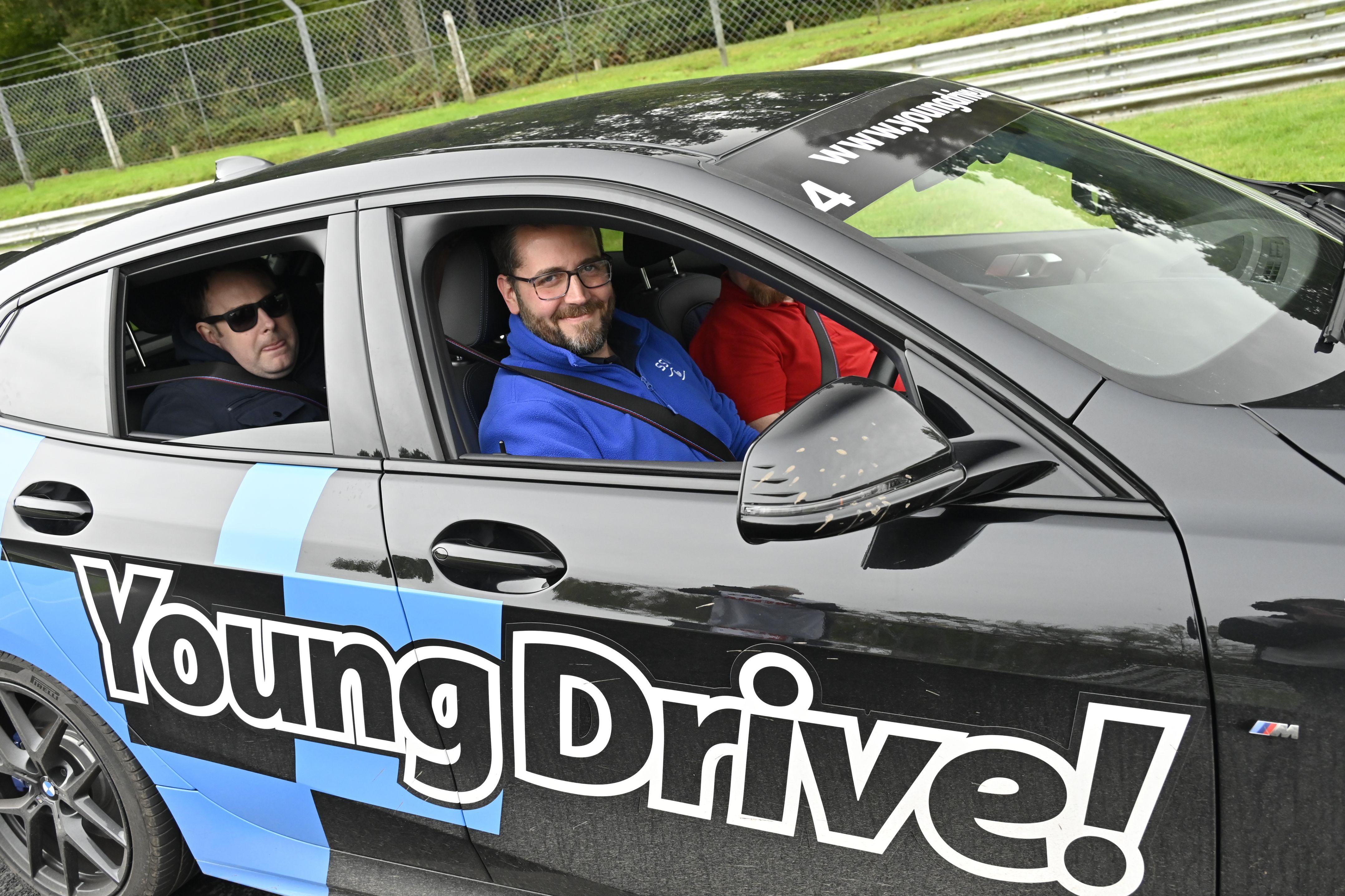

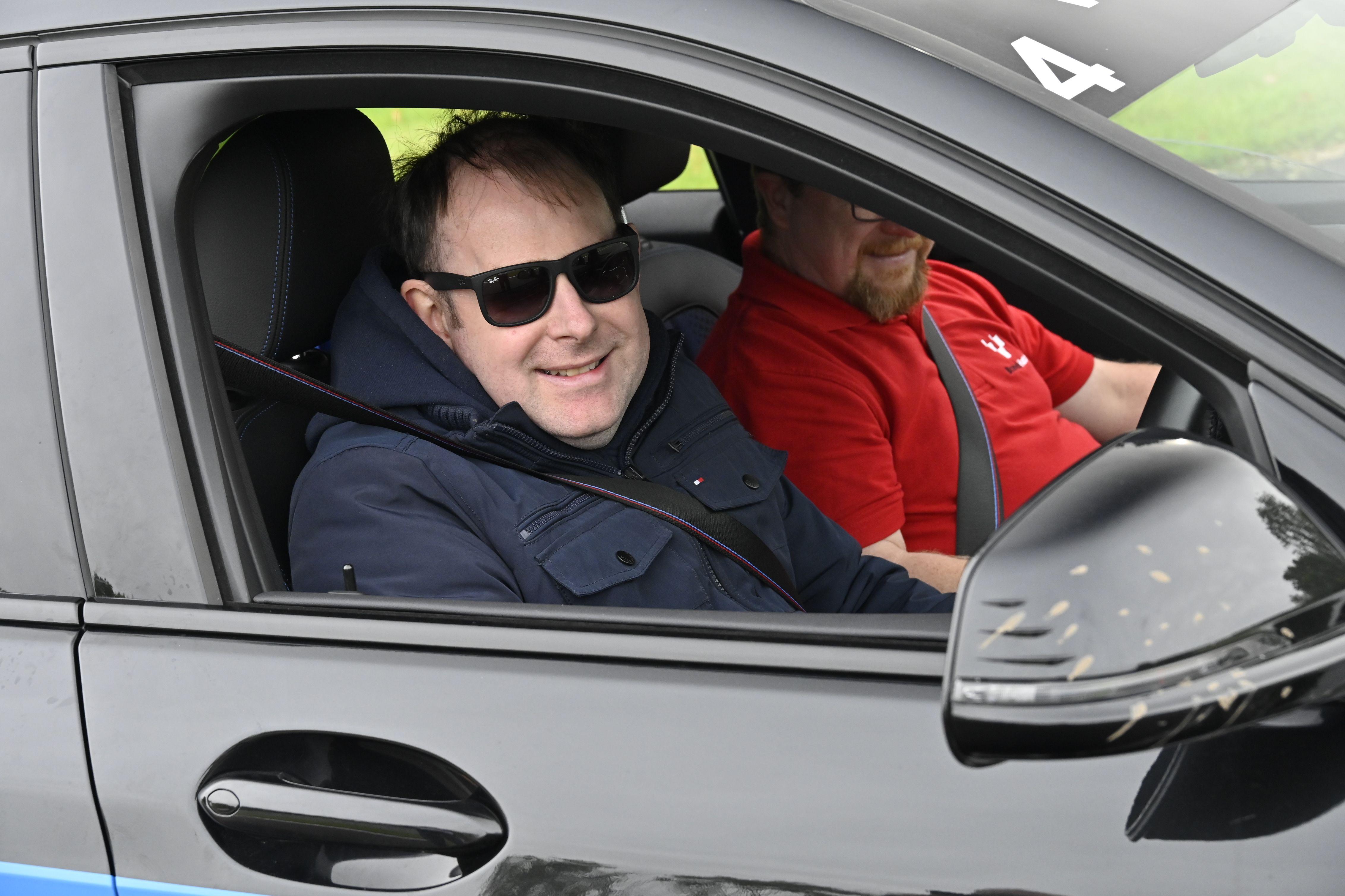
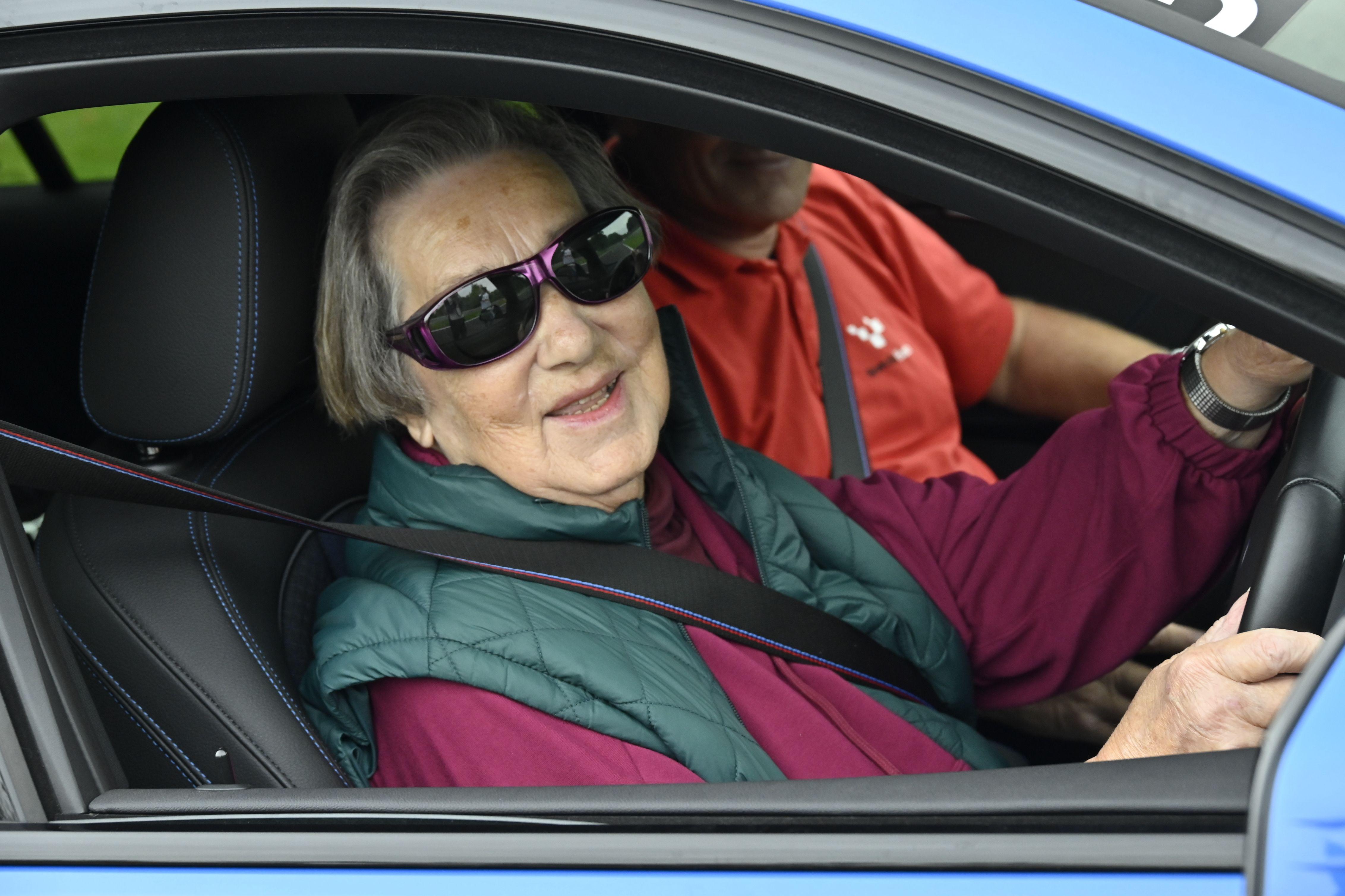
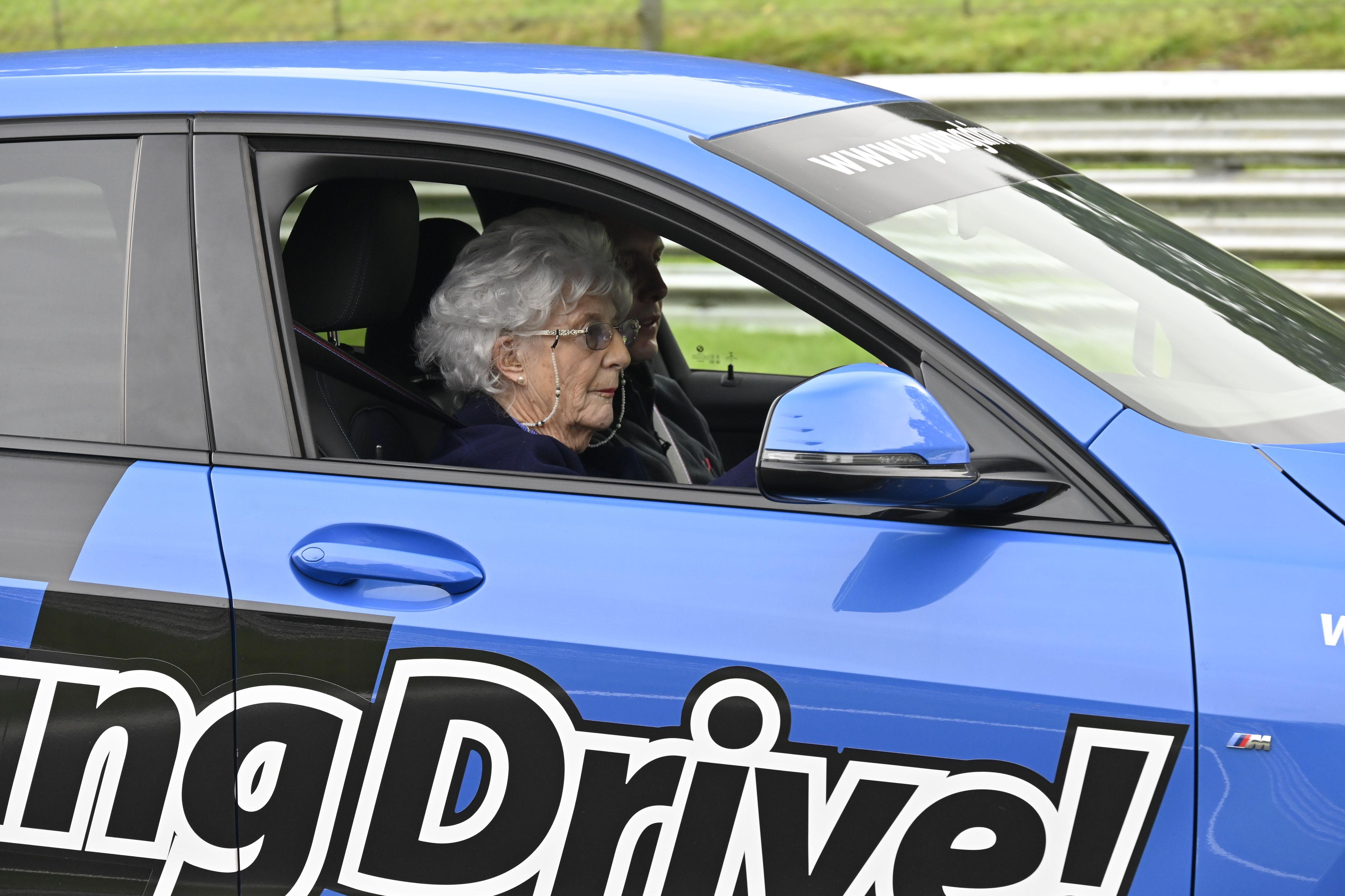
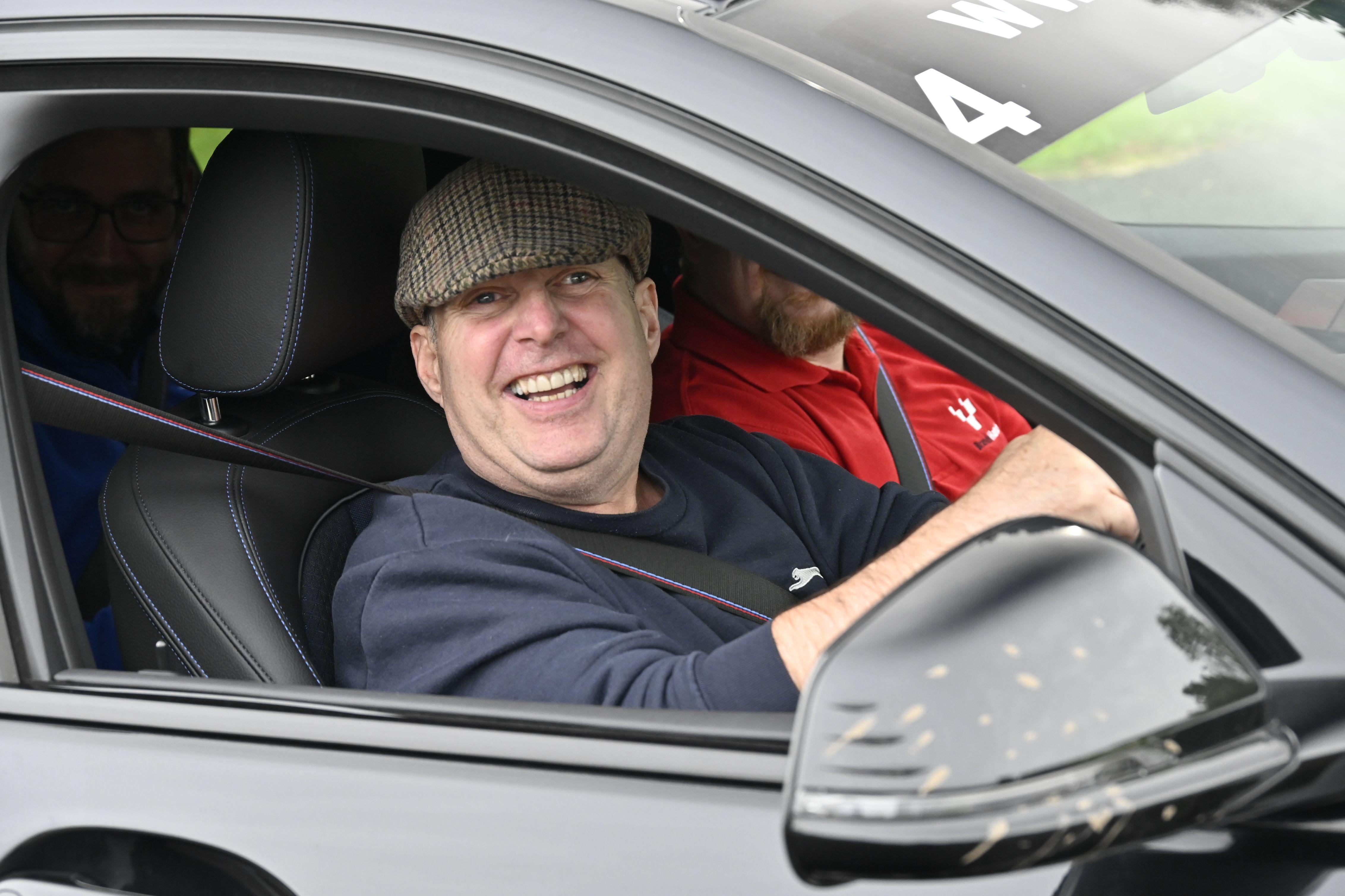
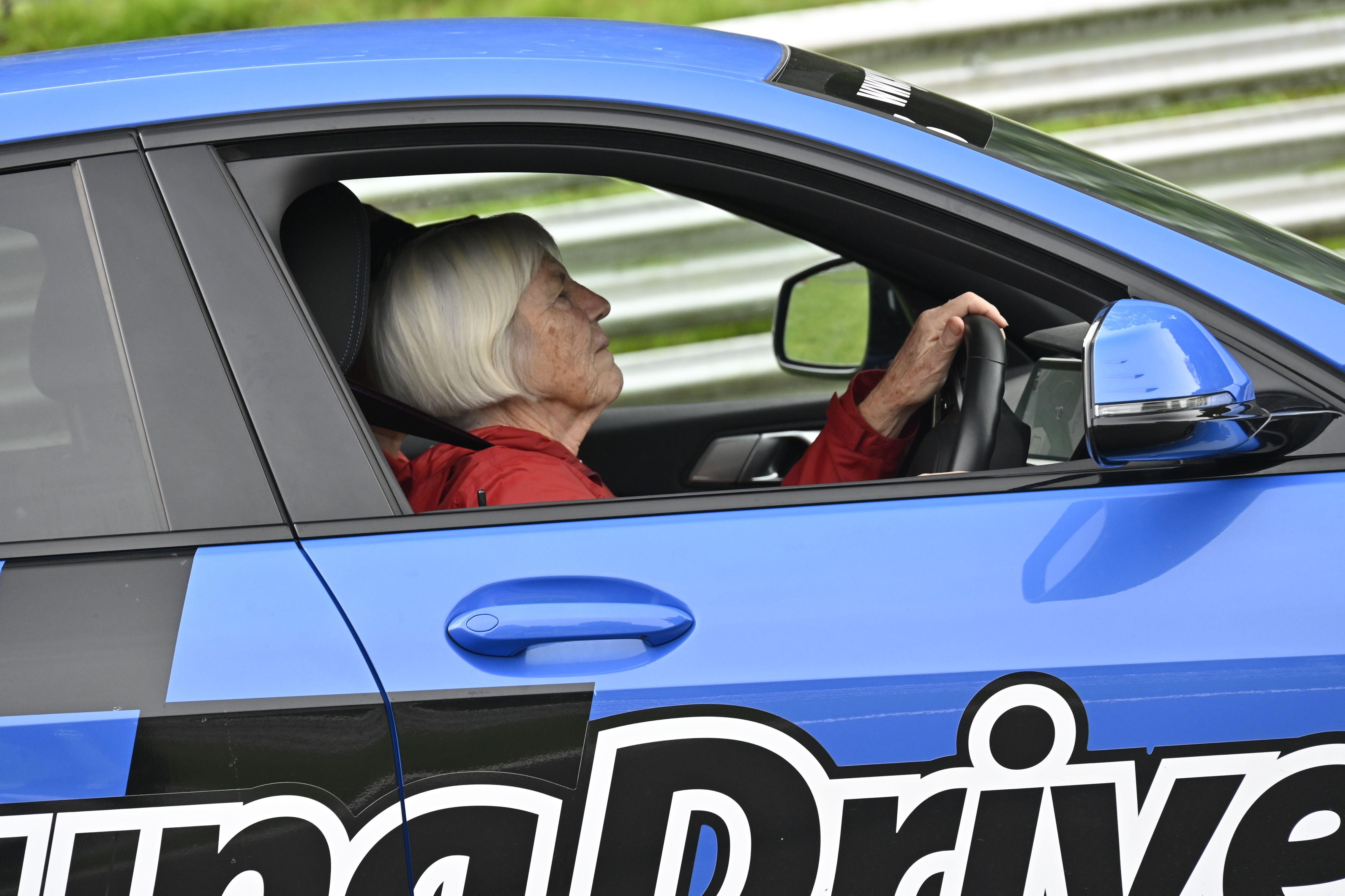
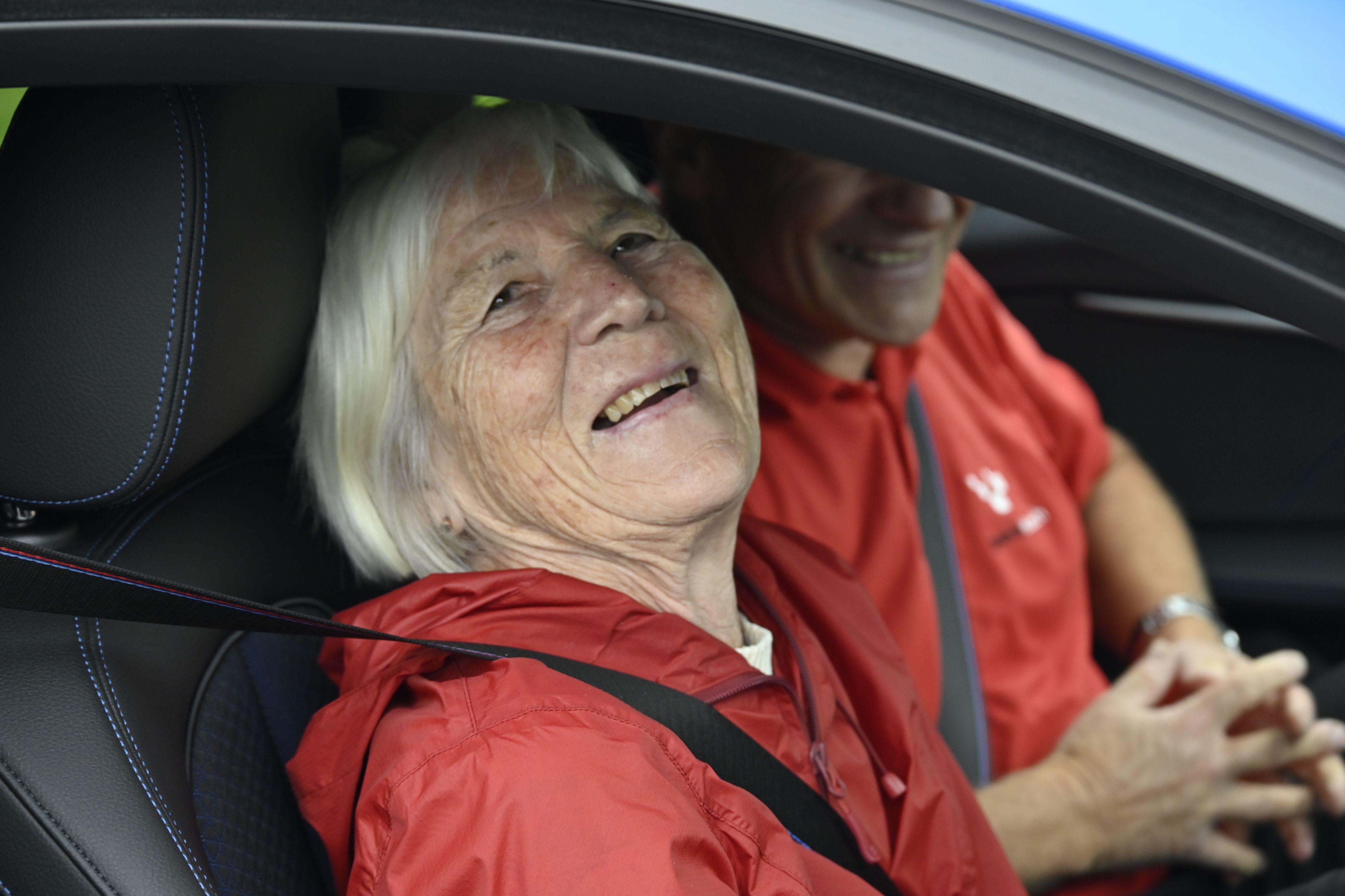

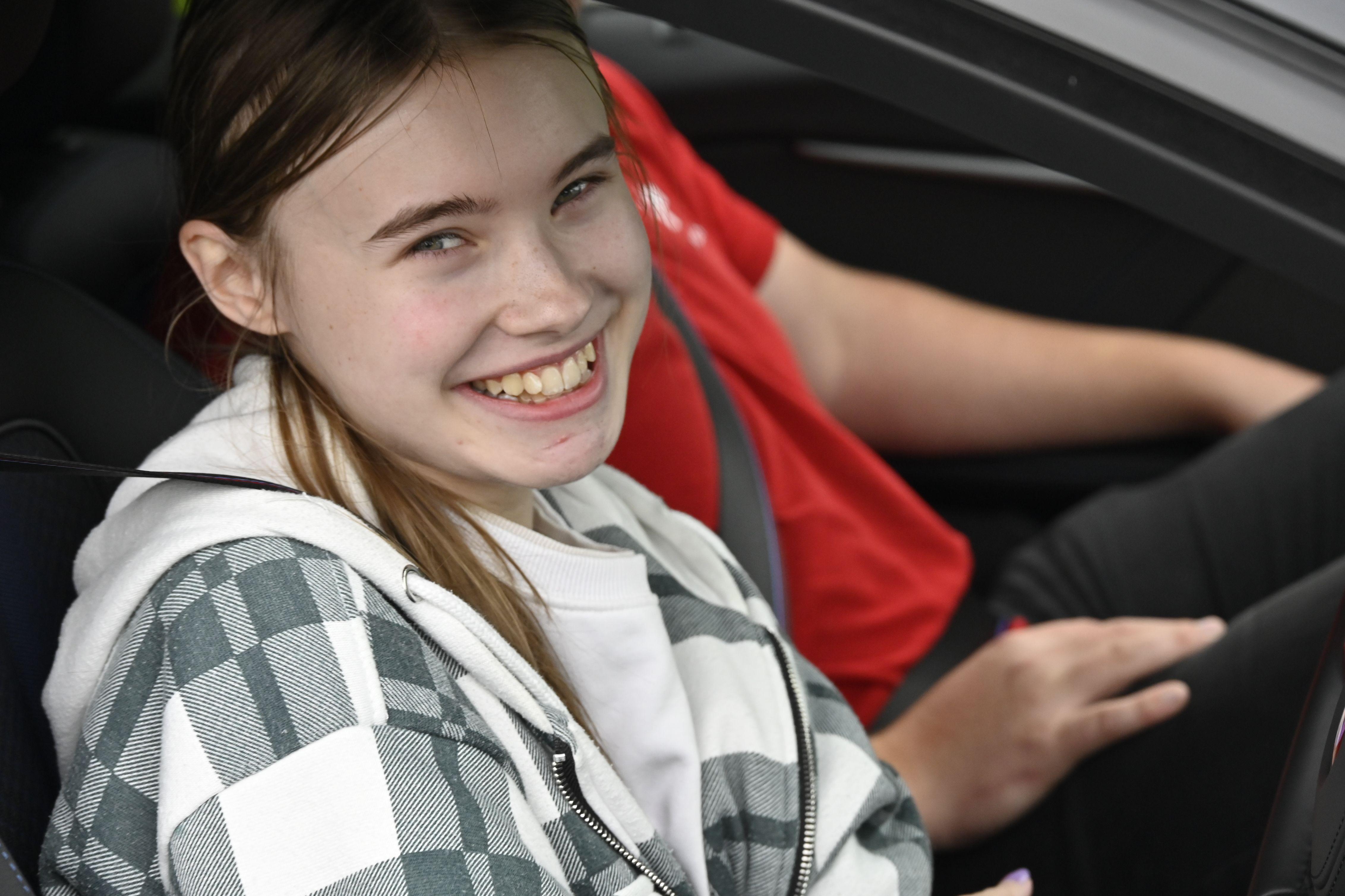


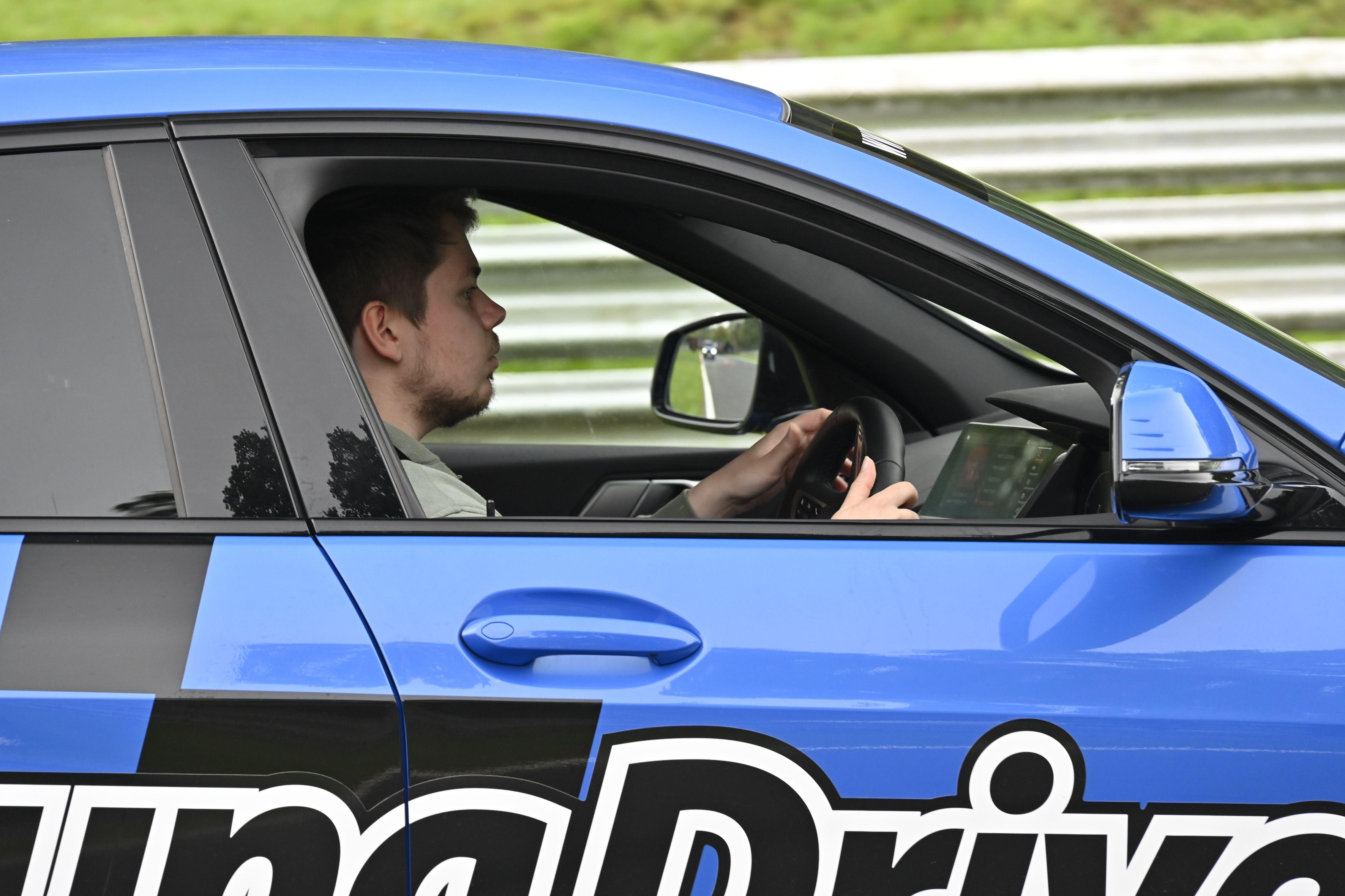


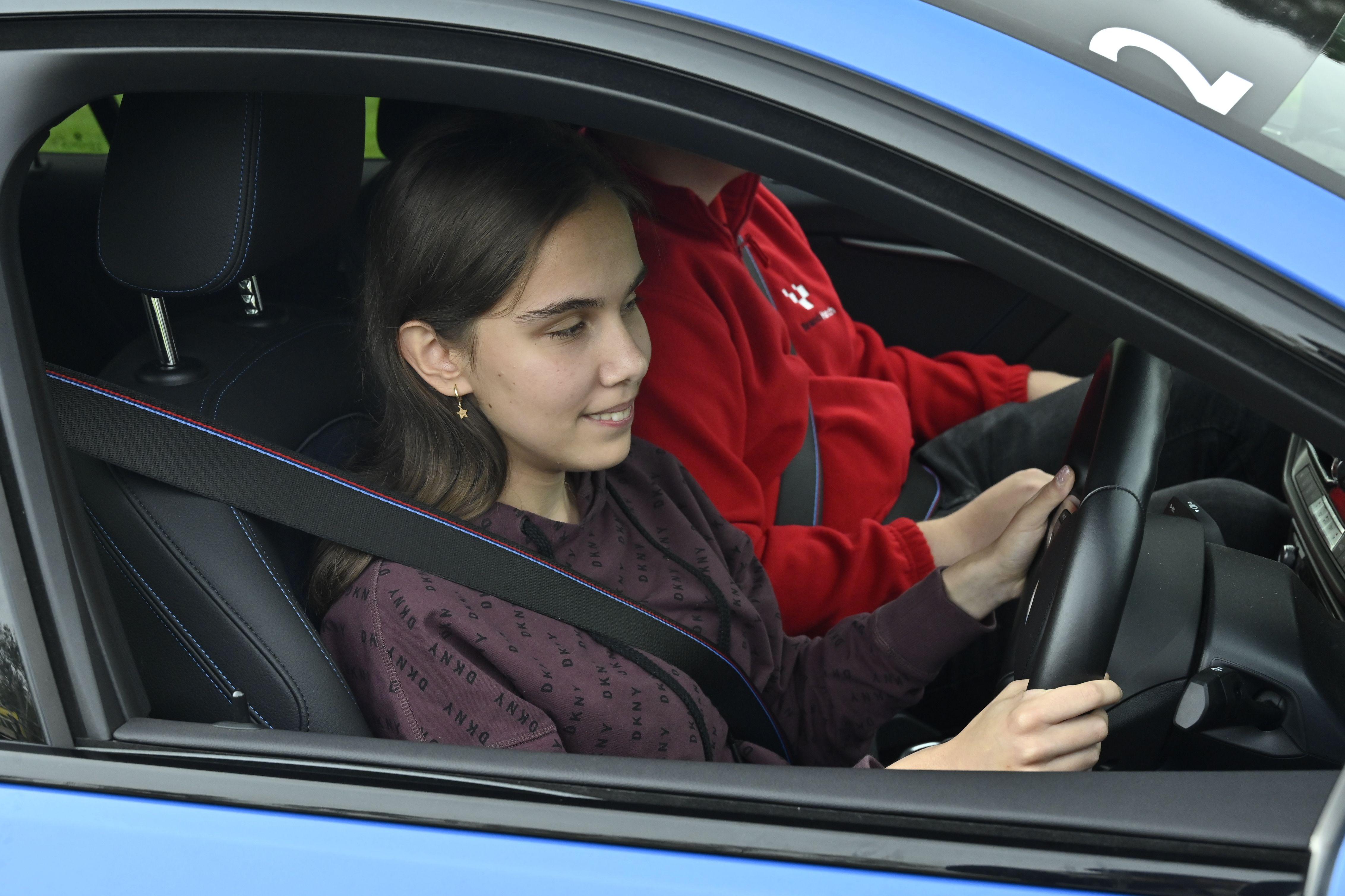
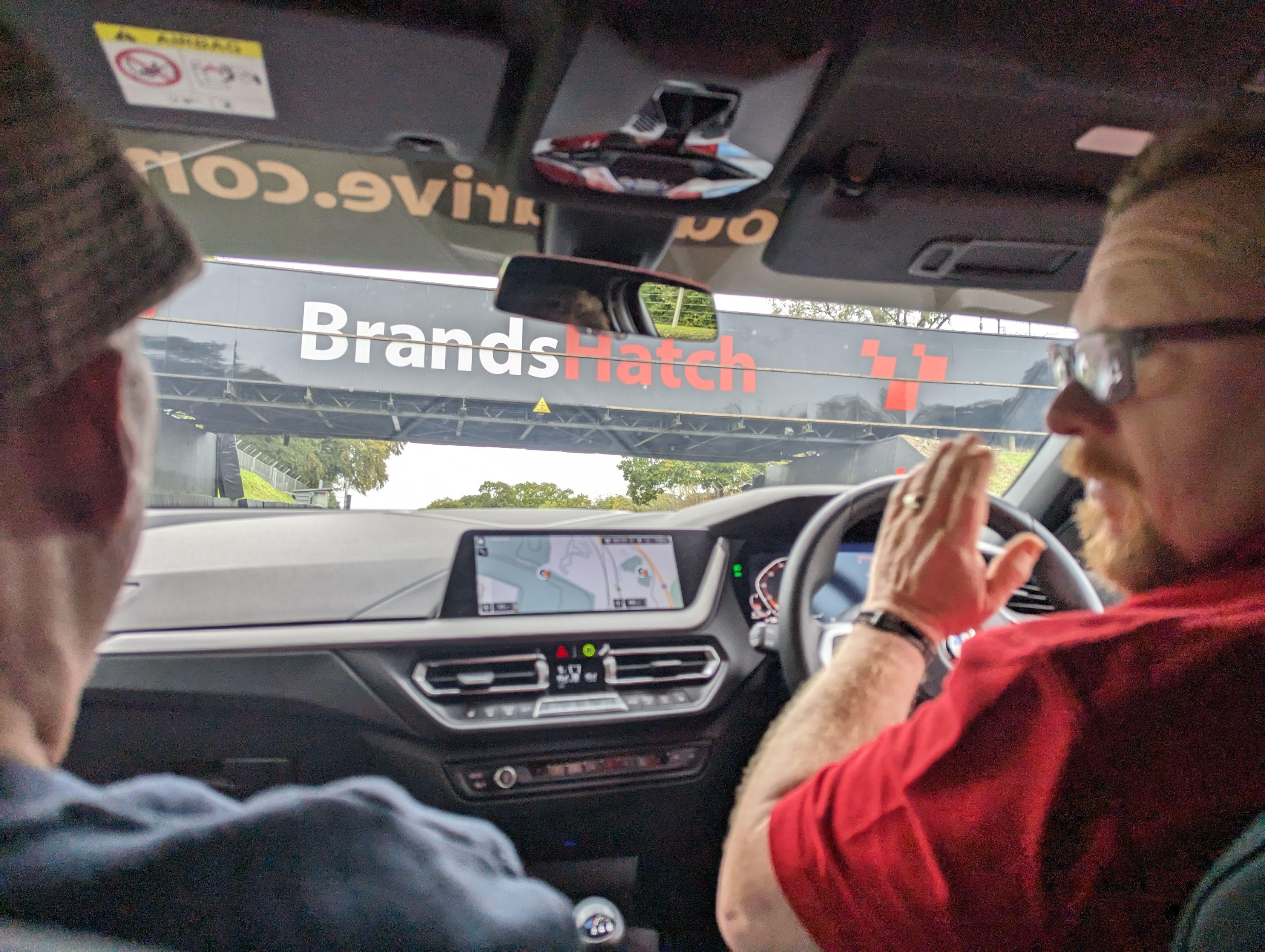
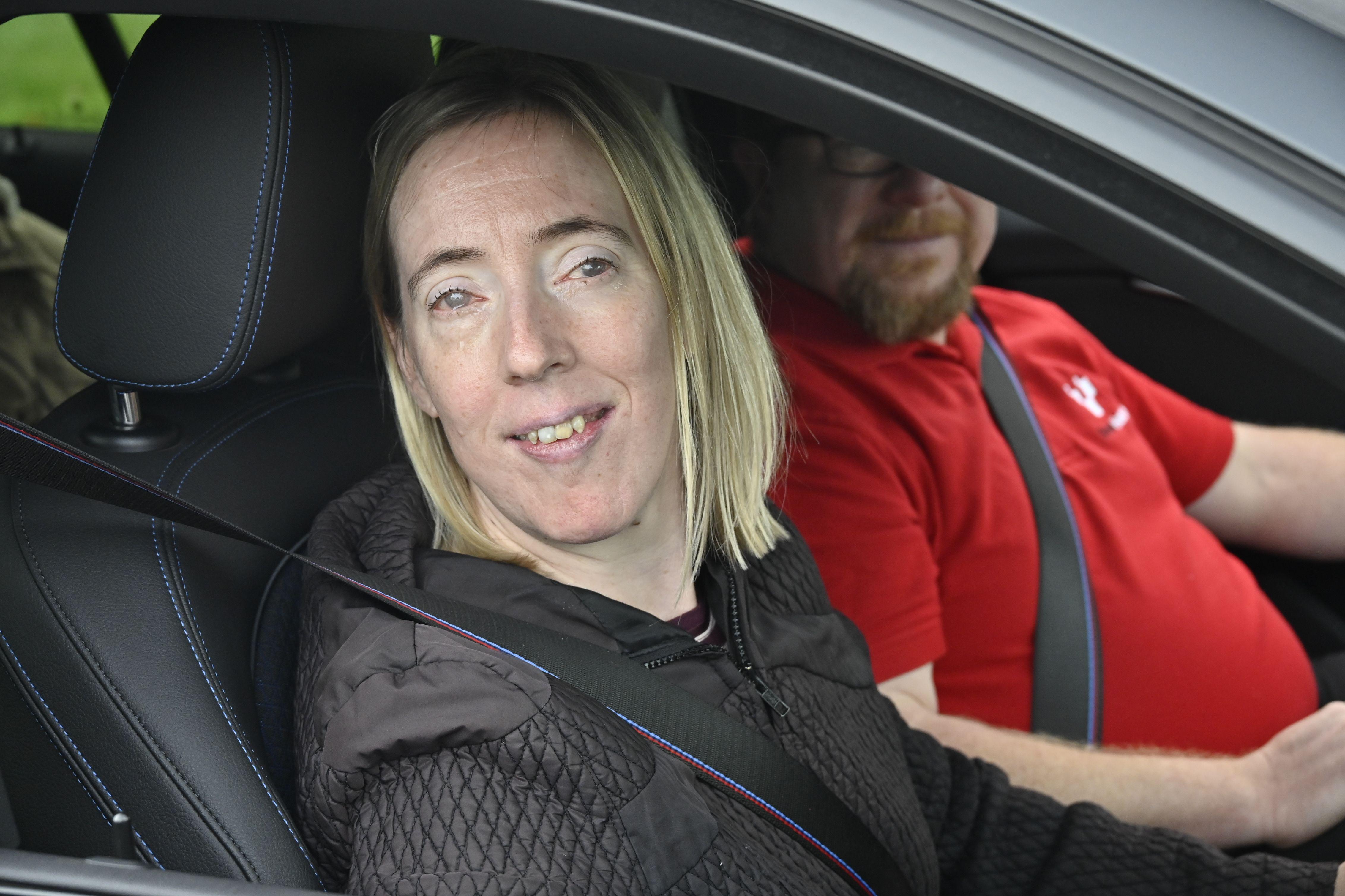
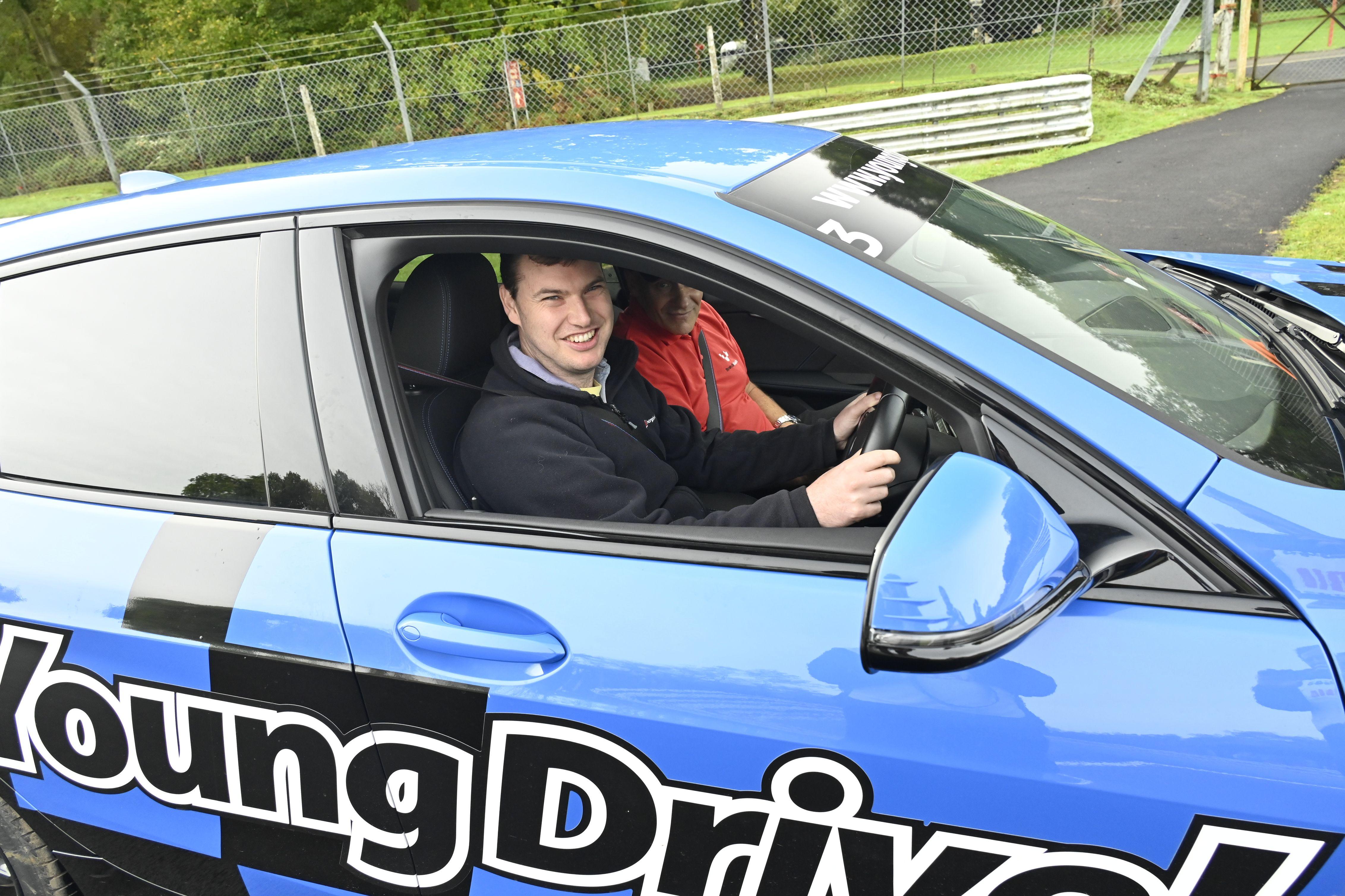
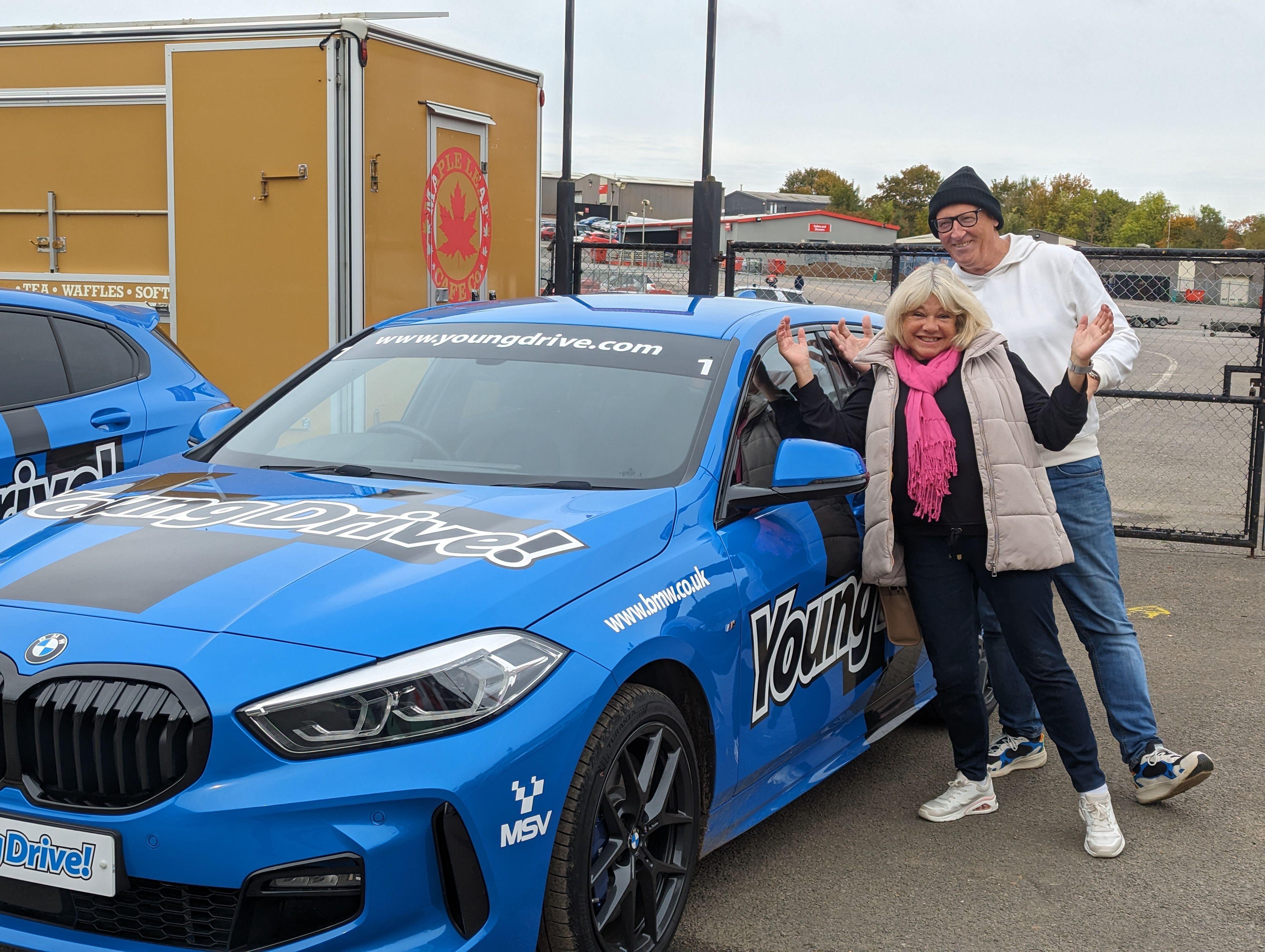

As some of you know, we hold birdsong events once a year which are always popular. Did you know you can use your phone to identify birds in your garden or when out and about? Merlin Bird ID app listens to the birds around you and tells you what they are by the song! If you’d like help setting up this app on your phone, give one of our tech advisors a call or email and enjoy impressing your friends and family with your superior bird recognition!
Download the app for Apple iPhones and iPads here.
Download the app for Android devices here (Android 6 or newer).
In more fantastic funding news, we have been given a grant by the Safer in Sussex community fund. Over the next 12 months we will be actively raising awareness of scams that can impact our members.
We will deliver this in many ways including:
- Articles in the newsletter and on social media
- Guest speakers sharing their knowledge and experiences at our Monday drop-in
- Dedicated awareness sessions at the Centre
- One-to-one coaching on dealing with targeted scams
All resources will be available in formats suitable for each member.
We are aware that, as part of our mission to get many of our members online, this comes with the responsibility of keeping them safe. Our aim is to ensure that our members are protected from potential scams, whatever the approach, by educating them to be able to recognise a scam and have the confidence to challlenge and report suspected scams. We would also hope that our members can then share their knowledge and experiences to help keep their families, friends and communities safe.
During October we are focusing on scam calls so do keep an eye out for information relating to these.
We are delighted to announce that we have been awarded funding from Worthing Community Infrastructure Levy to put towards electric powered transport for our members. This will give our members greater access to our community, reduce isolation and enable us to increase the number of outings we offer. The funding will also help reduce SSW’s environmental impact and carbon footprint.
We are so pleased to see that our friends at Cycall Adapted Cycling have also received funding; we look forward to many more trips to their newly funded hub and sensory space.
It was a brilliant day. The sun shone. The bees buzzed. And SSW members got free hot drinks and doughnuts. Bob Smytherman, Worthing Town Crier and SSW President, dressed smartly in black hat and blue satin tunic, began official proceedings by ringing his town crier’s bell. ‘Oyez. Oyez,’ he cried. ‘Mr Mayor. Ladies and gentlemen. Boys and girls. Welcome to sunny Worthing for our amazing Sight Support Worthing’s Sensory Garden official launch.’ The Mayor, Jon Roser, dutifully cut the inaugural blue-ribbon to heartfelt applause.
The summer weather and a rainy July made sure the Sensory Garden, opposite the seafront, had bloomed. The kitchen herbs, like feisty cat mint, thyme, Jerusalem sage, rosemary, green ginger, and fennel grow vibrantly among household names like fuchsias, lavender, geraniums, poppies, and petunias. There’s plenty of exotic plants too, like amazon mist grass, mountain sandwort, and Babiana-Stricta, which you’re likely to know only if you’re green fingered. For those of you selecting the Sensory Garden as your Mastermind subject (or are just curious), we’ve included a comprehensive list of the featured plants below. One of the most sensory is the lemon balm mint (try rubbing it between your fingers), which bursts with a pungent zesty citrus. The herb has made a spirited second home for itself among the white stones around the fountain. The abundance of plants suggests replanting was easy but, as our before and after photos show, there was an awful lot for the team, spearheaded by SSW Chair of Trustees Cherry Ward, and Adur & Worthing Council to do.

In receipt of only basic maintenance for more than a decade, there were only a few shrubs growing back in 2019, when they began. The team retained some of the old plants, like the hebes in the rockery, the blue sea holly and two myrtle bushes, but the vast majority are new. The exposed location of the garden made planting a challenge. Some plants were chosen specifically, with an eye on the climate, because they’re drought tolerant. That’s not to say there weren’t a few surprise success stories. Some plants strongly expected to perish proved their mettle and thrived, like the foxgloves and hollyhocks. A bigger surprise was discovering that each plant needed a UK passport to prove it had lived in the UK for at least two years and didn’t harbour disease. So, all told, it was far from straightforward. And then there was a pandemic.
As a community garden the team are keen for people to take cuttings to use in their own green spaces. The bronze fountain at the garden’s centre takes the form of the Greek god Triton. Featuring the body of a man and the tail of a fish, he stands upright holding a fish wriggling in each hand. The fountain has been fitted by the Council with new pumps, which provide the tranquil sound of trickling water. One SSW member said it reminded them of children playing in the summer. Radiating outwards from the fountain towards the protective fence are railway sleepers imbedded in shards of slate, representing the hands of a clock. Each tip is labelled with a golden number for the appropriate hour. “The colour contrast,” remarked one SSW member, “marks out the different zones. It’s enclosed, but accessible, with no steps. It’s not just a green canvas, it has texture.” Cultivating variety has been the goal to create, said Cherry, “a place of interest and intrigue”. Playful and interactive elements are included, like the concealed cast stone snails in the rockery and the red spotted illuminating mushroom sculptures.

A spirit of collaboration has flourished with the plants. From the children on the first spring planting day running riot with handfuls of seeds, to the graft of SSW volunteers like Andrew, Jane and Barry, as well as the rangers, The Camps Coffee Co. who kindly donated our launch day refreshments, and the Rampion community grant won by our ace fundraiser, Jackie Brownlee; all have had a crucial part to play. The grant is commemorated by the eye-catching circular shaped and multicoloured ‘Wind Spinner’ windmill twirling in the breeze. If everything on display suggests the job is done, well you’re in for a surprise. The park benches are soon to be updated, more bulbs set to be planted, a new sound feature installed and areas are to be textured with bark from materials shredded by the rangers in other public gardens.
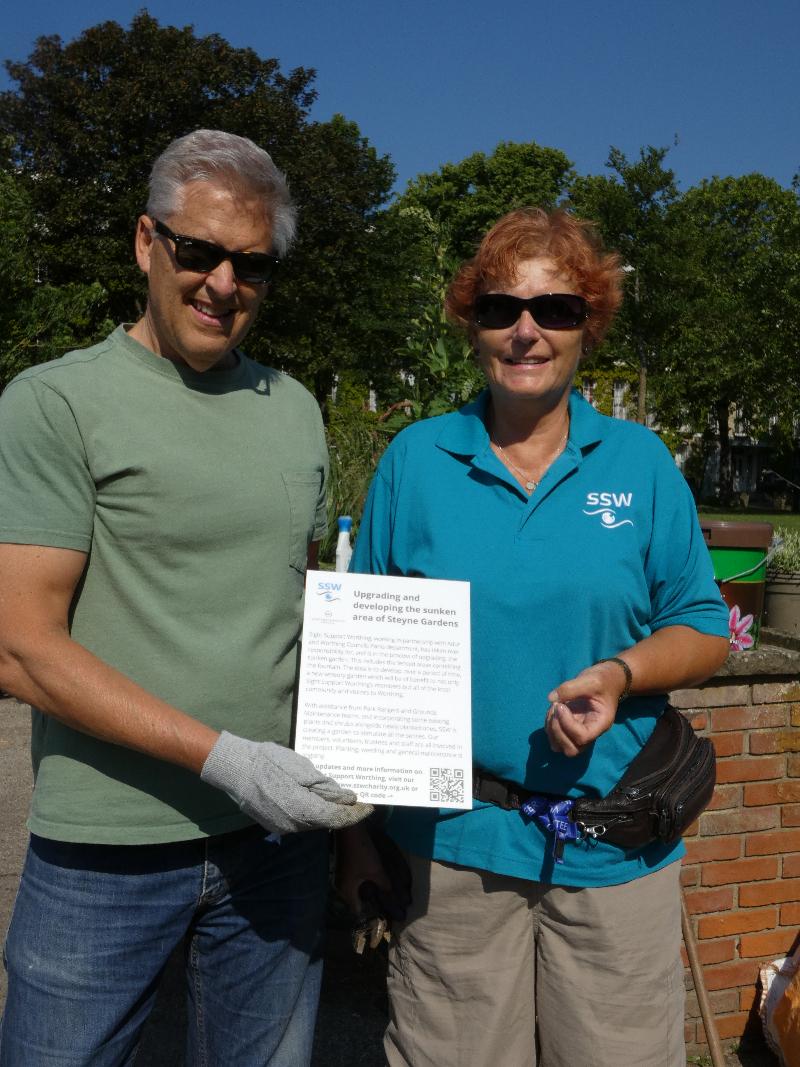
There’s plenty for wildlife too. Six willow, salix and acer trees have been planted in the raised brick outer borders as part of the Queen’s Green Canopy project. Add to that bird feeders for the winter, two wooden insect hotels (dubbed Buggingham Palace and Wingsor Castle), plants to attract butterflies and ‘beebombs’ for bees and you have a truly multidimensional garden. “Green spaces are so important for everyone at the moment,” said the mayor, casting a handful of seeds. ‘’It’s nice to see people working on it.’’ Work that is set to continue apace.

The Sensory Garden is permanently open. If you would like help visiting the garden, please call us on 01903 235782. We’d also love you to get involved with the maintenance of the garden. If you’d like to, please call us on the same number.
Further information
- The Triton fountain
- The Queen’s Green Canopy project
- Rampion offshore wind farm
- An A-Z of the plants in the garden
- Our feature length article in the Worthing Herald
Many people assume charities rely mostly on government funding to operate. Though in reality, this just isn’t the case. Whilst charities in the UK can receive some grants from the government, most charitable organisations get the bulk of their funding from three main sources: individuals, corporate giving, and foundation grants.
Statistics show that despite the perception that government support keeps charities afloat, the vast majority of nonprofit funding is generated through charitable giving from individuals, businesses, and foundations. According to CAF (Charities Aid Foundation) data, individual donations make up the largest slice of the pie, providing billions of pounds per year to charities across the country. Whilst corporate giving and foundation grants make up smaller portions, they also supply vital funding that allows charities to serve communities, advance their causes and provide assistance to those in need.
So, whilst state funding offers useful supplementary income, it’s private philanthropy from engaged citizens, companies and foundations that enables most charities to continue their good work.
Individual Donations
Individual donations are the lifeblood of non-profit organisations. These can range from small gifts from average people to large donations from wealthy individuals. Many charities seek these donations through appeals, social media campaigns, and fundraising events with some individuals taking it upon themselves to perform a sponsored activity or start a giving campaign independently.
Even though the number of people giving to charity has decreased by almost a quarter in the last decade, UK citizens still donated a whopping £11.3 billion to charity in 2020. No matter how small, individual donations really do make a difference to these non-profits, and without them, many charities that we rely on would no longer be able to function.
Corporate Giving
Corporate giving is another significant source of revenue for nonprofits. Companies often have philanthropic budgets to donate to causes aligned with their values and interests. The benefits of these donations are mutual, as by assisting these charities in staying afloat, the company becomes eligible for corporate gift aid and demonstrates its community values to potential customers. They may also sponsor events, match employee donations, or donate products and services as part of this.
Whilst corporate giving has traditionally been a major lifeline in the upkeep of charitable services, a report by the Charities Aid Foundation found that these donations are on the decline – shrinking by over a quarter compared to figures in 2013.
Trusts and Foundations
Trusts and foundations are the third major source of funding for UK charities, with over 8,000 charitable foundations and grant-making trusts in Britain providing vital monetary donations to non-profit causes. In 2020, UK foundations gave approximately £3.7 billion in grants to charities and non-government organisations working on specific issues or within particular regions.
When deciding where to direct their philanthropic grants, trusts and foundations often have precise criteria that charitable causes must meet to be eligible. Larger national foundations may provide grants upwards of £500,000 to charities running impactful projects nationwide, while local foundations tend to grant smaller amounts focused on causes within a particular city or region. Though the application process is highly competitive, securing foundation grants provides an important income stream for some UK charities doing vital work for their communities.
Conclusion
Charities in the UK rely primarily on generous donations from caring individuals, corporate philanthropy, and grants from charitable foundations and trusts. While government funding provides some assistance, the bulk of charity income comes from these three main sources.
Even in times of economic uncertainty, it’s crucial that those who can, continue to donate to causes close to their hearts. Finding ways to give back and support impactful nonprofits is one of the most effective ways we can create positive change in society, and donations make a difference no matter how small.
If you’re thinking about contributing to charity and making your mark, a good place to start is by looking up reputable organisations working on causes that you care about and consider setting up a monthly direct debit or making a one-off gift. By donating money, volunteering time, and spreading awareness, we all have the power to keep these critical organisations alive.
Are you a blind or partially sighted person in West Sussex who wants to change things? West Sussex Sight Loss Council is recruiting new members in your area.
Sight Loss Councils (SLCs), funded by Thomas Pocklington Trust, are regional groups led by blind and partially sighted volunteer members. Together, they use our lived experience to work with businesses and service providers to increase the accessibility of their services.
You will work with policy makers and local service providers to improve access for blind and partially sighted people in your local community.
You will also get the opportunity to come together with other blind and partially sighted people in your area, have a voice and develop new skills.
SLC volunteer, Clinton said: ”As a VI person myself, I am passionate in empowering blind and partially sighted people to be active within their communities through real community mindset change.”
West Sussex SLC members meet in person each month, currently in Worthing (although subject to change as membership grows). All SLC related travel expenses are paid for. For people unable to attend the in person meetings, a hybrid option can be made available.
To find out more and how to join Sight Loss Councils, visit www.sightlosscouncils.org.uk, email info@sightlosscouncils.org.uk or telephone 020 7031 6376.
View short videos from our volunteers about why you should join us.
Made possible by the National Lottery Community Fund, bLink is a matching service that covers the area of Worthing and connects adults living with sight loss/ vision impairment (VI) to like-minded volunteers, to participate in activities and go to events together that they both love.
The idea behind bLink is to enable people living with sight loss or vision impairment to engage in doing the things they enjoy and access all the great things going on in their community.
How it works
We carefully match each member to a volunteer, and pairs are matched based on their common interests and preferences. Once paired, they meet and collaborate on planning activities they can enjoy together at least once a month. These activities can range from leisurely walks and coffee outings to visiting galleries or playing games.
Accessible volunteering
bLink makes volunteering more accessible for people in Worthing by encouraging people to engage in activities they already love, while actively supporting someone with sight loss/VI. Our matched pairs can share their passions with one another, and volunteers can accommodate their commitments alongside other responsibilities.
To be a volunteer, no specific experience or skills are required, apart from being friendly and having a good sense of humour! We provide training, support, and conduct DBS checks on all volunteers to ensure the safety and well-being of our members.
Get in touch with Kate, our Wellbeing Coordinator, if you would like to be involved, whether as a vision impaired adult or as a volunteer. She can be reached at kate@sswcharity.org.uk or call her on 01903 235 782.
Whilst living with visual impairment can be both challenging and isolating, technology has come a long way towards making it easier for us all to navigate the world. With such a range of accessibility apps on the market, it’s never been more achievable for the blind or partially sighted to regain some of their independence.
We’ll run you through five of the most popular accessibility apps to support visual impairment and help you find the right tool to match your needs. From cutting-edge AI that can read the emotion on someone’s face, to a community of volunteers on standby to help visualise the world around you, there’s something right for everyone.
What are accessibility apps?
Accessibility apps are designed to help people with disabilities interact with their devices and the world around them more effectively. They provide features like text-to-speech, magnification and voice control, but also more complex tasks like identifying objects and facial expressions.
For example, a person with a visual impairment might use an app with computer visioning to read the label on a product when out shopping or to help them navigate around a new area, completely negating the need for outside help and putting the power back in their hands.
Read on to explore our top picks for accessibility apps for the blind and partially sighted.
Tap Tap See
Tap Tap See is a smartphone application designed specifically for blind and visually impaired users to identify objects around them by utilising CloudSight’s cutting-edge image recognition technology.
Designed for spur-of-the-moment use in everyday life, Tap Tap See is controlled by tapping anywhere on the screen to take a picture that gets analysed in-app and its description spoken back to you within moments. The app supports pictures of any object at any angle, removing the need for precise camera work.
Boasting awards from the American Foundation for the Blind, the RNIB, and having been inducted into the AppleVis Hall of Fame, this well-decorated app is a favourite amongst its users with everyday applications such as searching the fridge or browsing the shops.
Find the app totally free on the Apple or Google app store, or visit their website for more in-depth information.
Seeing AI
Microsoft’s Seeing AI is a powerful tool that uses computer vision, image and speech recognition, language processing and machine learning to help describe a person’s surroundings, read text, answer questions and even identify the emotions on people’s faces.
To use the app, the user first chooses a ‘channel’ they want to see such as documents, products, scenes or currency, used to instruct the app on what it is supposed to be identifying. Next, simply point your phone’s camera at the object or scene and Seeing AI will provide an audio description whilst guiding the user through the process with audio cues.
This can be of great help to people who are blind or have low vision, giving them the agency to identify objects, read text, and stay connected to the world around them at just the touch of a button.
The app is free and ready for download on iOS and Android devices, with Microsoft still releasing semi-regular updates to improve the user experience.
Be My Eyes
New technology like the above isn’t always for everyone and many of us can feel put off when confronted with unfamiliar tools. If you’d prefer a more personable touch, then Be My Eyes might just be the app for you!
Be My Eyes is a free mobile app that connects blind or partially sighted users with a huge community of volunteers who can assist them over a video call. The one-way video (two-way audio) call then allows the volunteer to see what the user needs help with so they can solve the task together.
This unique solution entirely removes the need for the partially sighted or blind to wait for physical help and empowers them in their day-to-day routines.
Find their website here for more information or download the app from the Apple or Android App Stores.
Clew
Clew is an AR indoor navigation app designed for blind and visually impaired users to help them independently return to a desired location. For example, if leaving your seat in a restaurant users can set their waypoint before standing up and then use that marker to navigate back to the same spot they left from.
The app uses software from Apple’s iOS 11 to record a precise path and guide the user back to their starting location with either a choice of voice direction, sound effects or haptic feedback. Whilst the technology is great, unfortunately, this means that the full experience is only available on iPhone 7’s or later.
Aside from that, this unique app is available for download from the Apple App Store and won’t cost you a penny.
If you’d like to find out more about Clew, find their website here.
Blind Square
Similar to Clew, BlindSquare is a navigation app designed for blind and visually impaired users to be able to move around freely without external assistance from others. Unlike Clew, however, BlindSquare is created for both indoor and outdoor use, making it a fantastic all-in-one app for getting around in your day-to-day life.
Using your GPS and compass on your smartphone to locate you, Blindsquare then gathers information about your surroundings and utilises its algorithms to discern what information to feed back to you via audio. This could include passing shops or places of interest, or even reporting disturbances up ahead.
As well as the range of typical voice commands for navigating the app itself, users can ask questions like: “What’s the most popular place for lunch within 300 meters?” to discover new locations with ease. From here, select the option that takes your fancy and choose from a range of options such as getting contact info, making a phone call, or tracking the place’s location.
Unlike the other apps mentioned here, BlindSquare comes with a hefty price tag of £39.99 – although the range of cleverly thought-out features goes a long way to justifying the cost. It’s also important to remember that whilst Blindsquare can be controlled entirely by voice commands, this feature also requires in-app purchases of credits for continuous use.
BlindSquare is available to download from the Apple App Store where you can also find a range of reviews to see what users think for themselves, or find more information here on their website.
Conclusion
In recent years technology has made it far easier for people with visual impairments to live much more independent and fulfilling lives. Of course, the apps mentioned in this article are just a few examples of the many tools available to help people with visual impairments navigate the world around them – so don’t be put off if nothing jumped out at you!
If you or someone you know is living with a visual impairment, it’s never been simpler to help them regain some of their independence. If you’d like more support and guidance on what app might be right for you, you can find a helpful guide on the RNIB’s website alongside their six-part podcast on the issue.
In September 2018, the UK government introduced new accessibility regulations for websites in the public sector such as charities, local government organisations, and other non-government websites. Even if your website doesn’t fall into the public sector there are over 2 million people living with sight loss in the UK alone. That’s a huge market that potentially can’t access your content and services.
But where do you start?
The Web Content Accessibility Guidelines (WCAG) are an internationally recognised set of recommendations for improving web accessibility. They explain point by point how to make web content more accessible to people with disabilities, such as those who are blind, deaf, or have cognitive impairments.
Designed around four basic principles of content being perceivable, operable, understandable, and robust (POUR), these guidelines strive to make the web a friendlier place for those with disabilities. Each of these principles is supported by guidelines and success criteria that provide specific requirements and testable standards for content accessibility.
Perceivable information and user interface:
This means that the information presented on the website should be accessible to all people and all levels of disability.
This can be achieved by providing text alternatives for non-text content such as pictures or promotional videos, as well as making use of Alt Text, captions, and transcripts in plain text.
Users should also be able to change how the content is presented, such as different colour schemes for those with colourblindness or resizable text, whilst also ensuring the content is easy to see and hear in the first place.
Operable user interface and navigation:
To ensure your website and content are operable by people of all abilities, WCAG suggests making sure users can interact with the user interface (UI) from their keyboard as well as making adjustments for different input modalities beyond that. For this to work effectively, it’s important that users can easily navigate, find content, and determine where on the website they are.
The guidelines also suggest making sure users have enough time to read and use time-sensitive content, as well as ensuring that the content shouldn’t cause seizures or physical reactions by disabling flashing imagery and colours.
Understandable information and user interface:
Text and UI must be readable by both user and e-reader to maximise the accessibility of your site, whilst also operating in predictable and standardised ways to prevent confusion when navigating.
People using the site must also be helped to avoid, and to correct, mistakes with the use of detailed instructions and error messages built into the site.
Robust content with reliable interpretation:
Robustness of content means the assurance that it’s compatible with a wide range of user agents, such as a variety of browsers, screen readers, and assistive technologies.
Using valid markup is one of the most important ways to ensure this is true by being able to accurately signpost content for these alternative user agents to function correctly.
For a free and easy way to check if your website has valid markup, simply enter your website address in the Web Consortiums Markup Validation service here.
For more info on the principles of the WCAG, you can find their website here. Or, for a handy graphic detailing the core principles of POUR, find the UX Hints website here.
We’ve all enjoyed shedding the winter layers over recent weeks, and now it’s time to reach for the sun cream to protect our skin from UVA and UVB rays from the sun.
One thing we may not consider is the damage those same rays can do to our eyes. It is important to start wearing proper eye protection at an early age to shield your eyes from years of ultraviolet exposure. The damage caused can take years to materialise and, by the time we notice the damage, it is often too late to reverse the effects.
Some of the conditions caused by UVA and UVB rays are:
- Cataracts: The most common cause of treatable sight loss and blindness, cataracts cloud and yellow the lens of your eye, causing progressive vision loss.
- Macular degeneration: A major cause of vision loss for people over age 60, macular degeneration is caused by cumulative UV damage to the central portion of the retina, the back layer inside each eye that records what we see and sends it to your brain.
- Keratitis, or corneal sunburn: UV exposure can cause painful burning of the cornea, the clear surface that admits light and images to the retina. Also known as “snowblindness”, this condition occurs in skiers and hikers because of the sun’s intensity at altitudes and its reflective nature off water, snow and ice.
- Conjunctival cancers: although rare, these eye cancers are increasing, especially among older people.
The best way to protect your eyes in the sun would be to avoid direct exposure although, even in this country, this can be quite difficult. You can wear sunglasses that block UVA and UVB rays; any reputable company will have this as standard. Prescription glasses can include a polarising tint that offers protection too. Hats with a good sized brim will provide shade for your eyes and the skin around them. Being aware of your surroundings and weather changes is great too as with cloud cover we often forget that harmful rays can still get through. Crucially bear in mind that, even if it is not hot in the sun, damage can still happen.
SSW has Cocoon branded sunglasses available in the centre for £45 (RRP £59.99). Get in touch if you’d like to know more.
This month we have two thank yous to make, to both the Co-op and the residents of Offington Drive in Worthing.
The £300 donation from the Co-op is being used to support two group life coaching sessions. One session will focus on overcoming our own barriers to employment. The second session will focus on transition points in education. If you’re interested in attending those sessions, get in touch so we can let you know dates when planned.
We were delighted to be the unexpected recipients of a generous donation made by the residents of Offington Drive. They held a street party to celebrate the King’s coronation, and raised £250! Thank you very much to everyone who donated; we are always appreciative as it helps us to provide more activities and services for our members.
Did you know we have a local hospital radio station? Seaside Hospital Radio broadcasts to the patients, staff and visitors of Worthing Hospital and Southlands in Shoreham-by-Sea, West Sussex, on the South Coast of England. But you don’t have to be in hospital to hear us!
You can listen for free within Worthing & Southlands Hospitals on the Hospital’s free WiFi network using your Smartphone, iPad/Tablet or Laptop, just follow these steps:
-
Connect to the Hospital WiFi network on your device
-
Open a web browser and browse to our website seasidehr.com
-
Click on ‘listen live’.
Look out for our QR code on display around the hospitals and in brochures and magazines. just scan it using your Smartphone or iPad/Tablet!
You can also listen live from here; just click here. If you’re at home and have a Smart Speaker, simply ask it to ‘Play Seaside Hospital Radio’.
If you’ve got a request that you’d like played on the radio, you can email: requests@seasidehr.com
If you’re on Twitter you can find them using the handle www.twitter.com/SeasideHR
On Facebook they’re here: www.facebook.com/seasidehr
You can take a read of the current Seaside Hospital Radio magazine here: www.worthing.smilepublishing.com
We’re thrilled to have been granted BACP Organisational Membership for our counselling service. This demonstrates that we’re committed to providing safe, ethical and professional counselling, highlights our credibility as committed and qualified counselling professionals, while at the same time helping to spread the message that counselling changes lives.
Made possible by the National Lottery Community Fund, our counselling service is available to people diagnosed with a sight condition who live in East or West Sussex, is free of charge, and completely confidential.
To find out more about the service or to book an appointment, email our Wellbeing Services Coordinator, Kate at wellbeing@sightsupportworthing.org.uk or telephone her on 01903 385025.
Hello: my name is Jodie. In this article I would like to share with you my journey of becoming a cane user, drawing upon how I felt when I did not use a cane, the day that changed my whole outlook about using a cane and finally the impact it has had on my life today.
Growing up I remember not wanting to be seen as different to those around me. I would always ask my teachers if I could join in with whatever the other children were doing, whether I found it a challenge or not. I guess this is one of the reasons why I was so reluctant to use any aids that would make me stand out. I just wanted to be treated as an equal.
If I’m honest, as a child, I found it hard to accept the fact that I could not see that well, and thought that if I gave in to the idea of using a cane then it was like admitting that I was different to everyone else. I felt scared, angry, sad… all sorts of different emotions. In my mind I was a failure. I had been bullied throughout school and college; surely this would give the bullies more of a reason to target me? How wrong I was!
One incident that sticks in my mind was one Winter evening whilst walking to my Gran’s, as I did often. I somehow lost my bearings and ended up falling over someone’s garden fence, losing my shopping in the process. Even this did not faze me and make me reconsider using a cane; all I was concerned about was my lost shopping (which I never did find)!
The turning point for me was when I was out shopping in my local town with a good friend of mine. All was going well until I accidently walked into a young mother pushing a pushchair, as I did not see her coming towards me. I immediately apologized and explained to her that I was visually impaired and registered blind. Unfortunately, her reaction was to become aggravated and she began shouting and hurling abuse at me. At this point my friend stepped in and said “look, there is no need to treat her like that. She told you why it had happened”. The woman then turned on my friend, grabbing hold of her, pushing her into a shop window and winding her. I felt awful that this had happened to her because of something I had done. That was the day my whole attitude changed. I needed something to make others around me aware of my visual impairment, so I began my journey of becoming a cane user.
Initially I was apprehensive about getting a cane. However, after a little bit of training my confidence grew and, for the first time ever, I did not feel scared about going out. Most importantly I did not care about what others thought of me.
On a personal level the impact of using a cane has been life changing. It has given me even more independence and I can honestly say that, if did not have it, I would feel totally lost and extremely vulnerable without it. My friends call me Speedy Gonzales as they struggle to keep up with me!
Like most things, using a cane does have its downfalls. One day, whilst out, a member of the public ran over my cane with her mobility aid which resulted in her ripping off the roller ball completely breaking the whole cane. Also, with my miles of walking, I have a tendency to wear out the roller balls meaning they have to be replaced regularly. This process can sometimes be lengthy, leaving me for periods of time without a fully functioning cane. I have now invested in a higher mileage ball but even this is wearing thin now.
The overall outcome is that the positives heavily outweigh the negatives. So my message for anyone who is unsure whether or not using a white cane will help them: just go for it! It is one of the best decisions I ever made. My late gran’s motto was “always say I can instead of I can’t” and this is something I like to live by.
Following the departure of our previous Chair, Barry Ward, we are pleased to welcome Cherry Ward into the role. Cherry has been a Trustee for several years, and was a volunteer before that, so has an excellent understanding of how the charity works and the needs and expectations of our members.
Please join us in welcoming Cherry to her new role at SSW!
The recently launched West Sussex Sight Loss Council is looking for volunteers to be members. Volunteers will work with policy makers and local service providers to improve access for blind and partially sighted people in their local community. It is also a great opportunity to come together with other blind and partially sighted people in the area. This is your chance to gain advocacy skills and influence positive change.
David Smith, Engagement Manager (South East), says: “We’re excited to have launched our Sight Loss Council in West Sussex.
“Like the other SLCs, we will be working across the county and engaging with organisations from both the public and private sector. We will be working with service providers to raise their awareness of the daily challenges and barriers blind and partially sighted people face.
“If you have a vision impairment, live in West Sussex and are passionate about improving services for blind and partially sighted people, then please consider becoming a Sight Loss Council volunteer.”
You can find out more about the West Sussex Sight Loss Council on their website, including how to apply to join. SSW team member James is a member of the West Sussex Sight Loss Council and would be happy to answer any questions you have about his role. Contact him at the Centre on 01903 235782 or email james@sightsupportworthing.org.uk
West Sussex has a higher-than-average percentage of people aged over 50, with this figure set to increase further in the coming years.
As we get older, many of us will need additional support to continue to live fulfilling, independent lives in our own homes for as long possible.
To help you plan ahead, there’s plenty of local guidance, help and advice available:
- West Sussex Connect To Support is for anyone looking for support to maintain their independence, manage day-to-day tasks and improve their health and wellbeing.
- The West Sussex Care Guide: Living Well in your Community provides advice on improving health and wellbeing and information to support people to live as independently as possible. It includes information about the different care options available and the organisations which provide support.
- Carers Support West Sussex offers a range of support services and free information, advice and guidance to unpaid carers aged 18 or older.
- The Carewise care funding scheme helps you and your family make informed decisions on paying for long-term care. Book a free consultation and receive specialist independent financial advice from trusted advisors via the website. Alternatively email carewise@westsussex.gov.uk or call 0330 222 7000.
- The West Sussex Prevention Assessment Team works with local partners and communities to enable people to access the support they need to live independently. Contact them by calling 0330 222 4222 or emailing prevention@westsussex.gov.uk.
If you’re aware of another organisation or service we should add to this list, please do get in touch.
You can stay in the loop with all of Sight Support’s news and events with Alexa! Just tell your voice assistant device to ‘enable SSW Event Reader’ and it will set up a special application. Then, next time you want to know what’s happening at Sight Support, simply say ‘Alexa, open Sight Support Events’ and you’ll get all the info you need!
If you’d like help setting this up, contact our Tech Support team on 01903 235782.
We’re pleased to have launched our wellbeing service including counselling and coaching. For a confidential chat about how we can support you, please get in touch with our dedicated Wellbeing Services Coordinator Kate.
You can email Kate – wellbeing@sightsupportworthing.org.uk or telephone her on 01903 385025.
A Safe and Well Visit is a free service carried out by West Sussex Fire & Rescue Service. It involves a pre-arranged visit to your home to offer advice on how to make it safer and, where appropriate, fit smoke alarms or other specialist fire detection equipment free of charge.
Visits are tailored to the specific needs of the household – they normally last between 30-45 minutes.
Find out more and book your Visit on the West Sussex County Council website.
It’s hard to visit your local supermarket these days without coming across aisles upon aisles of eye-catching multivitamins, protein powders and food supplements that each promise results far beyond the powers of ordinary food and drink.
Together, these products make up a multi-million-pound industry that’s promoted by everyone from sports stars to morally dubious health professionals. But do they really work?
It’s common knowledge that our bodies require a balanced mix of different vitamins, minerals, and proteins to perform at our best – but pricey supplements aren’t necessarily the best way to achieve this.
Michael Gannon, president of the Australian Medical Association, was quoted in one interview stating that supplements provide “no benefit” to the majority of people and simply helped in the production of very expensive urine.
The fact is, if you’re eating a healthy, balanced diet, then you’re likely already consuming all the nutrients your body needs in order to maintain itself and assist recovery from illness or injury. But that doesn’t mean you should be throwing away those supplements just yet.
The National Eye Institute (NEI) in the United States has conducted two major studies into age-related eye diseases that focused on two of the most common eye diseases in older Americans: age-related macular degeneration (AMD) and cataracts. During these studies, researchers found that ‘lutein’ – an antioxidant made by plants – seemed to neutralise light-induced damage to the eye and reduce risks of progressing into late-stage AMD.
Since this discovery, lutein has been regularly prescribed as part of an AMD prevention regimen and shows real promise in even reversing some of the disease’s early effects such as the disappearance of crystalline deposit build-ups in the eye. Lutein doesn’t have to come from a supplement, however, with a study held by the University of Utah suggesting that a diet naturally rich in lutein is just as effective as taking it in pill form.
Lutein is found in abundance in dark green, leafy vegetables such as kale, broccoli, peas and lettuce. For example, 100g of shredded lettuce alone contains around 4 mg of lutein and makes up almost half of the NEI’s recommended dose of 10 mg per day for maintained eye health.
Whilst these findings are fantastic for those at risk with age-related eye problems, the unfortunate side is that there have been very few studies done on the effectiveness of supplements for those suffering from non-age-related issues.
However, some research does suggest that long-term multivitamin use can decrease cataract risk in men, although this only adds up to a total decrease of 9%. The study also suggested that in those who already had a low risk of cataracts, the decrease was next to negligible.
It seems that there’s just not enough research to say for sure whether food supplements can truly provide a real benefit to your eye health, and most health professionals including the NHS agree that those of us eating a regular healthy diet shouldn’t need any supplementation. Instead, that money could be put to better use by making sure to include a healthy amount of whole grains, healthy fats such as omega-3, and leafy green vegetables in our diets.
As always, your GP should always be your first point of call for health-related issues and you should always check with them before taking any new supplements or medication. If you’d like to learn more about eye health and supplementation, you can find NHS’s brilliantly informative online leaflet by following the link here – or by enquiring with your GP.
“I have decided, after more than 10 years as Chairman of SSW’s Board of Trustees, that the time is right to stand down – both as Chairman and as a Trustee. I have thoroughly enjoyed my time in those roles during which SSW has extended the range of services it offers. Everything the Board has done has been aimed at supporting our members in their daily lives. In so doing, working with the members has certainly opened my eyes (no pun intended) and given me some memorable moments.
My thanks to all my fellow Trustees and to all the staff and volunteers who have been so supportive during my time as Chairman.
I hope to remain as a volunteer with SSW, initially supporting the 1:1 driver service but also helping wherever Katie Simmons (SSW Volunteer Co-ordinator) feels I could be helpful.
The SSW Trustees have elected Cherry Ward to replace me. I will stand down as Chairman from 31st January but will remain a “silent” Trustee until a number of admin changes (eg signatories for banking) can be implemented.”
As part of a Cost-of-Living response, all 36 libraries in West Sussex are offering Essential Toiletries Kits for residents who might benefit from them. These kits contain shampoo, body wash, roll on deodorant and toothpaste, which will be distributed in a readymade kit in a brown paper bag. Adults and children’s toothbrushes will also be available for people to add to the kits themselves, depending on their needs and will be on display for anyone to pick up and take away if they would like one. Last week, Worthing Library took delivery of enough supplies to make 2000 kits (that’s 12,000 single items) and with the help of the amazing library staff and van drivers they have been unpacked, repacked and distributed to all the West Sussex libraries. The kits are in libraries now and will be available while stocks last. All customers have to do is to visit their local library and find the display of the toiletry kits and they can help themselves to one and select their toothbrush of choice. They then need to tick a sheet for our data records to say which group best represents their household (families with children/people with disabilities/older people/other).
We’re all conscious that this year, more than before, we need to think about our energy consumption and, in particular, our heating bills. We’ve pulled together some of the financial support that is available, so you can establish which of it is applicable to you.
This winter (2022-23), all eligible households will be given a £400 non-repayable discount through the Energy Bill Relief Scheme (EBRS).
The discount is automatic. If you get a message asking for your bank details, this could be a scam. You can report messages you think are suspicious on this form.
The discount will be applied to your monthly household electricity bill for 6 months starting in October 2022. You’ll get:
- £66 in October and November
- £67 in December, January, February and March
You’ll get the discount monthly, even if you pay for your energy quarterly or use a payment card.
If you receive pension credit you may be entitled to £140 warm home discount
The local council are offering cold weather payments of £25 per week from November until March.
For advice on any of the above call the Local Energy Advice Partnership on 0800 060 7567 or visit https://applyforleap.org.uk/.
There’s more advice on energy bill relief on the Government’s website here.
We’ve also got a blog post with organisations you can seek help from to cope with the cost of living crisis.
We’ve added another method for you to find out about what’s coming up at SSW in the next two weeks. You can now call 01903 477220 to hear a recorded message giving details of the coming fortnight’s activities, as well as any important service updates.
This is in addition to our website calendar, Facebook event details, email newsletters, and the printed version of our emails. To sign up for our email newsletter click here: http://eepurl.com/hh2Adr
One of SSW’s regular activities is our classical music session, which takes place the last Wednesday afternoon of the month from 2–4pm. The event is hosted by volunteer Tony Meggitt, and is open to anyone with a visual impairment.
Here we meet Tony and ask him a few questions about his love of classical music.
How did you get into music in the first place, Tony?
When I was a teenager, I would listen to LPs, and whilst my brother was into the Elvis rock genre at that age, I chose to listen to Tchaikovsky, which got me hooked on piano music. One LP led to another; I discovered a love of opera, and my musical tastes grew and grew by introducing composers such as Gilbert and Sullivan, Mozart and Beethoven.
Who are your favourite composers?
Verdi, Wagner, Beethoven and Mozart are amongst some of my favourite composers.
What can our members expect from a classical music session with you?
The classical music sessions are very relaxed and light-hearted, where it really is like a live version of Classic FM (but without the adverts!).
I will introduce the selected music piece, say a little about the composer, or the music, then we listen. After each piece, members are free to comment and express anything they like about the music, then we move on to the next piece. The session is broken down into two sections; first we may have an Overture, Concerto and a piece of Opera. Then we have a tea break, and for the final half we will have some more relaxed music, perhaps a laugh with a humorous piece to bring the session to a happy end.
Tony says that his main aim for the sessions is “to please all of the people, some of the time”, knowing that not everyone will love every piece out there, but he makes sure he has a good mixture to satisfy most tastes!
Thank you Tony!
If you or someone you know would like to join our classical music session, we’d love to see you there. All SSW events are open to the blind and visually impaired, as well as their carers. To book your space or to find out more, give us a call on 01903 235782.
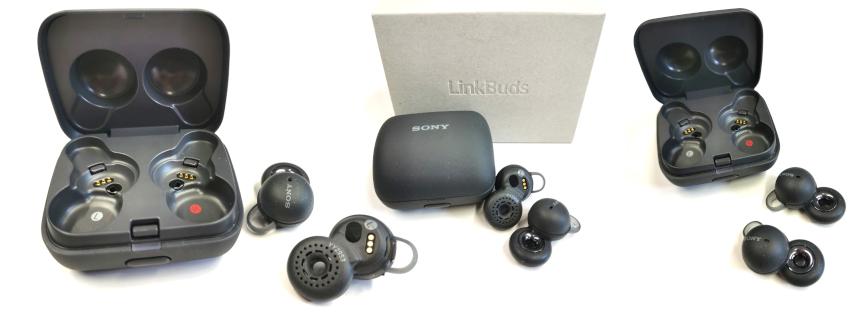
Details
Product: LinkBuds WF-L900
Brand: Sony
Price: £149 (at time of writing)
Features
- Open-Ring Earpeice Design
- Super-Light Weight
- Splash & Sweat Proof
- 360° Audio Capability
Personal listening equipment such as headphones and earphones are a huge part of life for so many people nowadays, with a lot of tasks involving using our devices, especially when our devices are aiding accessibility.
The Sony LinkBuds feature a strange looking design, with the centre of the earpiece missing, leaving it looking like a doughnut. This allows them to play into your ear whilst still allowing sound in from the world around. The LinkBuds are designed with everyday usage in mind, with the idea that you should be able to listen to music and take calls, whilst still being aware of the environment around you.
The LinkBuds are 360° audio enabled, meaning they can place sound at any point in a 360° circle around you. This feature means these LinkBuds would be great paired with navigational apps such as Microsoft’s Soundscape or BlindSquare, as they can use directional audio to direct you in the right direction. This coupled with the smart design that allows more ambient noise in makes for a much better experience when using some accessibility apps like this. You can also listen to certain songs and watch film with 360° audio, giving a completely different feel to the sound.
For those looking for something purely for listening to music with, I would suggest something else. The sound quality of the LinkBuds is very good, but does lack some depth with there being a lack of bass, however this is probably in part because there is no room for a subwoofer (the speaker that produces deeper bass) due to the hole cut out of the middle, and also if there were much more bass it would most likely interfere with the ambient sound entering from outside.
The LinkBuds themselves have a solid battery life, lasting 5 hours on a charge. They come with a charging case too, which if fully charged also, can give your LinkBuds up to 17 hours of battery, more than I’m sure most people would need in a day!
They may not be the cheapest option for earbuds, retailing at £149, but the features and charging case definitely make it more worth the price.
If you’d like to know more about these – or any accessibility gear for that matter – please don’t hesitate to call the Tech Team here at SSW!
A blog by Tom Hamblin – Tech Advisor at SSW.
The Global Myopia Awareness Coalition is launching a campaign to help reduce the likelihood of children developing myopia. Here’s some facts on myopia as well as ideas for reducing screentime for the young people in your life.
What is myopia?
You may know it as “short-sightedness” —when you can see close objects clearly, but far away objects appear blurred, such as the TV screen or the board in school. But did you know that it is a disease that gets worse over time and is growing at a rapid rate in children, especially with more time spent on screens?
Myopia affects one in six children in the UK by the age of 15 and it has been estimated that by 2050, almost 50% of the world’s population will be myopic. If not treated early, myopia could continue to progress and increase the risk of your child developing sight-threatening eye diseases.
How about trying a screen staycation?
Did you know, just 76 extra minutes outside a day can reduce the risk of myopia (short-sightedness) by 50%?
How about, for one weekend, you and your family to go screen-free and head outside instead?
While summer is the time for relaxation, it can also be when children spend most of their days off watching TV or playing on devices, contributing to the progression of myopia. To help, the Global Myopia Awareness Coalition has teamed up with optometrist Dr Keyur Patel, and created the Screen Staycation Guide. Packed with outdoor screen-free activity swaps and tips to help children keep their eyes healthy, their guide also includes information on the top signs you should watch out for to see if your child may have myopia.
Screen staycation ideas
Here are optometrist Dr Keyur Patel’s Screen Staycation activity swaps to help give your child’s eyes a break:
1. Watching YouTube – swap to:
– Run a mini archeological excavation in your mini sandpit or on your activity table
– Exercise your vision both near and far as you throw a frisbee around or fly a kite
– Go paintballing with your friends and family (ensure you wear eye protection)
2. Watching a movie – swap to:
– Dress up and put on an outdoor show for family and friends
– Take part in a ‘Natural Scavenger Hunt’ – collect things from nature and make a collage
– Learn a new skill or take up a new hobby like skateboarding
3. Playing computer games – swap to:
– Take part in ‘Bug Bingo’ – see how many you can spot!
– Host a sports tournament and see who will bring home this year’s trophy
– Get your friends together and visit an outdoor adventure centre, like Go Ape!
Top 5 tips from the Global Myopia Awareness Coalition and Optometrist, Dr Keyur Patel, on how to keep your child’s eyes healthy
1. Spend more time outdoors – it has been shown to have a protective effect for the onset of myopia and reduction in myopic progression
2. Get a good night’s sleep – a study found that children with less than seven hours of sleep had a higher risk of myopia compared to children who slept nine or more hours a night
3. Take a break when using smart devices – as exposure may be associated with an increased risk of myopia
4. Encourage your child to hold books or devices at a distance – the same distance as from their knuckle to their elbow is a good guide – as holding them too close can increase myopia
5. Eating a balanced diet rich in vitamins and nutrients can have a positive impact on your child’s eye health.
What signs should I look out for to see if my child has myopia?
Optometrist, Dr Keyur Patel, shares the top 10 signs you should watch out for – to see if your child has myopia:
1. Difficulty reading words from a distance, such as reading the board at school
2. Sitting too close to the TV or computer, or even holding a mobile phone or tablet too close to their face
3. Getting headaches could be a sign of strained eyes and poor vision
4. Rubbing their eyes, a lot
5. Unaware of things in the distance
6. Complaining their eyes feel tired or strained
7. Your child’s teacher saying your child is having difficulty
in the classroom or with simple eye hand coordination tasks
(e.g. catching a ball)
8. Covering up one of their eyes to try and focus their vision
9. Squinting when looking at objects in the distance
10. Excessive blinking
If not treated early, myopia will continue to progress and could even lead to serious eye diseases. But there’s good news! Myopia can be managed and now is the time to ask an optometrist about new treatment options—beyond regular contacts and glasses—that can help slow the progression of myopia and set your children up for success today and in the future.
Do not delay: book an appointment for your child to see an optometrist before they go back to school!
You may be aware that an intrepid group of SSW staff headed off for a sponsored skydive recently. Below are some of the photos taken before, during and after the jump.
You can also see a full gallery of photos here and here.
The UK Health Security Agency has produced a poster with tips to help you ‘Beat the Heat’ during heatwaves. You can see the English language version below and it is available as a downloadable PDF in many other languages too. Take a look here.
We have also included the tips as an accessible text-based list below the image of the poster.
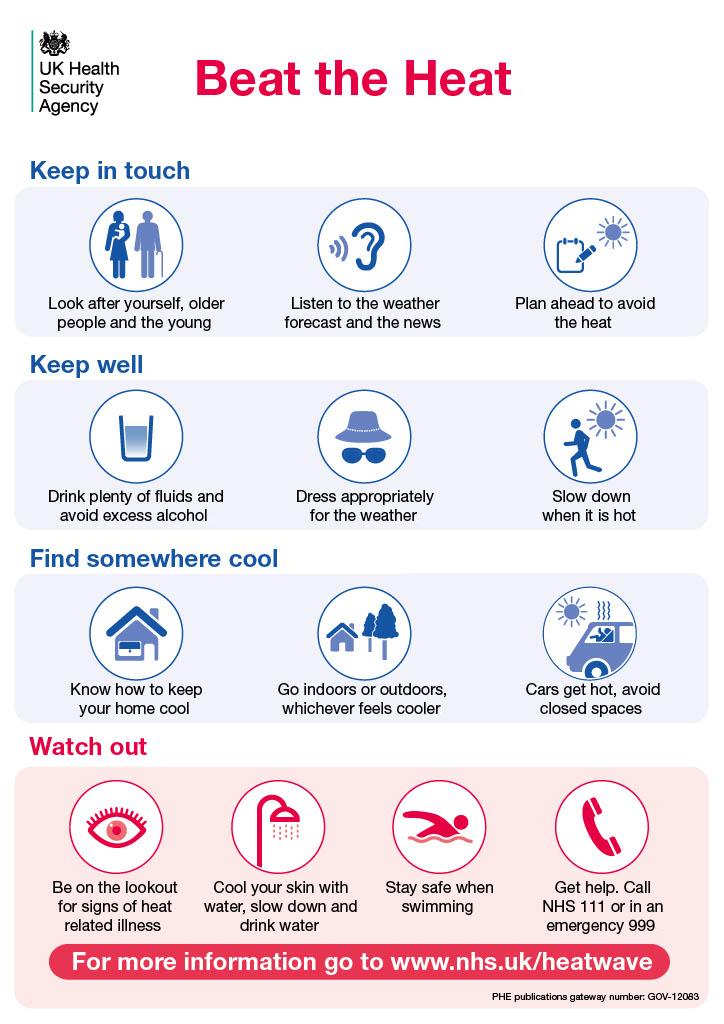
Keep in touch.
Look after yourself, older people and the young.
Listen to the weather forecast and the news.
Plan ahead to avoid the heat.
Keep well.
Drink plenty of fluids and avoid excess alcohol.
Dress appropriately for the weather.
Slow down when it is hot.
Find somewhere cool.
Know how to keep your home cool.
Go indoors or outdoors, whichever feels cooler.
Cars get hot, avoid closed spaces.
Watch out.
Be on the lookout for signs of heat related illness.
Cool your skin with water, slow down and drink water.
Stay safe when swimming.
Get help. Call NHS 111 or in an emergency 999.
For more information go to www.nhs.uk/heatwave
What is Optical Character Recognition (OCR)?
OCR is the process of converting an image of printed or handwritten text into electronic form. This technology is used heavily in the mailing industry as a way of quickly reading address labels for the sortation of letters and parcels.
In a VI setting, the technology has been adapted to provide the end user with an audio transcript of the scanned image.
Types of OCR readers
If you own a smartphone then you can scan any document or handwriting to receive an audio transcript. A good example of an app that can do this is Google Lens.

For those that prefer a stand-alone tabletop device then numerous manufacturers supply scanners that will efficiently read aloud printed text and handwriting.

Manufactures such as Orcam build a highly portable device which reads aloud text from any medium without the need for an internet connection.

Three practical use examples
A delivery driver leaves a note on your door. The note has some very scruffy handwriting which you make out. Most OCR readers will recognize the worst handwriting, including apps such as Google Lens.
The Worthing Journal lands on your doormat. This publication is printed on A5 which can make it a challenge to read. An OCR reader will recognise the smallest of fonts so you can consume most materials, including newspapers. The only thing you’ll need to do is turn the page!
You need to read a sign at distance. You’re at a concert and you need to find your seat number. Using a portable OCR device such as the Orcam Read you can point it in the general direction of the sign you need to read and it will announce it to you.
How much do they cost?
Using a smartphone is the most cost-effective option here and costs vary hugely depending on the specification of the mobile device. A functional smartphone at the lower end of the scale can be purchased for approx. £80 but will require the internet / data to function correctly.
For stand-alone devices the price increases substantially and you could expect to pay between £1000-£2000. However, the advantage of a stand-alone device is that no internet is required and they will work straight out of the box.
If you have any questions about the above or would like a demonstration then please contact us! Call the Centre on
Are you looking after someone who couldn’t manage without your help?
If so, you’ll know caring can be wonderfully rewarding but also stressful – and that it’s difficult sometimes to manage your own physical and mental health, and find time for yourself.
Carers Support West Sussex provide unpaid carers of any age, looking after parents, and people with dementia, memory loss, autism, drug & alcohol issues, learning disabilities and mental health issues, with financial help, information and guidance, and practical and emotional support.To find out more, or register as a Carer:Call 0300 028 8888email info@carerssupport.org.ukvisit www.carerssupport.org.ukFacebook facebook.com/CarersWSussexTwitter @carerswsussexInstagram @carerswestsussex
A new text-based service is available for anyone feeling anxious, overwhelmed or stressed. Text SHOUT to 85258 to start a free, confidential text conversation with a trained volunteer, who can help with issues such as:
-
- Suicidal thoughts
- Depression
- Anxiety
- Panic attacks
- Abuse
- Self-harm
- Relationship problems
- Bullying
You can text from wherever you are in the UK. Text SHOUT to 85258 for free and confidential support 24/7.
If your life is at risk, please call 999 for immediate help.
Sunday 17th July is Disability Awareness Day. If you’re up near Warrington you might like to take part in the world’s largest ‘not for profit’ voluntary-led disability exhibition, held annually in a huge tented village within the grounds of Walton Hall Gardens in Warrington. As well as lots of interesting exhibitors, there’s a sports zone, an arts area and family entertainment.
Assuming that most of you will be at home in Sussex, you might, instead, like to check out some useful resources designed to help both individuals and organisations access different technology such as phones, computers and smart devices.
One fantastically useful resource is SSW’s very own tech team. They are on hand to help you with any tech issues you might have. Perhaps you want to learn to use the accessibility settings on your phone better? Or maybe set your smart speaker up so you can use it for what you’ll find helpful on a daily basis. The team can either send you help sheets, talk to you on the phone, see you at the Centre or even visit you in your own home. Give them a call on 01903 235782.

You also might like to take a browse of this interesting resource: it’s a set of device ‘how to’ guides from AbilityNet (a charity that believes technology should be equally available to all) . Type in what it is you want to change on your device, and it will give you a choice of guides, for example a short guide, step-by-step and video. You can enlarge the size of your mouse pointer on your computer, learn how to use VoiceOver on your phone, find out how to use Google Assistant and loads more (there are several hundred guides available!). Take a look here to see exactly what this comprehensive resource offers.
If you work in a organisation and would like to improve how your computers and other digital technologies can help people with different conditions and impairments, AbilityNet provide a series of factsheets. Written by their specialist team of assessors and accessibility consultants they give detailed information on a wide range of assistive technology, services and related organisations. Head to their website to have a browse and find the guide that will help you make your computers accessible for the people in your organisation. There are other resources as well as training available if you want to explore further.

As well as helping individuals with their devices, our tech team can visit your organisation and talk to a team about how to be more disability aware. Sometimes asking the right questions and just making small tweaks to processes or equipment can make the world of difference to an individual’s experience at work or as a customer of yours.
If you’ve any questions about how to make the best use of technology – whether at home or in the workplace – please do give our brilliant tech team a call on 01903 235782.
SSW recently welcomed a work experience student to the team: Ella, from Davison High School. Here’s her account of her time spent at SSW:
Hi, I’m Ella and I am a Year 10 student from Davison High School. I had my work experience placement at Sight Support Worthing, and I’ve written this to tell you all about my experience during the week. I arrived on Monday and got stuck in straight away, picking up different members on the SSW bus and taking them to Steyne Gardens to have a look at the renovation work the charity had been doing there (which looked great by the way!).
We then came back to the Centre for tea, coffee and cakes and then took everyone back home again. It was great to see everyone having a great time and catching up with each other and you could tell the services and activities that the charity holds benefit people greatly.
Also, during the week I learnt about and tested out some equipment designed to help visually impaired people with daily activities, such as the OrCam which magnets to the side of a pair of glasses and will photograph text and then read it out to the user. There were also the liquid level indicators that would make noises when the hot water going into a mug reached the right level, and the long cane that could sense when a hazard was approaching in front of the user. It was interesting to learn about these things and how technology is advancing to help visually impaired people in our society.
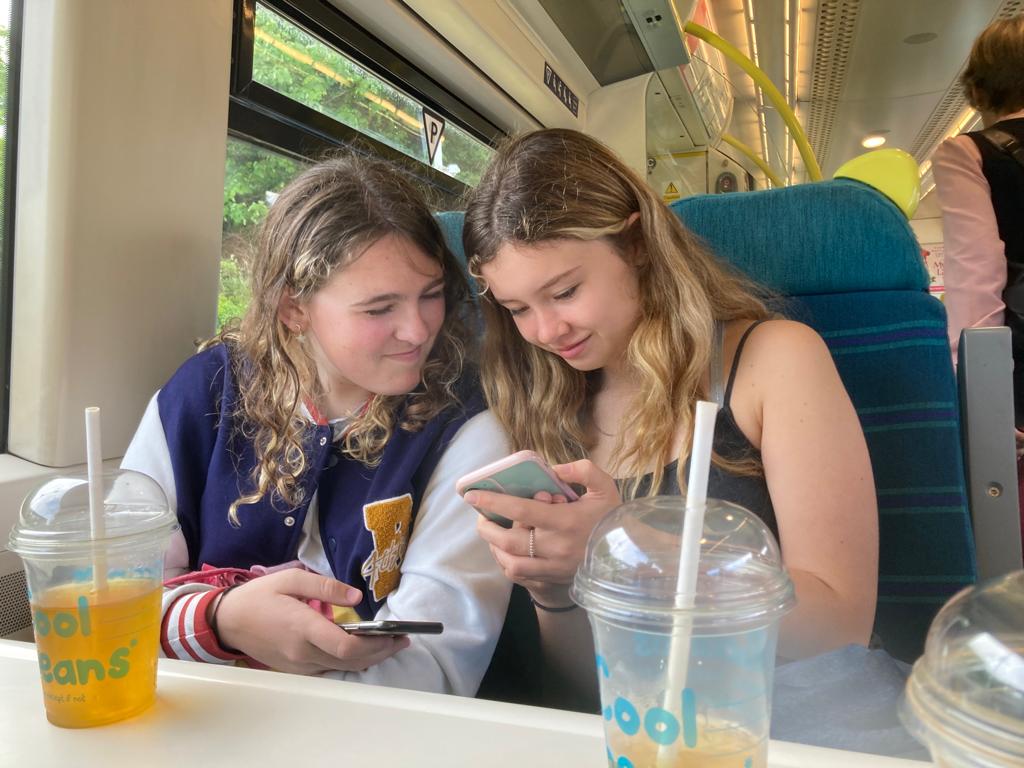
I also completed training so that I could become a qualified Level 1 Sighted Guide, which was a useful thing to complete as it means I am now able to lead a blind or severely visually impaired person confidently and accurately.
I learnt more about the different activities SSW offers, which seem varied and fun, such as the Cycall event I went to which is inclusive cycling that takes visually impaired people into consideration with their bike designs and allows them to have a easier cycling experience. It was great fun, and I was surprised at the speeds some of the members could cycle at – they were zooming past! Other events held by the charity include regular art classes, shooting, woodwork, water activities and even skydiving! They challenge peoples’ initial perceptions that visually impaired people may not be able to do certain activities, as members regularly partake in fun and unique events. I’ve learnt that there are a lot of different ways one can be visually impaired, and I’ve got to speak to different people with different capabilities and experiences, which was very eye-opening.
Overall, I had a great experience and got a good insight on what life is like for the visually impaired which was useful as it allows me to be more understanding of different people in the community. I was getting involved in different activities and talking to a range of people, volunteers and members alike, which showed me a different side to having a job. The staff and volunteers at SSW were very friendly and welcoming and made the experience a pleasant one. It was a great taster into life in the workplace and I would recommend it to anyone who wants to get involved in some fun activities and learn about the charity and how it helps people.
Thanks Ella; we’re glad you enjoyed your work experience with us!
The tech team at SSW have recognised that some SSW members may wish to experience the benefits of using a smart speaker at home without committing to the initial financial outlay for an internet connection. So, in response to this, we have launched a new service for our members which will allow you to try a smart speaker before you buy.
How does it work?
The trial will last for one month during which SSW will cover all costs. This includes the setup and installation of a smart speaker (an Amazon Echo) and mobile internet.
What if I already have the internet but just want to try a smart speaker?
The trial is open to those with and without existing internet connections.
What happens after the 1-month trial ends?
After the one month has expired you will need to return the devices or, if you would like to continue with the service, someone from the tech team will go over the internet provider and speaker options available to you.
If you would like to try out a smart speaker on this basis, please get in touch with either Chris or Ali on 01903 235782.
by Ali Bates, SSW Tech Advisor
One of the consequences of dealing with sight loss is losing the ability to read a regular book. The font can be too small and other issues such as the contrast of the ink and paper and general eye fatigue can create a negative and frustrating experience, resulting in once avid readers giving up reading altogether.
Thankfully there are many options available to the blind and visually impaired community.
RNIB Talking Books offer their service in a few formats.
You can get your Talking Books by digital download. They have a range of titles available to buy or borrow from their online shop. Take a look here to get started.
You can also get your books through an Alexa-enabled device such as your smart speaker, tablet or phone. Here’s some more information on how to access books through this method.
The RNIB can also send a DAISY CD (one book per disc) or USB stick (three books per stick).
To register for any of these formats, call 0303 123 9999 or email helpline@rnib.org.uk
If you have a library card, as well as being able to borrow large print books and audiobooks, they now have an online service called Libby. Libby is a free to download app available on all Android and iOS devices. It works the same way as a library; you can borrow books and read them on your device, using the settings to adjust the font size and contrast as needed. They also have a library of over 7000 audiobooks available.
To register for this you need to get a four digit PIN number from your local library which, in conjunction with your library card number, enables you to access the service.
To find Libby in the Android store click here.
To find Libby in the Apple store click here.
There are other digital ways to access books but these do incur a cost:
If you would like help with accessing any of these services, please do get in touch with Ali or Chris, the SSW tech support team.
You may have noticed that a large square has appeared on the SSW news and events newsletters recently with the words ‘Scan Me’ next to it.
This square is known as a QR Code (Quick Response Code for those that do a crossword or pub quiz) and you may have noticed them around town, on Covid 19 testing materials and in other similar communications.
A QR Code is a more advanced version of a barcode, usually found in the retail industry. Its key advantage is that it can store more characters, which is perfect for presenting website links. For example, if I wanted to inform you of a specific page within a website in a printed document such as the SSW Newsletter then it traditionally might look like this:
https://hadley.edu/workshops/android-low-vision-features-series
The above link is not very easy to copy, so instead we use a QR Code which looks like this:
So how do we scan a QR Code?
Your smartphone or tablet will come with the ability to scan QR Codes but, as always, there are some slight differences between iPhone and Android procedures, which are explained below.
Android Phone/Tablet users
An Android device will make use of an app called Google Lens. This app integrates with your phone/tablet in a couple of places depending on how recently your phone was updated.
Look for the below icon when you open your camera app and using the QR code above, move it into position.

The app will pick up the website link instantly and will open the website when the shutter button is pressed.
Google Lens is also often found on your home screen search bar and shows as a camera icon, as shown below:
 iPhone/iPad users
Simply open your Apple camera app and point it towards the QR Code and you will be given a link to click on.
Practice QR Code
Try this one to see how it works:
It will take you to this URL: https://hadley.edu/workshops/outlook-low-vision-series
Struggling?
If you’re keen to get your head around QR Codes but need a bit more help, come and speak to one of our tech advisors. They’re also on hand to help with any other tech issues you might have. Contact the Centre on 01903 235782.
As part of our Art Class, members have been making quoits to be used by other members when they come to our Boccia days. The group also made a planter for members Sandra and Carl.
Safety measures are in place to ensure that this activity is accessible to our VI members. So far all fingers are intact..!
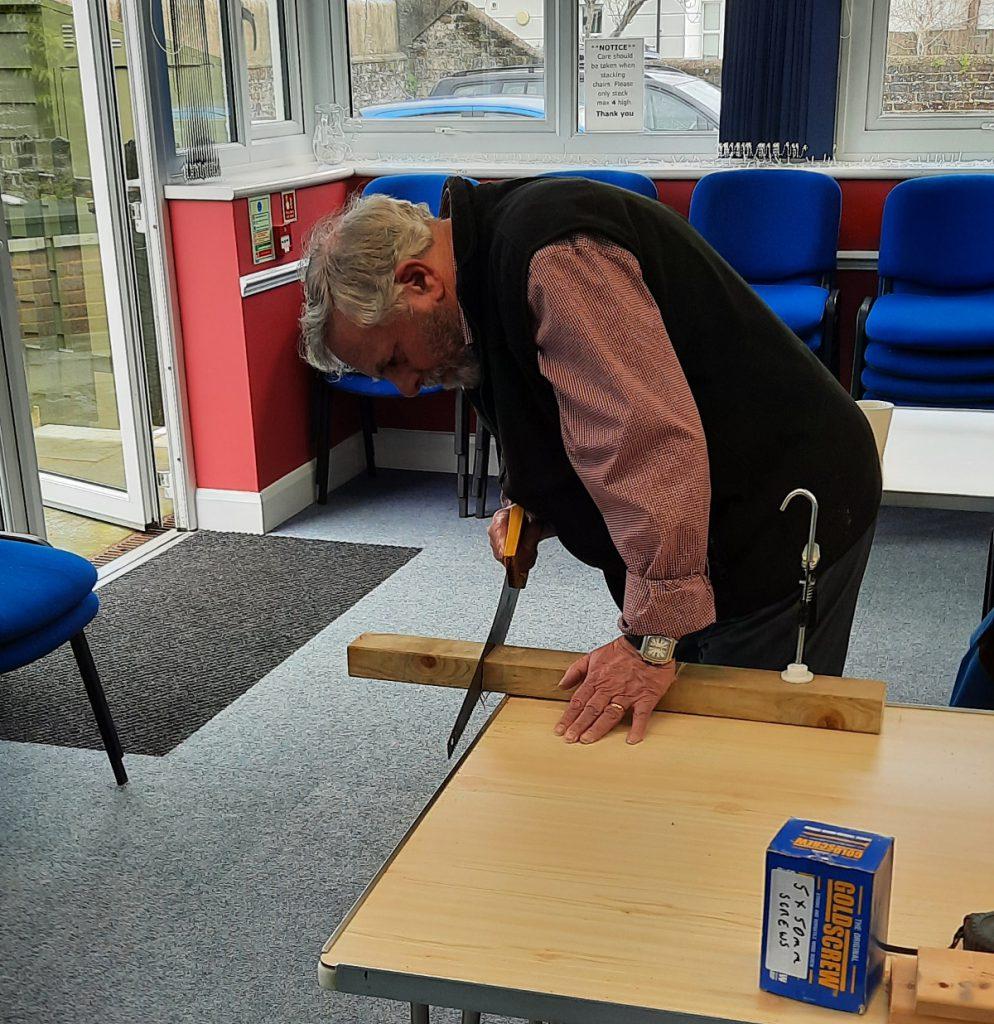
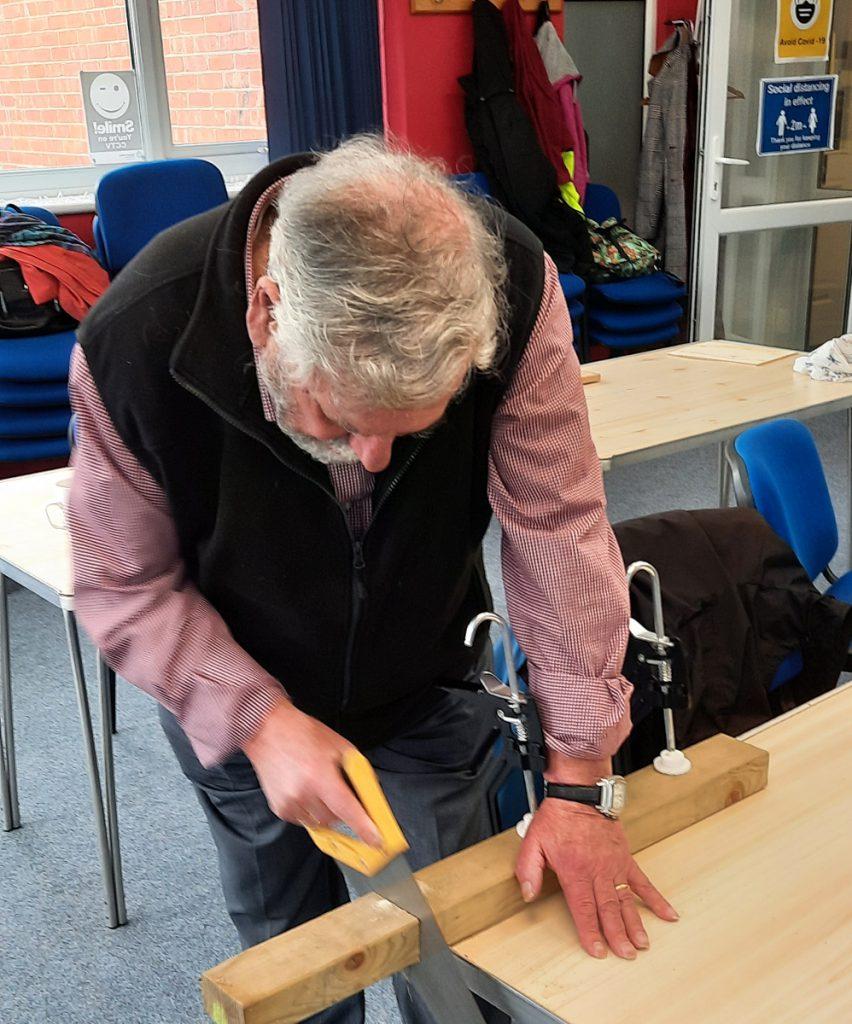
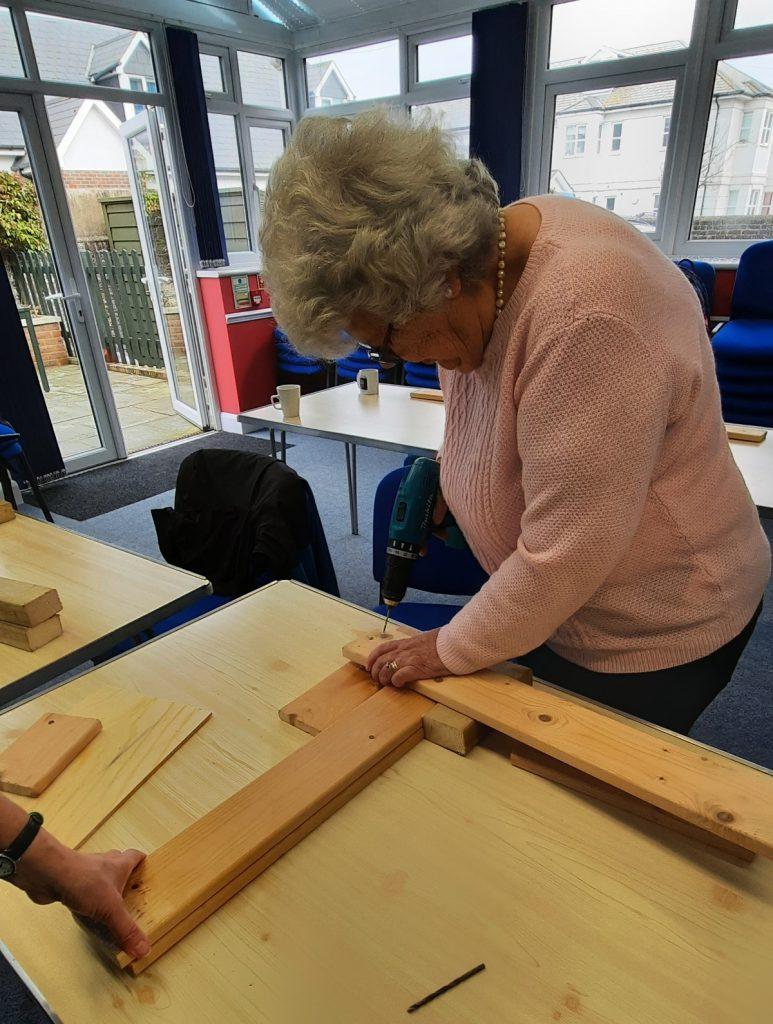
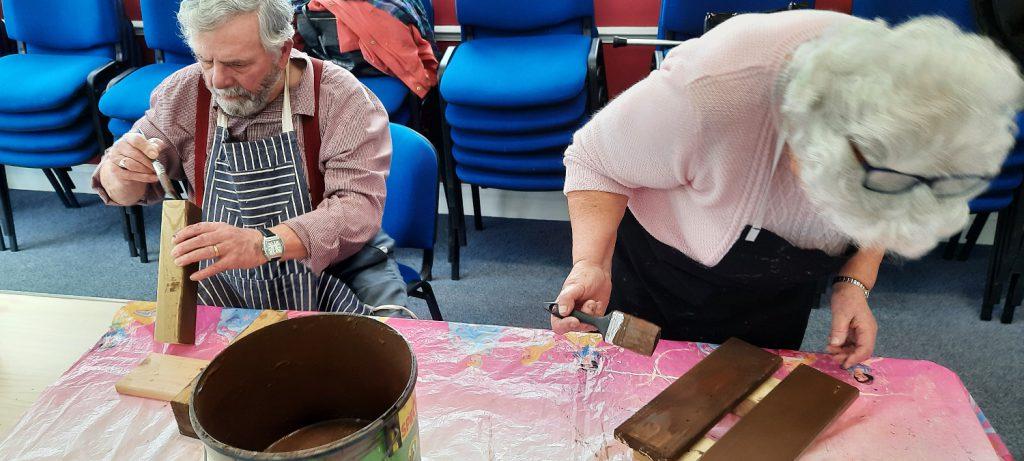
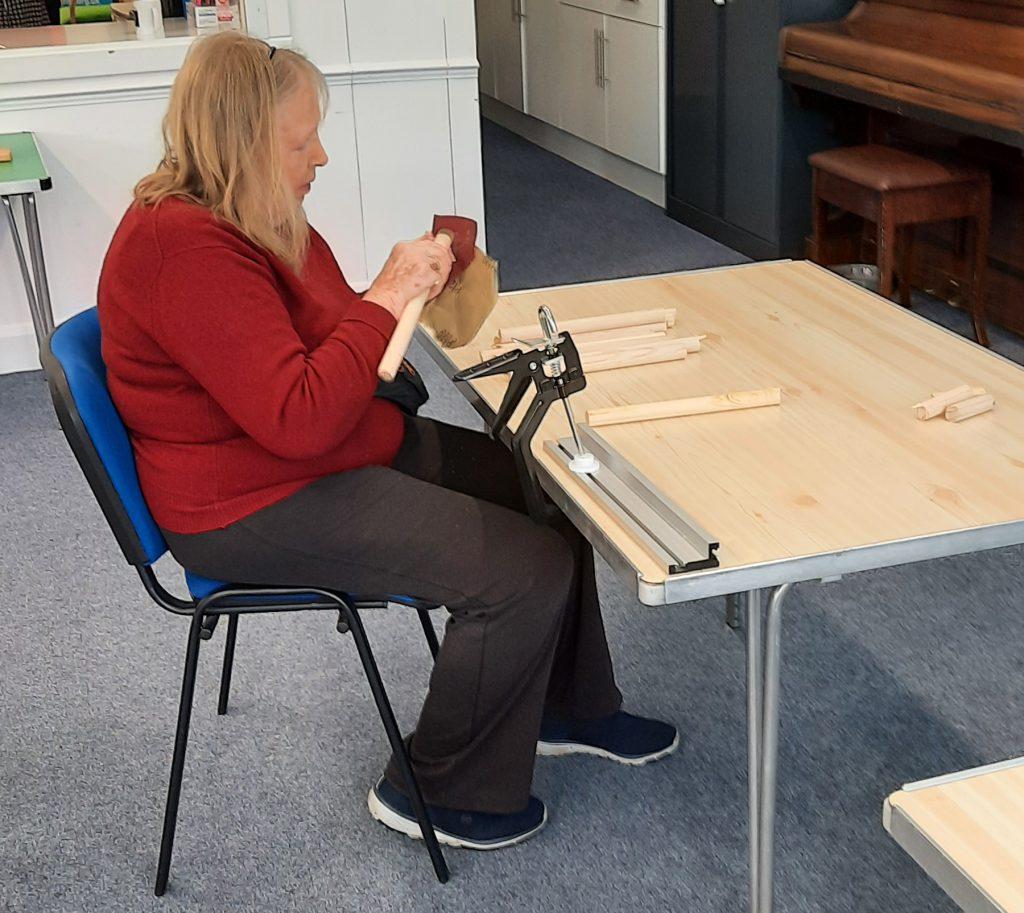
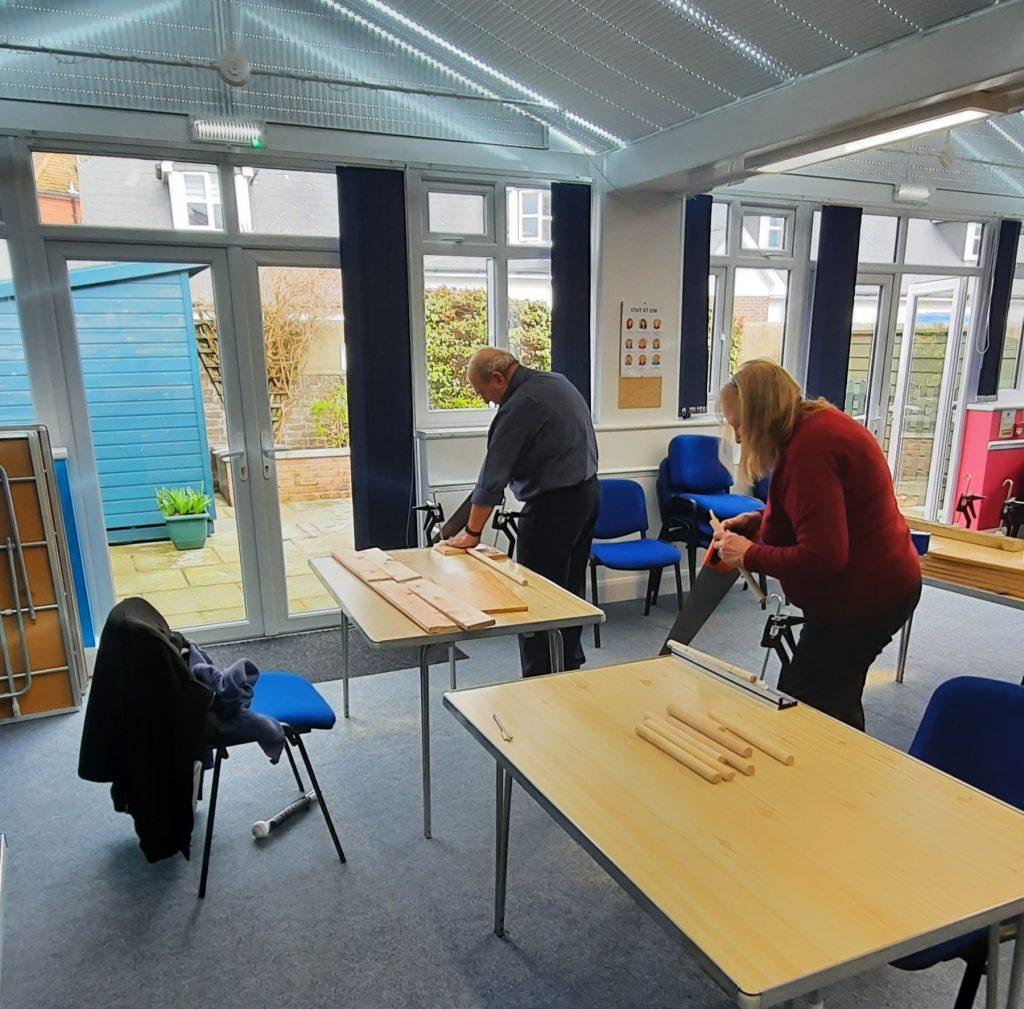
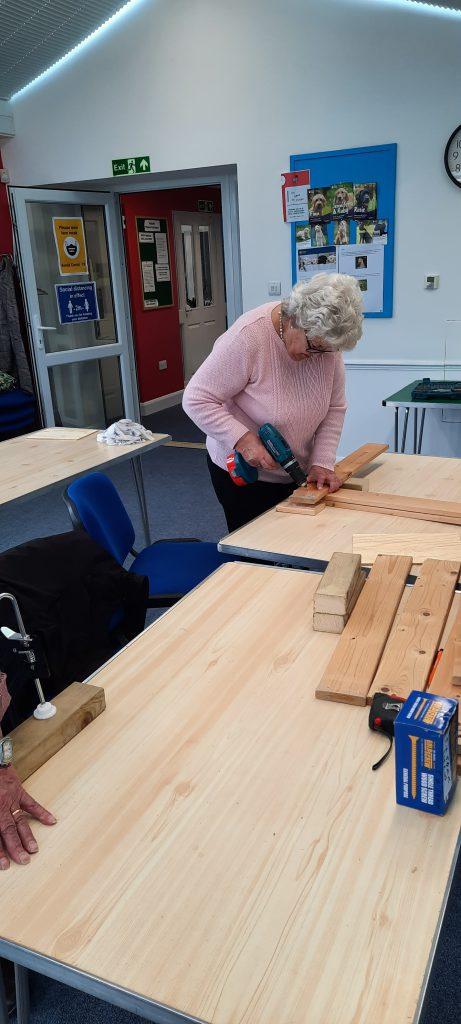
We are aware that some members have needed to hand in their driving licenses due to sight loss and, with many people’s passports expiring during COVID, a number of people have found themselves unable to prove their identity.
SSW team member Jackie Brownlee can help people apply for a Citizencard, which is recognized by the Home Office as well as on public transport. The card is an 18+ photo ID, it costs £15, takes approximately 21 days to arrive and lasts 15 years. More information can be found here.
If you’d like Jackie’s help to apply for a Citizenship card, give the Centre a call on 01903 235782.
by James Langley, SSW Events Coordinator
I wanted to share an interesting visit I had to the opticians recently. I have congenital nystagmus and ocular albinism and have not had a specialist appointment since I was a child. I decided it was time for an up-to-date and in-depth diagnosis.
In the past, visiting a high street opticians has felt like being put through a check out. However, on the recommendation of a friend who has recently been registered severely sight impaired, I visited my local Vision Express and asked for an appointment with the optician she had recommended.
We started with eye scans and distance vision. The machines the optician used picked up an astigmatism. However, she told me this was due to the eye movement associated with nystagmus, and that the reading was not accurate. When looking at distance vision I was unsurprised to hear that lenses would have little to no effect. It was very refreshing to hear that she did not recommend glasses as they would be very big, very expensive and of little use!
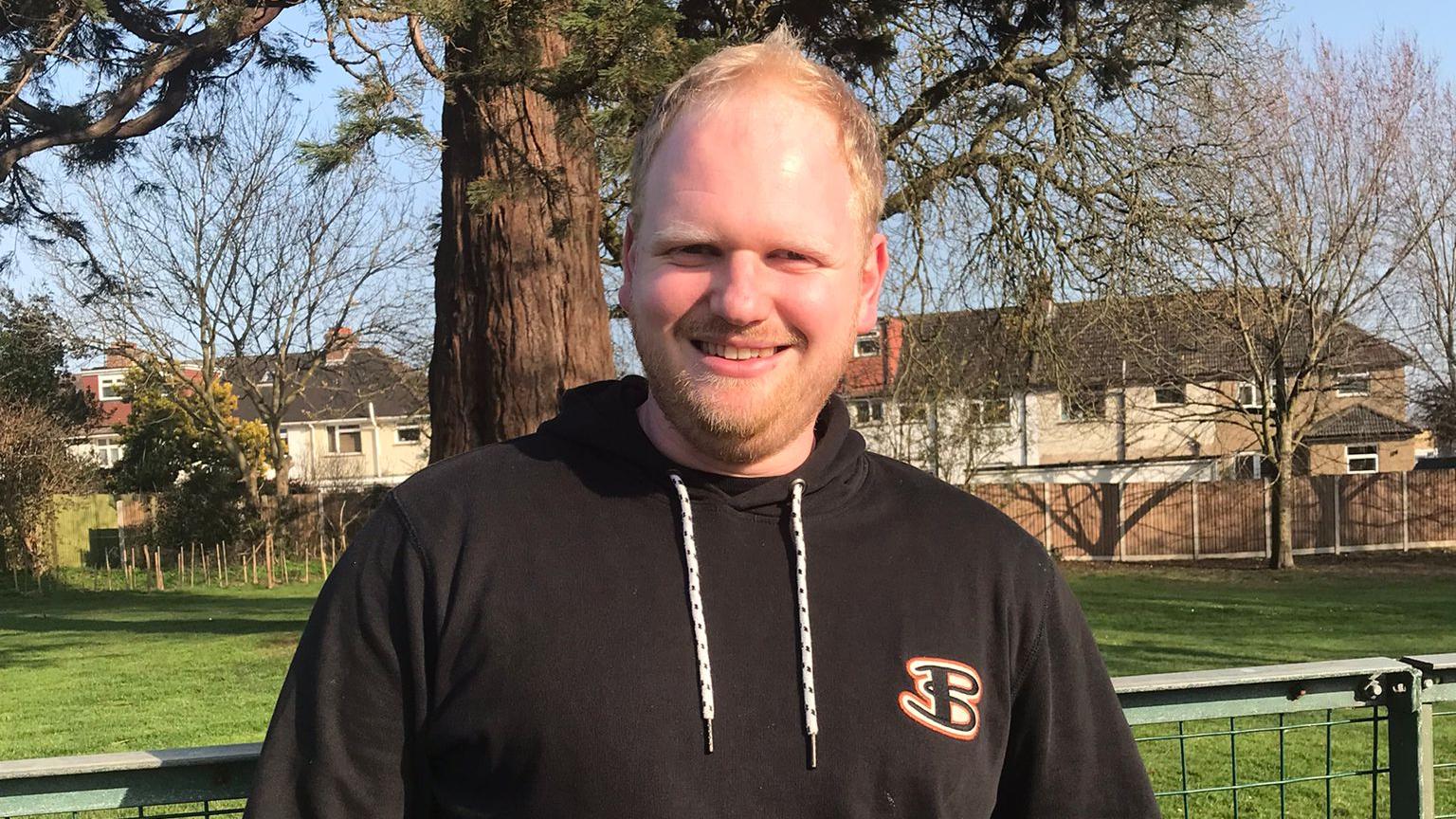
We then moved on to near/reading vision. Again, I was unsurprised to hear that lenses would have minimal effect. Annoyingly, I had forgotten my magnifying spectacles, which I occasionally use for reading long documents. However, with smart phone accessibility I find myself using them less and less. The optician told me to pop them in next time I was passing and she would update my record.
A few days later I returned to show her my glasses. We tried a couple of near reading tests, first with the naked eye, then with my glasses, then with the lenses she thought might help. But no such luck.
For reference, I can normally read font 14 with the naked eye, 12 if I squint, font 12 with my glasses, 10 if I squint.
I removed the temporary frame and put my own glasses back on. Here is where it gets interesting… I noticed that my glasses had a very wide field of view; you may know that the temporary frames and lenses they use give you almost tunnel vision.
I pointed this out and told her that I tend to tilt/turn my head when reading and that the temporary lenses blocked that part of my visual field. She widened the space between the two lenses and my vision improved so that I could read font 10 comfortably and 8 if I squinted.
It’s not a huge leap, I know, but for the sake of a minor adjustment to the lenses position I did experience an improvement. I thought this may help someone whose vision is just on the borderline and preventing them from doing something they really want to do.
My vision puts me just below the threshold to drive in the UK so I now wonder if a similar adjustment could be made with distance lenses. That might allow me to drive which would give me increased opportunities.
I am 33 and can’t believe I haven’t thought about this before. Maybe I’m alone and this is common practice but the optician was just as surprised as me, so thought it worth sharing in case someone else can benefit from a quick trip to the opticians.
If you’d like to speak to James about his experience at the opticians you can contact him at the Centre or email james@sswcharity.org.uk. Alternatively if you’d like advice about your eyesight, or maybe you’ve a story to share, we’d love to hear from you!
by Ali Bates, SSW Tech Advisor
It’s Mental Health Awareness week and the theme this year is loneliness. Loneliness is something that one in four of us suffer with at some point in our life. Today I will share my own experience of dealing with loneliness after sight loss.
Six years ago I suffered a detached retina. It was completely unexpected. I woke up one day with slightly blurry vision in my right eye and didn’t really pay it any attention as my eyes would occasionally go blurry and correct themselves later in the day. On this occasion it did not fix itself and I ignored it. I happened to have a routine optician appointment booked in and it was during this that I got told my retina had detached and I should visit the eye clinic. Me being me, I left it a few days… I worked at the hospital at the time so I just called the eye clinic on my next shift. They demanded I came in to them immediately.
I had not expected that what was going on with my eye was an emergency that required urgent surgery. Unfortunately for me, the surgery was not a success. I woke up from the anaesthetic in complete darkness and excruciating pain. Nobody told me but I knew immediately that it had not been a success. The reality of sight loss had not previously occurred to me,
As part of my recovery I had to learn to sleep on my front and lay facedown for 80% of the day in order to give any chance to have some useable sight.
I existed like this for six weeks, in darkness and constant pain. My husband became my carer; he fed, bathed, did hourly eye drops and did everything in the house including looking after both of our children as well as me. For both of us it was incredibly lonely. I was bored, I wanted to read the news, see a friend and just feel normal and not like I was a burden on my husband.
One Saturday, a few weeks in, everything came to a head. I had only left the house for hospital appointments. My husband was physically and mentally exhausted from doing everything and dealing with the shock and uncertainty of my sight loss and inability to do anything. It was like the mental load had physically paralyzed him. We knew we needed some help from outside our four walls but this was not something either of us had ever sought before.
Monday morning my husband called the GP. He asked for help, he broke down, he felt like he had somehow failed as a husband. But, as I type this, I am literally sat here with tears in my eyes because I am so proud of him for recognising he needed some help. It was not failure; it was acceptance that he is human and there is only so much we can deal with on our own. During our entire relationship, every hurdle we have faced we have got through together, but he was so busy being everything to everyone else that he had nothing left for himself. Something had to give.
He had counselling; he was able to talk openly with someone that could help him adjust to our new normal, give him coping strategies and help him feel less alone. He felt able to tell me how he was feeling without feeling guilty, as the reality is that we both lost a lot more than an eye. It changed who we are and the dynamic of our relationship. It was a long recovery but as I adjusted to living without my right eye I was able to be his supportive and fun wife again.
My own mental health recovery took a lot longer. I was so determined to get back to normal and back to work, that I did not stop still and give myself time to make adjustments; I threw myself into everything. I was in denial and angry at the same time. Everyone around me was so busy telling me that I am so brave and what an inspiration I am, which only confused me further as some days my only achievement was getting out of the house to get the kids to school. I would then go home and sit in my house alone, hiding from the real world so no one could see how not ok I was. The short periods of time I was with others I could put my mask on and pretend all was ok.
It was actually our mortgage falling through nearly three years later that finally broke me, us buying our first home had been a focus for so long and at the last moment it was taken away from us. This rekindled my feelings of life being unfair and I went into a tailspin. All my focus went on finding us somewhere new to live and, thankfully, it only took 11 days to find somewhere and get moved in. But then I had a full breakdown. I could not hide from my feelings anymore. I didn’t want to take pills to numb the pain; I NEEDED to deal with everything so now it was my turn to reach out and ask a professional for help. I was lucky to be given a counsellor very quickly.
This lady changed my life. I worked through so much of the trauma I had been living with, accepted that I can still be me even with sight loss and, most importantly, I started to talk openly and honestly. It was not an overnight fix; it has been a long road of acceptance. I still have days of negative feelings but they do not control how I live my life or fill me with feelings of inadequacy. I definitely have many more positive interactions. I will always have a small amount of denial that I am blind but I know that is my stubbornness and determination to live my life on my terms.
I am sharing this as I know being open and honest with my experience may make others feel that they can ask for help. Here at Sight Support Worthing we are passionate about offering our members and their families the support they need. One of our future plans is to offer specialist talking therapy for those living with sight loss as well as their immediate family.
We are putting in a bid to the National Lottery to help fund this vital service. As part of the process we would like feedback from our community. Those of you on our mailing list (email and post) will have had a copy of the survey already. For those of you who have yet to complete it, you can find it here. It should take 3-5 minutes of your time and your feedback will be extremely valued. Thank you.
by Chris Green, Tech Advisor
We’ve all encountered individuals that have attempted to gain sensitive information from us to commit fraudulent activity. You will have received calls from people pretending to be your internet/telephone provider, bank or maybe even Amazon. They all have one task in mind which is to extract that valuable data from you. This could be conducted over several different calls to build trust and acceptance that you are speaking to who they say they are.
An important thing to remember is that companies (including your bank and utility providers) will very rarely contact you over the phone. You should never feel pressurized to reveal any information over the phone. Here’s what some of these organizations say:
Santander
Anyone can be easily impersonated, and criminals can make the caller ID, email address or name look exactly like the genuine caller. So, if you receive an email, text or call, verify it’s genuine by phoning them back on a known and trusted number.
Amazon
Amazon will never ask for payment or offer you a refund you do not expect.
BT
If the caller sounds urgent or threatening, they ask for remote access to your computer, they ask for personal details, passwords or bank details then hang up.
If the above sounds familiar and you fear you may have revealed personal information to a stranger then you can take some steps to protect yourself.
- Change your email account password first
- Change all other passwords (this should be done regularly to maintain security)
- Ensure that your contact details are correct for these accounts, especially your mobile phone/home number and backup email address (if you have one)
- Enable 2-factor authentication where possible

What is 2-factor authentication?
The phrase ‘2-factor authentication’ sounds complex to many users. Chances are you have already used it in some way, but didn’t know it was called that. You might also hear it called “multi-factor authentication” or “2 step verification”.
Basically, it means that before you can access some services, you need to provide two different pieces of information. Examples might include:
|
Authentication types |
Examples |
|
Something you know |
account name, password, email account |
|
Something in your possession |
security key, application, code |
|
Some physical attribute |
fingerprint, facial recognition |
This means that if someone has managed to gain your password then they would also need your device or a fingerprint to get any further making it highly unlikely they can successfully complete both two steps.
If you’d like to activate 2-step verification on your devices, or would like to have a chat about how to best manage the security of your data then please get in touch with one of our tech advisors.
Have you ever heard of a condition called visual stress? It might sound like it’s to do with tired eyes from too much screen time, but actually it’s not related to eye function at all.
SSW Manager Sonia became aware of differences in her vision in her late thirties. But, as everyone’s eyesight is unique to them, it was difficult for her to ascertain if everyone’s sight was like hers.
It was years before Sonia began to investigate as, fortunately for her, it wasn’t (and doesn’t now) interfering significantly with her ability to read. She said: “I’ve always struggled with glare and needed sunglasses throughout the year but since my late 30’s I’ve noticed that my field of vision fluctuates with blotchy or grainy interference. Depending on how bad it is, I can forget about it, but sometimes it can be a real nuisance and distraction.”
The coloured filters used to test someone who may have visual stress
Sonia made an appointment to have a Colorimetry test and, following this, the Optometrist confirmed she suffers from visual stress. The test involves reading a paragraph of repetitive words with different coloured lenses and timing the reading speed. There are so many different colour variations, so the process involves narrowing down by choosing between types of colour and then shades.
So what is visual stress?
Visual stress, sometimes referred to as Meares-Irlen or Irlen syndrome, is a neurological perceptual processing disorder. Lines of text are rather like a striped pattern. When some people look at black and white stripes of specific width and spacing, it causes visual distortions and illusions. Thes edistortions are due to hyper-excitability in the part of the brain known as the visual cortex. It is thought that when some people try to read, the ‘stripy’ effect of the lines of print cause symptoms affecting their ability to read the text. There appears to be a link between visual stress and Dyslexia, though you can have either without the other.
Examples of how text can look for someone with visual stress / Irlen syndrome
What are the symptoms of visual stress?
- Headaches, eyestrain
- Blurring of print
- Words moving and appearing to jump out of the page
- Colours in the text
- Glare, page too bright
- Losing place, skipping words or lines
- Poor understanding of text being read
How can I get tested?
Unfortunately, Colorimetry testing at this time is not available on the NHS and specialist optometrists are not widely found. For West Sussex residents, Sonia recommends Forbes Eyecare Ltd in Chichester. If you live further afield, try the Cerium Visual Technologies website where you can search for a specialist in your area.
Feel free to get in touch with SSW if you’d like to chat with Sonia or any of the team about your visual condition.
Dry eyes is a fairly common condition and it occurs when there’s a problem with the tear production process or with the quality or quantity of tears produced. Women are twice as likely to suffer with this ailment.
Symptoms include:
- Sore or gritty eyes.
- Dry or burning eyes.
- Blurred vision that improves after blinking.
- Watery eyes (this occurs because the eye tries to produce more tears to relieve the dryness)
The most common causes are:
- Hormonal changes, such as during pregnancy, menopause or when using the contraceptive pill.
- Environmental factors, such as too much sun, wind or heat.
- Activities that can either strain the eyes by making you stare more or reduce your blink rate, such as reading, writing or using the computer for prolonged periods of time.
- Medicines, which include some antidepressants, antihistamines, and certain blood pressure-lowering medicines (diuretics and beta-blockers)
- Using contact lenses.
- Recent laser eye surgery.
- Medical conditions such as Bell’s palsy, Sjögren’s syndrome, rheumatoid arthritis and lupus.
If left untreated some complications can occur such as
- Conjunctivitis, which is an infection of the eye and may need antibiotics to resolve
- Keratitis, which is an inflammation of the cornea, which, again, may need antibiotics, prescription eye drops or anti-viral medicine.
The good news is dry eyes are easy to manage. Here’s a few ways you can reduce the effects of dry eyes:
- Keep yourself hydrated and drink plenty of water.
- Try an over the counter product that’s designed to alleviate dry eye symptoms, like artificial tears or lubricating eye drops.
- Keep your eyelids and eyelashes clean by gently cleaning them.
- Omega-3 may help to ease symptoms but this has not been proven. It can be found in oily fish and plant-based sources like walnuts and rapeseed oil.
If you are at all concerned you can speak to a pharmacist, optician or the health professionals in the eye clinic who will be able to advise you on the best treatment for you.
James Langley joined the SSW team in late 2021 as our Events Coordinator and Accessibility Tester. He also works for Blatchington Court Trust as a Leisure Development Officer. Outside of work he has a busy life and enjoys socialising with his buddies, exploring on his mountain bike and honing his Judo skills.
James is visually impaired; he has nystagmus and ocular albinism. Spurred on by SSW team-mate Ali’s recent experiences with her eyes, James has recently asked to be referred to the eye clinic as it has been years since he has had any input from them. He’s aware that there may have been changes in his eyes or he could have even had unknown conditions develop.
Nystagmus presents itself as an involuntary movement of the eyes. In James’s case this is horizontal but it can be vertical, circular or a mixture of these. The condition is due to the signals from the eye to the brain being disrupted and, as such, it cannot be corrected by lenses. James finds it hard to see near things like printed text as well as far away things like objects in the distance.
Ocular albinism reduces the colouring of the iris (the coloured part of the eye) and the retina, which is the light-sensitive tissue at the back of the eye. It affects visual acuity (sharpness of vision) and makes James more sensitive to light. It takes a little longer for his eyes to adjust when he goes from a light room to a dark room and vice versa.
We’ll check back with James when he’s been to see the eye clinic for an update.
Perhaps you’d like to share a little bit about you and your eye health? We’d love to feature you on the website too! Get in touch with Emily – emily@sswcharity.org.uk
by Chris Green, Tech Advisor
There are so many different types of technology out there, it can be hard to keep up. In this series of blog posts, I’m going to take a look at some of the latest accessibility tech to see if it’s worth it. Whether you’re a tech expert or just starting to think about the possibilities, we’re sure you’ll find something new here.
In this post, we will discuss the merits of introducing a smart speaker such as an Amazon Alexa or Google Home into the house, and the associated costs of entry.
So, what is smart tech?
This is a diverse subject with many offshoots, but the general definition is as follows:
It is a technology that uses artificial intelligence, machine learning, and big data analysis to provide cognitive awareness to objects that were in the past considered inanimate.
In this series of blog posts, we will be focusing on ‘Smart Devices’. The definition of a smart device is as follows:
A smart device is an electronic device, generally connected to other devices or networks via different wireless protocols such as WiFi. They can operate to some extent interactively and autonomously.
Some examples of smart devices you may already be familiar with:
- Amazon Alexa
- Google Home
- Smart Phones (Android or Apple)
What is a Smart Speaker?
If you’ve ever heard someone saying ‘Alexa’… ‘Hey Google’… or ‘Siri’ then they are most likely initiating contact with a smart speaker. A smart speaker is a speaker with a built-in microphone that allows users to interact with other smart devices or internet services using their voice.
Saying these keywords (‘Alexa’… ‘Hey Google’… or ‘Siri’) is a way of opening a line to the internet, the same as picking up the phone is opening a line ready to dial a number. It is the job of a smart speaker to translate your spoken word into text which is then sent via the internet as a question or command.

What will it do for me?
The examples below can be performed by using voice commands anywhere in the room:
- Listen to your favourite radio station, audiobook or play your favourite song
- Set alarms, timers, reminders, calendar entries and create/recall lists
- Listen to the news and weather
- Recipes, conversion tools and calculations
- Make free calls
- Control other smart connected devices such as lighting, TV, heating thermostats and power points
What will I need to get going?
- An internet connection at your home address
- An email address
- A smart phone or tablet for initial setup **
- A smart speaker
**it’s possible that a friend could complete the initial setup for you
How much will it cost?
If you have no internet, smart phone or tablet then the initial setup cost will vary depending on the devices you choose. The prices below are based on what I feel would provide adequate performance for value.
One off cost
Email account – FREE
Smart phone or tablet – £80
Smart speaker – £30
Ongoing costs
Average cost for a basic internet connection – £19 pcm
Is it worth it?
Personally, as someone who has been using smart devices for a number of years, I have grown accustomed to the convenience of having an encyclopaedia of information to hand for those moments when the grey matter isn’t up to the job.
I also like that my smart speaker doubles up as a radio alarm clock, controls my lighting, I can set my house alarm remotely or control my heating if I’m away.
Do I ‘need’ a smart speaker in my life? Probably not, but it sure does help.
If you’d like more advice or help setting up tech in your home, please do get in touch with me, or my colleague Ali, and we can discuss the possibilities available to you.
If you’re after some new sunglasses this Spring (or, indeed, any time of the year!) check out the ranges we have available here at SSW.
There are three brands available:
Cocoons – these come in a variety of frame colours, sizes, shapes and lens tints, so there’s something for everyone. They cost £45 per pair (R.R.P. £59.99) if you buy them through us.
Cobolt – these come in one size, with a black frame and a choice of different lens tints. They are £20 per pair.
Plastic wrap arounds – these go over your existing glasses. There are different tints available and they’re just £7 per pair.
Ask in the Centre to browse and try on the choices we have.
by Alison Bates, Tech Adviser
March is Workplace Eye Wellness Month. Although there are a huge range of settings for work, we are generally becoming more reliant on digital technology. This can result in extended time in front of a screen which can cause eye strain, headaches, blurry vision, and neck and shoulder pain.
Thankfully, there are many ways we can prevent these symptoms and here are a few suggestions:
Good posture
Sit making sure your head and neck are upright and in-line with your torso, not bent down or leaning back. Face your screen directly in front and position the screen around 25 inches (roughly an arm’s length away).
20-20-20
Every 20 minutes, look at an object at least 20 feet away for at least 20 seconds. This will give your eyes a rest from the screen for a suitable amount of time.
Device settings
There are a number of ways you can make your computer, tablet or phone better for your eyes. You can raise the contrast on your screen. Perhaps make the text larger which can reduce strain, and also change the brightness of the screen. It shouldn’t be lighter or darker than your surroundings.
You can also lower the colour temperature of your screen. That means it will give off less blue light, which is linked to more eye strain.
Get regular eye tests
Regular eye tests are essential for maintaining eye health at work; you should have one every two years unless your eye care specialist recommends you have them more regularly.
Many workplaces will cover the cost of your test and may help towards the cost of any glasses needed so it is worth checking with your HR department.
At Sight Support Worthing we encourage our staff to maintain good eye health by covering the cost of an eye test and pay towards any glasses needed.
“People often take their vision for granted, but problems with eyesight can occur at any time in your life.
As a sight loss charity, we ensure our team take regular screen breaks and keep up to date with routine eye tests but it’s really something all employers should be doing.
The people are the most important part of any organisation, and their sight is often critical to the work they do so it makes sense to protect the eyes as the most important resource.”
by Alison Bates, SSW Tech Advisor
Ok, so I will start off by saying I didn’t actually notice I am blind. Earlier this week I had an appointment with the eye clinic and during the visit a doctor suggested I be registered as sight impaired. I was pleased as I have been asking about this for the last few years but got fobbed off and didn’t pursue it.
Today I had a sight care advisor call me to ask some questions, so that she could get the paperwork sorted to get me registered as severe sight impaired. I had to ask her to repeat herself as I thought I was being registered simply as sight impaired. She apologised as she had been told I had consented to being registered, which I had: I just had just assumed it was for sight impairment.
Sight impaired means partially sighted, and severe sight impaired means blind. But I can see – sort of – out of one eye that randomly goes blurry. But I CAN SEE! It’s just hard work. ‘Blind’ doesn’t mean no vision – I know that – I just never really considered that my sight was that bad.
Then I remember I can’t read books anymore, not the paper ones anyway. I can’t make eye contact with people because I can’t see their eyes; I can’t even see my own eye colour in the mirror. So this, and so much more that I don’t even take into consideration, means that legally I am blind.
This changes nothing about me or my sight except a bit more self-awareness. Maybe I will be more patient with myself and allow more time to process things, ask for help and – even better – still accept help when its offered rather than just trying to stubbornly get on with it (yeah, right).
Alison Bates, official BLINDO
by Alison Bates, SSW Tech Advisor
It is World Glaucoma Week 2022 and it gives me the opportunity to share my own life of living in denial that I have this disease of the eye.
Glaucoma is a group of eye diseases that can cause blindness or vision loss by damaging the optic nerve in the back of the eye (the optic nerve carries sensory nerve impulses from the retina to the brain) so, in simple terms, if the optic nerve is damaged it means the connection with the eye and the brain is not working properly so vision can become blurry or, worse, non existent.
I have Glaucoma. Last week I had my eyes tested and part of the routine test was an eye pressure checkup during which it was discovered that the pressure in my left eye is 25 and the pressure in my right eye is 60. To put this into context, the healthy range is 10-21.
My optometrist was in absolute shock that it was so high and I had to reassure them that, while I’m surprised it is higher than what is considered healthy, a) I know I have Glaucoma so it is going to be high and b) because – shock horror! – I have not taken an eye drop since the beginning of the pandemic because I have not been to the optician or the hospital. I won’t lie to you or myself and say it is due to the pandemic: it is because I live in denial that there is anything wrong and convince myself that I am going to be fine… somehow by brain will just work it out… but you know what: IT WON’T.
I have to actually get off my in-denial bum and see a professional to get eye drops and a completely called for telling off and stop ruining any chance I have of at least having one healthy eye.
Tomorrow I have an appointment with a doctor in an eye clinic and I will wear my big girl pants, accept my telling off, and start taking my eyedrops regularly (and now you all know how lax I have been you have permission to nag me)!
For more information about Glaucoma take a look at the World Glaucoma Association’s patient guide to caring for Glaucoma during a pandemic which you can access here or the more general NHS information here.
SSW members were treated to a day out at the South Downs Gun Club. This was a new activity for us and proved to be very popular!
Members were expertly guided by the Club’s coaches, with everyone enjoying their stint shooting at the targets. Take a look at the photos and video below.
In fact, the event was so popular we’re planning a return visit in the Spring. If you’d like to join us, drop us an email (info@sswcharity.org.uk) or call on 01903 235782. Sign up to our email newsletter to get regular updates on our new events and activities, as well as information about our services.
Citizens Advice in West Sussex is offering appointments to specifically give advice around energy, from helping you understand your bills to advice on how you can reduce your costs as well as the help available to you. If you or someone you know is on a low income, vulnerable or has a health condition, you could benefit from this service.
You can book a free energy advice appointment with Citizens Advice’s fantastic team. Either email energyadvice@westsussexcab.org.uk or call 0808 278 7969.
In the meantime, here’s some quick hints and tips from Citizens Advice on ways to help reduce the cost of energy and the amount of energy you use.
- Use your heating controls more effectively, such as thermostats, radiator valves and timers. You can save £100 per year by only heating your home when you really need it.
- Use energy efficient lightbulbs – this can save £50 over the lifetime of the bulb.
- Turn off appliances instead of leaving them on standby – this can save £30 each year.
- Switch your provider for one that gives you a better tariff. You can check whether you can get a better rate yourself by using the Citizens Advice comparison tool.
- You can apply for grants and support from your supplier and also from the Government.
- Get in touch with Citizens Advice to get expert, friendly help.
The Priority Services Register is a free support service to help people in vulnerable situations. Energy suppliers and network operators offer it. Each keeps their own register, although some share with each other.We recommend that people who may be vulnerable or at risk during severe weather should be on a Priority Services Register. Parts of the UK have recently had severe weather – our turn may be coming! Friends and relatives – or us, here at SSW – can assist those who may be in need of a bit of help to register. Each operator can be contacted online or by phone. Power cuts don’t happen very often but if the electricity or water supply network is damaged or develops a fault, engineers work around the clock 24/7 to restore supplies as quickly as is safely possible. Being on a Priority Services Register will ensure that extra support will be received if the customer experiences an outage. Support is likely to include:
- A priority number that you can call 24 hours a day
- Text and voice message alerts, letting you know when they are aware of a large power cut in your area or should your water supply be interrupted
- Tailored support if needed such as home visits, hot meals, advice and keeping your friends and relatives updated
- Where possible they will send you text and voice messages when severe weather is expected, to help you prepare
- In certain scenarios they may also offer a free hotel overnight and transport to the hotel
- For complex power cuts, community welfare teams provide on-site support which includes hot drinks, hot meals, a Wi-Fi connection and charge points.
OFGEM has a summary at https://www.ofgem.gov.uk/information-consumers/energy-advice-households/getting-extra-help-priority-services-register, and this includes help in finding the suppliers in your area. As various energy suppliers and network operators are active in Sussex, the following are the ones who cover most of the county, but there are some others. If you try to register with the wrong operator they will usually steer you in the right direction.ElectricityUK Power Networks – most of the SE of England https://www.ukpowernetworks.co.uk/power-cut/priority-services/about-the-priority-services-registerSSEN – parts of the West of Sussex https://www.ssen.co.uk/PriorityServices/WaterSouthern Water https://www.southernwater.co.uk/help-advice/join-our-priority-services-registerSouth East Water https://www.southeastwater.co.uk/get-help/help-for-priority-customersThank you for helping to keep Sussex safe.
Did you know that you may be entitled to Attendance Allowance?
You can get Attendance Allowance if
- you’ve reached State Pension age and
- you have a physical disability (including sensory disability, for example blindness) and your disability is severe enough for you to need help caring for yourself or someone to supervise you, for your own safety.
Attendance Allowance is not means tested.
It takes 25 days to process the claim for attendance allowance which is paid at two different rates. Lower rate is £60 per week and the higher rate is £89.60.
Jackie Brownlee at Sight Support Worthing is able to help you complete the application form so if you think you may be eligible and would like to know more or get help from Jackie, please give us a call on the usual office number 01903 235782.
apetito is the WSCC meals on wheels service, delivering a two-course hot nutritious meal into clients’ homes 7 days a week, 365 days a year.
You can choose from a daily selection of meals and puddings and, as they cater for every dietary need, there is something for everyone.
The meals are delivered between 11am and 2pm each day. On delivery their friendly drivers will carry out a safe and wellbeing check which gives your next of kin peace of mind. They can also plate your meal up for you, fetch your cutlery and a glass of water and pop the meal in front of you if required.
There are no contracts which makes the service very flexible and enables you to stop and start the service whenever you like. The cost of a two course meal is £5.85 and you can add an extra course for just £1. They also offer a tea time pack which consists of a sandwich, piece of cake and fruit.
To find out more or to sign up to the service please call 01903 718893 or visit www.apetito.co.uk/meals-on-wheels
Blind Person’s Allowance is added to your yearly personal allowance. The allowance is £2520 for 2021/2022.
You can claim if you are registered as blind or severely sight impaired with your local council, or if you have a certificate.
Jackie Brownlee at SSW is able to help you complete the application form so if you think you may be eligible and would like to know more or get help from Jackie, please give us a call on the usual office number 01903 235782.
How do you like the idea of getting instant access to thousands of RNIB audio books, free of charge, just by using your voice?
Well, that’s exactly what RNIB can offer! They’re giving away 3,000 Amazon Echos (smart speakers) to celebrate the launch of their Talking Books library being available on Amazon Alexa.
You can simply say “Alexa, open RNIB Talking Books” to access thousands of titles. RNIB Library and Reading Services are fully accessible via an Amazon Echo and you can also ask the device to call the RNIB Helpline.
Terms and conditions do apply.
If you would like to try out the Alexa, we have them at the Centre for you to come in and see what all the fuss is about.
Our Tech Advisor Ali is on hand to help set up your device at home, answer questions and show you everything Alexa can do and give ongoing support.
To book a slot with Ali, drop her an email – alison@sswcharity.org.uk – or call the Centre on 01903 235782.
Last year, SSW Chairman Barry Ward underwent a cataract operation. Here’s his experience of this eye health journey, with each stage written as it happened.
Diagnosis
I was referred to the Shoreham Eye clinic “as a precaution” after my annual eye test with Specsavers.
When I attended the subsequent appointment at the Eye Clinic, I must admit I was very surprised and somewhat shocked to be told that I needed both cataracts removing. I had no idea that there was a real problem with my eyes and initially I found it hard to accept.
However, the total lack of any surprise when I told friends and colleagues brought home to me that not only was this par for the course for someone in their 70s, but also that the general view is that such an operation is very straightforward with brilliant results.
Did that make be feel better? To be honest, it didn’t at first, although I fully understood the logic of those views. I am now just three days away from the first operation and I’m feeling reasonably calm but nonetheless anxious – if that’s not a contradiction in terms!
Operation
On the day I was much calmer than I expected. The nursing staff were very reassuring and helpful, responding positively to all my questions.
The operation itself was strange (being fully awake) but totally pain free and not even uncomfortable. If, as expected, the other eye needs doing then I shall have no anxieties at all.
The de-briefing from a nurse was thorough and fully documented. I left with a patch and padding to provide protection for the first night. Then the advice was to wear the patch (without the padding) just overnight for the first two or three nights, to avoid anything hitting the eye.
Recovery
This varies apparently, depending on the severity of the initial condition and the individual’s own health.In my case, the following days were as follows:
- Days 1 and 2: I could see very little out of the eye that was treated. It was like being in a white cloud trying to look out.
- Day 3: there was an improvement. It was now like looking through heavy net curtains particularly in the centre of my vision.
- Day 4: I could now see more consistently although with a slight “haze”.
- Day 5 onwards: I have been managing without my glasses at all when walking or just sitting indoors (I am long sighted). Having worn glasses all the time for nearly 40 years, that is a strange feeling (something that my children and grandchildren are finding equally strange as they have not seen me without glasses).
Some time has now passed since the operation and the sight in the eye continues to improve. I had the left lens in my previous glasses changed to clear glass as the prescription lens was making it difficult to focus with my newly improving eye when reading.
Cataracts: did you know?
- Cataracts are caused when the eye’s lens becomes cloudy and no longer focuses light properly, often causing a blurry vision effect.
- It’s not just the elderly who are affected by cataracts. Although it is more prevalent in the elderly, it is possible in people of all ages.
- Cataracts are the biggest cause of vision loss in the world.
- Sun exposure can increase your risk of cataracts. So, the hat you wear to protect the skin on your face will actually help prevent the onset of cataracts too. Sunglasses (or some sort of protective eyewear), of course, are also helpful.
- You can reduce your risk for cataracts. While you cannot completely prevent cataracts, you can reduce your risk by eating healthily, exercising, not smoking and wearing sunglasses.
- Surgery is the only treatment but cataracts can’t grow back – because the lens is replaced by a plastic one, it can’t then develop a new cataract. It can become cloudy but this can be removed with the use of a laser.
Thanks to Barry for sharing his experiences of cataracts – the initial diagnosis, the run up to and the operation itself, as well as his recovery from the operation.
We hope Barry’s experience helps you understand the process and that there is nothing to fear. In fact, like most operations, the results are worth the possible apprehension.
If you have an eye health experience to share, or you would like more advice on sight loss, please do get in touch with us. If we cannot help you ourselves, we will know someone who can!
If you need help with a PIP or benefits application, we can help. Jackie, a member of the SSW team (you can read about her here), has lots of experience of completing PIP applications and benefit forms, and would be delighted to help you too.
All you need to do, in the first instance, is contact the SSW office by emailing info@sswcharity.org.uk or calling us on 01903 235782.
Let’s meet another of our fabulous trustees! This time we’re getting to know Cherry Ward who runs several of our activity sessions for us as well as her duties as trustee. Name: Cherry Ward How long have you been involved with SSW? What’s your role at SSW? I have now been involved in SSW for over 6 years firstly as a volunteer, and then became both a Trustee and a volunteer, along with providing exercise classes and taking responsibility for other activities such as Boccia and the Burns Supper event. Also, Barry & I use to do Sunday picnics and did take a group on holiday for three years….. even went overseas…. Isle of Wight! All were a great success and fond memories were made. There is many a photo on file or a tale to tell. I also carry out 1:1 drives for our members wherever they wish to be taken. Which moments at SSW have you particularly enjoyed? I thoroughly enjoy the interaction with the very varied membership we have, getting them motivated and hearing about their lives, having often found some link either in where they have lived or interests and even to the point of knowing the same people totally not associated to SSW. What do you love about living where you do? Living were we do we have everything very close to hand. We do not have to travel too far before you are in a big city or the countryside, where there are many very interesting places to visit – National Trust sites, for example – which the members have enjoyed too.
 How do you spend your free time? My free time is taken up with family and friends. We have three adult children, four adult grandchildren and one younger grandchild and two great-grand children. We are fortunate that they all live within walking distance. We have family both in Plymouth and Weymouth who we keep in contact with and try to visit regularly. We have a good circle of friends and social events are a key aspect of any circle. I do try to keep fit but long term health issues sometimes slow me down. Tell us an amazing fact about yourself… When staying in Bulawayo, Rhodesia in 1972 I attended a racehorse mare and aided the premature birth to one of twins. I had to milk the mare to start the milk flow and feed the foal. All this in full ball gown as both the vet who was on duty and I were attending a government house function. The following day I was told by the owner and stable hand that she was a VERY difficult mare and had put quite a few staff in hospital! Another interesting fact is that I have the badge to prove that I was a Show Steward at Crufts Dog Show centenary year when they moved if from Olympia to Birmingham – my mother was senior Judge for ‘French Bulldogs’ a breed that she had bred for some years and produced a champion in her own right. Thanks Cherry – that’s a great end to a fascinating snap shot of your life and involvement with SSW.
Staff and volunteers from Sight Support Worthing (SSW) met yesterday with the owners and managers of cafés, restaurants and pubs in Warwick Street, Worthing, to demonstrate how blind and visually impaired customers experience their establishments, and how they can make their premises more accessible.
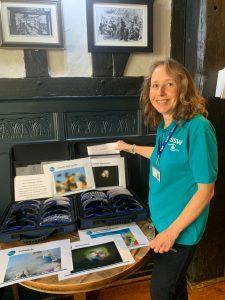
This special visual awareness event, held in conjunction with Adur and Worthing Council, kicked off with a heart-felt appeal from SSW Trustee Brian Butcher, who is visually impaired himself. Brian highlighted the main problems visually impaired customers have when walking around town centres and visiting hospitality outlets, with a focus on obstacles such as A-boards, tables and chairs, and other street furniture.
SSW representatives gave the business owners – including Thieves’ Kitchen and Jonny’s Restaurant – an opportunity to experience first-hand – through the use of ‘sim specs’ – what it is like to visit their business with a visual impairment. Jonny Abrahams, owner of Jonny’s Restaurant, wore the sim specs for a stroll down Warwick Street: “It’s been really useful to experience some of the eye conditions that visually impaired people have and to see how it is for them on the street and in my restaurant.”
Tim Loughton, MP for East Worthing and Shoreham, came along to support the event and tried out the sim specs, escorted by a sighted volunteer. Mr Loughton said “Events like this are really important to remind people that it’s great to have a busy street like Warwick Street – it’s fantastic that people are coming back out and socialising – but there are people for whom this can be a real trip hazard. We just need to remember that people with sight disability are customers as well and we need to make it as safe as possible for them to be able to enjoy life on the high street like everybody else.”
Brian Butcher, SSW Trustee and volunteer with RNIB and Guide Dogs, was delighted with how the event had gone: “It’s fantastic that so many of the Warwick Street establishments were keen to understand how they can make their premises more accessible for blind and visually impaired people. We’re keen to work with as many of the amazing businesses in Worthing as possible to help them in the same way. For hospitality outlets it’s especially important, as we can help them understand the requirements of their pavement licences in an easy, practical and cost-effective way.” You can watch Brian’s opening address below.
Plans are now being made for a similar event to be held for hospitality businesses in other locations throughout Worthing.
https://www.youtube.com/watch?v=4zdpBRc9GPA
Hello – I’m Gill! It’s always nice to put a face to a voice – and for those of you who listen to the newsletter on CD, it’s high time I introduced myself.
I’m Gill Medway, a local actor and writer – and it’s my great privilege to record your monthly newsletter.
I’ve been a primary school teacher, a magazine editor and – believe it or not – a puppeteer in Saudi Arabia. My glove puppet theatre, Magic Forest, featured the adventures of Horace the Hedgehog and was a real hit with the under-fives – both for Saudi children and British expats.
I’m now the resident writer with a local theatre company, Hurly-burly Theatre. We’ve been performing regularly at the Ardington Hotel in Worthing – and I’m lucky to be writing for a great bunch of actors.
Our work there has been seriously curtailed, due to you-know-what but with the easing of restrictions, we’re now back on track and planning our next performance. As we return slowly to normal, there’s plenty going on at Sight Support, too. I look forward to telling you all about it very soon…
SSW recently joined forces with Adur & Worthing Councils to give parts of Steyne Gardens in Worthing a summer facelift.

Cherry Ward, trustee of SSW, reported that the team planted numerous Salvia in the small bed with pink verbena. Similar plants were put in either side of the small bed along wth some ground covering. It is hoped that the beds will provide a fanastic scent throughout the coming months.
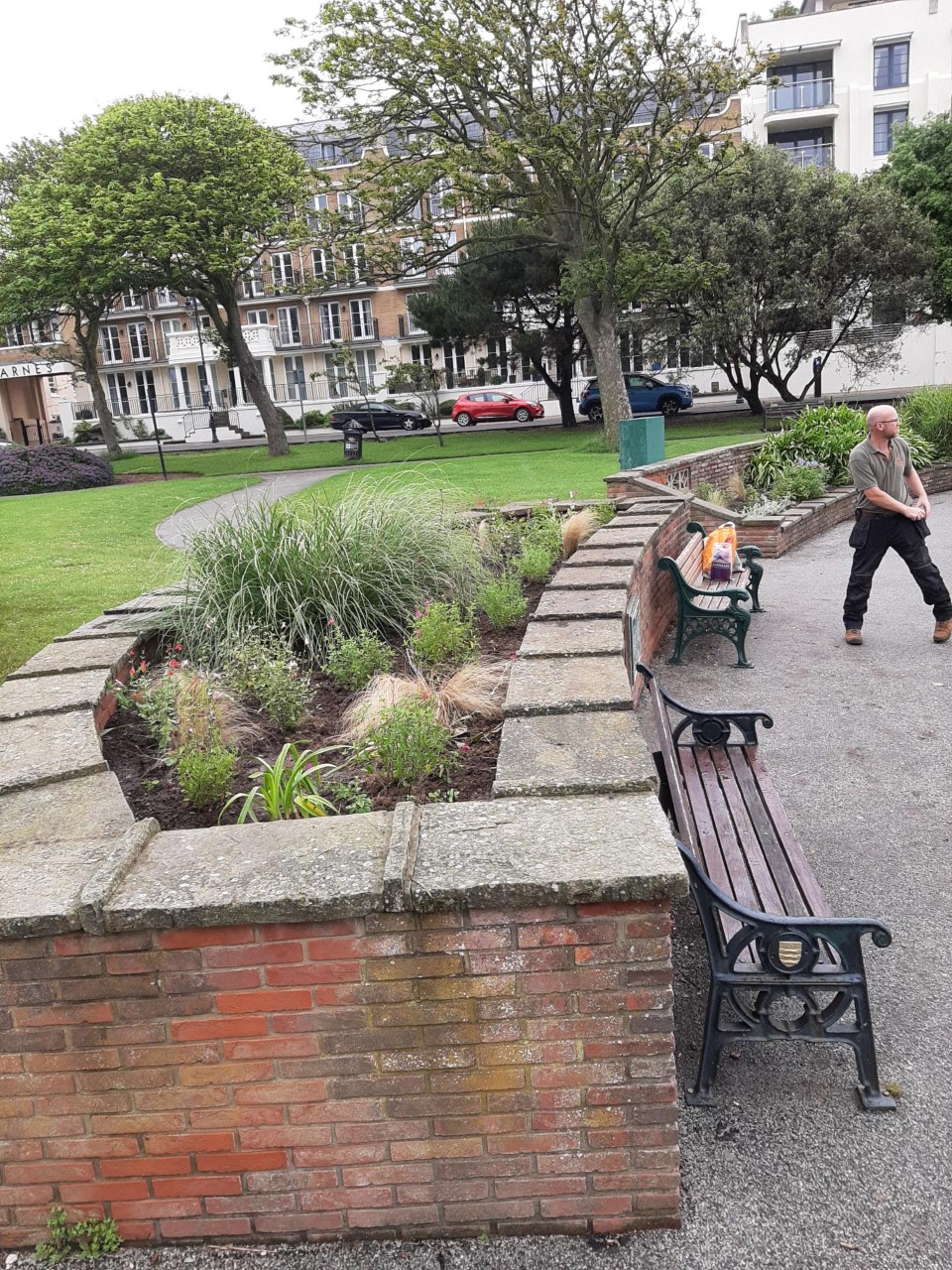
A second planting session is also planned. If you are in the town centre, do take a walk down to Steyne Gardens to admire the team’s work and enjoy the improved setting.
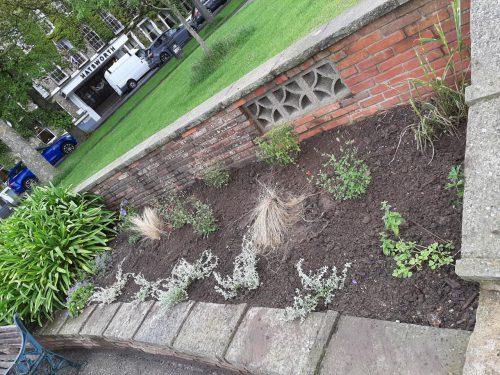
In our latest interview with a member of the SSW community we meet Frances Jacobs, who is a Trustee, and was a volunteer before that. Hello Frances!
Name: Frances Jacobs
Have you always lived in Worthing? I have lived in the Worthing area since I was 10 and I now live in Angmering.
How long have you been involved with Sight Support Worthing (SSW)? I have been a volunteer since 2015 and a trustee since 2016.
What’s your role at SSW? I make teas and coffees at the music afternoon and other social events. I also help on the mini bus and on members’ outings.
What do you especially enjoy about your role? I enjoy meeting both members and other volunteers
Tell us about a time at SSW that you have particularly enjoyed? I used to help with an art group and have a special memory of holding an exhibition at Worthing Library. We took the members to see it; the pictures were amazing.
What do you love about living where you do? I love living in this area being near both the sea and the Downs
How do you spend your free time? Walking with friends and playing golf
Tell us an amazing fact about yourself! I have been very lucky to travel extensively with my husband Graham, including trips to Antartica and trekking in the Himalayas. My most memorable experiences were spending time with the street children in Delhi and visiting a township in Kampala, Uganda representing ActionAid.
Thanks for your responses Frances! The experiences overseas sound fascinating. If you’re a member of SSW and would like to feature in our interview slot, we’d love to hear from you. Just email emily@sightsupportworthing.org.uk and she will send you through the questions.
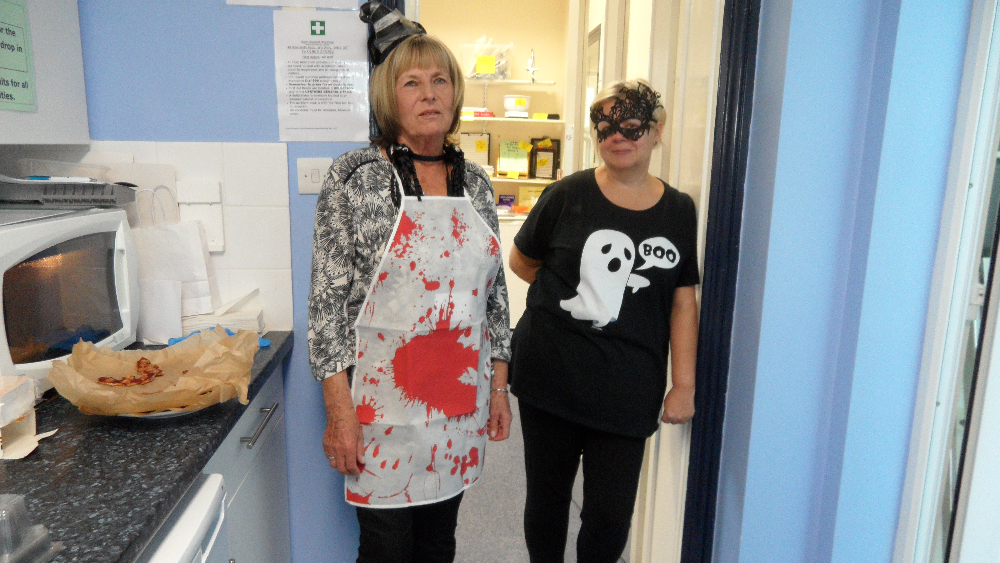
Our Executive Board play an important role in SSW and it’s always interesting to find out more about their background. In this insight we meet Bob Smytherman, who is President of SSW. You might also recognise him as Worthing’s Town Crier!
Name: Bob Smytherman
Lives: Worthing
Have you always lived in Worthing? I born in our family home in Lancing before moving to my own home in Worthing in 1991
How long have you been involved with Sight Support Worthing (SSW)? Since 2012

What’s your role at SSW? President
What do you especially enjoy about your role? I love meeting with our Members at our regular events such as the Burns Lunch or Christmas Party and Volunteers afternoon tea.
Which moments at SSW have you particularly enjoyed?
Being Master of Ceremonies for the Burns Lunch and addressing the Haggis is always a particular highlight as was Chairing the steering group for the lottery project looking in to the history of the charity and visually impaired people in the town.
What do you love about living where you do? I love being close to both the sea and Downs with a great range of shopping and leisure facilities on our doorstep.
How do you spend your free time? I love spending my time as Worthing Town Crier promoting our amazing town and community organisations
Tell us an amazing fact about yourself! I was Milk Monitor at St Mary’s Catholic Primary school in Worthing where I am now a School Governor.

Name: Dawn O’Donnell Lives: I have lived in Worthing for 4.5 years moving from south east London in 2016. How long have you been involved with SSW?When I moved here I knew no one and my husband was commuting back to London each day. He was leaving at 6 in the morning and not getting home until 5 in the evening; that’s a long day with no one to talk to especially if talking is your specialist subject! I decided no one would knock on my door just for a chat so I better find some company. I walked down the road, saw the sign at SSW (then The Blind Society) asking if you could make tea and coffee, and applied as a volunteer. I volunteered for about two years then was asked to become a trustee in August 2019. What’s your role at SSW? What do you especially enjoy about your role?I started in the Art class which I absolutely loved. Then I started taking members on trips and coffee mornings and helping out at afternoon events, which I did right up until covid stopped play. If you take part in the activities or groups at SSW which have you particularly enjoyed or have special memories of?I have many fabulous memories of conversations with members, Christmas parties, days out and, of cours,e directing the legendary (in my mind) SSW pantomime but I think my favourite was in an art class. Fiona, the tutor, asked a member – also called Dawn – if she wanted to make a birthday card with an owl in it. She said “ohh I can’t do that” so I said I would help her. Dawn’s sight was poor and she was also quite fragile but, between us, we made the card and the look on her face when we finished it was magic. Sadly Dawn passed away not that long after but I will always remember her grinning from ear to ear with pride at her achievement. What do you love about living where you do?I love the community feel in Worthing and every day during the pandemic I have thanked my lucky stars to be living by the sea. How do you spend your free time?I do work part-time for another charity but have been furloughed for the best part of a year. In this time I have been drawing. I belong to the Lockdown Scribblers (started by Jacqui who works for SSW) and have drawn something, mainly with a Disney twist, every day since 1st Jan. I also belong to the Worthing Blue Tits and have swum in the sea about a dozen times so far this year, including Easter Sunday.  Tell us an amazing fact about yourself!I don’t have many amazing facts about myself but I did get married in Las Vegas and Elvis walked me down the aisle. —–That’s a great fact to end on Dawn and in the words of the great man himself… “Thank you very much!”
Any organisation is formed, influenced and representative of the people involved, and especially in the case of a people-focused charity like Sight Support Worthing. We’re planning to introduce you to a wide range of the people that make Sight Support Worthing the wonderful community it is. We’ll be chatting with members, staff, trustees and volunteers.
It’s with a volunteer that we kick the series off. Here’s Victoria, who has recently started volunteering for us.
Name: Victoria Gray
Age: 26
Where do you live: Shoreham-by-Sea
Have you always lived in the same place?
I was born in Shoreham-by-Sea and it has always been my home town, however I have also been at a residential school and college. I went away to study at New College Worcester from the age of 11 for 7 years. This is a school for the blind. After this I went to The Royal National College for the Blind for 2 years. I found it hard living away from home as I missed my family and I have always loved Shoreham-by-Sea.
How long have you been volunteering with Sight Support Worthing (SSW)?
I have only recently started volunteering. I would like to be involved in the things that SSW do as I am totally blind myself so I feel very passionate about meeting other people with sight loss and helping to make things accessible.
What activities (whether now or pre-Covid) have you enjoyed at SSW?
SSW have recently started running Chair Yoga sessions which I have really enjoyed. Yoga is very good for relaxation and I find I get a lot out of it because I struggle a lot with my balance which makes Chair Yoga the easiest form of Yoga for me to do.
Is there an activity or social group you’d like SSW to start?
Book Group where members could come together and discuss what they are reading.
Quizzes
Walking group where we could go for a walk and maybe get a pub lunch after.
Tandem Riding
Which of SSW’s other services or support have you used?
I haven’t used any other services but this is something I would like to do and as a volunteer I would like to help in any way I can.
What do you love about living where you do?
I love the community feel. It’s nice to live somewhere where people look out for each other. I also love living by the sea.
How do you spend your free time?
Socialising with friends
Gaming
Reading
Yoga
Choir
Drama workshops
Tell us an amazing fact about yourself!
I have recently started helping to run a book group for the RNIB. It is the first ever group that I have helped to run and it feels like a great achievement. I sometimes get a bit anxious so being able to help run a group and bring people together is such a wonderful feeling and I love being able to help people to connect with each other.
Thanks, Victoria; how brilliant it is to have you on-board as a volunteer! Victoria’s input as someone with sight loss will be of great benefit to the team as they develop services and activities for members. Look out for Victoria when the Centre reopens in the coming months.
Are you a volunteer or member of Sight Support Worthing and would like to be featured in our interviews, you can email Emily.
Of course we’re always keen to welcome new members and volunteers. Do get in touch if you’d like to find out more.
Sight Support Worthing couldn’t function as well as we do without the amazing help and support of our volunteer Sight Supporters. They undertake a range of valuable tasks for us, and they get a real feel-good factor from helping our clients! Each volunteer has their own reasons for giving their time and energy to us, and chances are some of those are listed below. Take a look at some of the brilliant benefits of becoming a volunteer:
Make a difference – yes, there’s no denying it: you will make a difference to everyone involved in Sight Support Worthing or wherever you choose to volunteer. Some days it might be small and help one person, other days you might do something that helps a whole crowd. Either way, you will affect someone, somehow in a positive way.
Gain confidence and build self-esteem – not all of us are as confident as we’d like, and volunteering is a great way to remedy this. Once you start volunteering you’ll begin to get a sense of accomplishment and pride in your achievements, especially when you see the difference you’re making to others. Your confidence and sense of achievement will be boosted even higher if your volunteer role takes you out of your comfort zone.
This self-assurance will then spill over into other areas of your life so you’ll feel more confident and positive at home or work. If you’re shy, putting yourself into unknown (but hopefully welcoming) situations can condition you to find them less scary. Win-win.
Create new connections – whether you come away with a brand new best friend or find somewhere to have a regular chat with friendly faces, you’ll form new connections with like-minded people. If you’re someone who finds life a little lonely at times, volunteering is an excellent way to combat this. Choose somewhere to volunteer where you’ll be amongst people and you’ll be part of a whole new community.
Makes you happier – as humans we’re wired to want to help others, so the brain reacts well to situations when it knows you’re doing that, and makes you feel happier. Choosing a volunteering opportunity that’s right for you will also mean you spend that time having fun – and who doesn’t want an extra bit of fun in their life?!

Sense of purpose – most people choose to volunteer for an organisation or issue that is important to them. By giving your time and energy for free, and helping others achieve something, you’ll be boosting your sense of purpose and with it your feelings of happiness. Studies have shown that volunteering can help with depression, anxiety and other negative feelings by providing that regular sense of purpose and a positive reason to get up and out of the house.
Help with your career – volunteering offers opportunities to learn new skills and many of those will be transferable to other aspects of life including work. It’ll also show any employer that you go above and beyond and take time to help others; who wouldn’t want someone like that working with them? Volunteering is especially good if you’re lacking in work experience as it can provide you with new skills and proof of attributes that can then be added to a CV or used as examples in job interviews. Say you’d like to work in admin… find a volunteering role that will see you helping out with filing, perhaps doing a stock inventory, or maybe sorting out mail. The more you help out, the more you will learn.
So if you score one or more of these benefits while volunteering, you’re on to a winner. Perhaps you’re already volunteering and can add to our list of benefits? What do you gain from being a volunteer?
We’re always on the lookout for people like you to help us in volunteer roles. Take a look at our web page dedicated to volunteering opportunities at Sight Support Worthing or get in touch for a chat.
Sight Support Worthing couldn’t function as well as we do without the amazing help and support of our volunteer Sight Supporters. They undertake a range of valuable tasks for us, and they get a real feel-good factor from helping our clients! Each volunteer has their own reasons for giving their time and energy to us, and chances are some of those are listed below. Take a look at some of the brilliant benefits of becoming a volunteer:
Make a difference – yes, there’s no denying it: you will make a difference to everyone involved in Sight Support Worthing or wherever you choose to volunteer. Some days it might be small and help one person, other days you might do something that helps a whole crowd. Either way, you will affect someone, somehow in a positive way.
Gain confidence and build self-esteem – not all of us are as confident as we’d like, and volunteering is a great way to remedy this. Once you start volunteering you’ll begin to get a sense of accomplishment and pride in your achievements, especially when you see the difference you’re making to others. Your confidence and sense of achievement will be boosted even higher if your volunteer role takes you out of your comfort zone.
This self-assurance will then spill over into other areas of your life so you’ll feel more confident and positive at home or work. If you’re shy, putting yourself into unknown (but hopefully welcoming) situations can condition you to find them less scary. Win-win.
Create new connections – whether you come away with a brand new best friend or find somewhere to have a regular chat with friendly faces, you’ll form new connections with like-minded people. If you’re someone who finds life a little lonely at times, volunteering is an excellent way to combat this. Choose somewhere to volunteer where you’ll be amongst people and you’ll be part of a whole new community.
Makes you happier – as humans we’re wired to want to help others, so the brain reacts well to situations when it knows you’re doing that, and makes you feel happier. Choosing a volunteering opportunity that’s right for you will also mean you spend that time having fun – and who doesn’t want an extra bit of fun in their life?!
Sense of purpose – most people choose to volunteer for an organisation or issue that is important to them. By giving your time and energy for free, and helping others achieve something, you’ll be boosting your sense of purpose and with it your feelings of happiness. Studies have shown that volunteering can help with depression, anxiety and other negative feelings by providing that regular sense of purpose and a positive reason to get up and out of the house.
Help with your career – volunteering offers opportunities to learn new skills and many of those will be transferable to other aspects of life including work. It’ll also show any employer that you go above and beyond and take time to help others; who wouldn’t want someone like that working with them? Volunteering is especially good if you’re lacking in work experience as it can provide you with new skills and proof of attributes that can then be added to a CV or used as examples in job interviews. Say you’d like to work in admin… find a volunteering role that will see you helping out with filing, perhaps doing a stock inventory, or maybe sorting out mail. The more you help out, the more you will learn.
So if you score one or more of these benefits while volunteering, you’re on to a winner. Perhaps you’re already volunteering and can add to our list of benefits? What do you gain from being a volunteer?
We’re always on the lookout for people like you to help us in volunteer roles. Take a look at our web page dedicated to volunteering opportunities at Sight Support Worthing or get in touch for a chat.
‘Providing the Jam’ is a fascinating look at the visually impaired community of Worthing, and focuses on the past 100+ years of support that Sight Support Worthing has provided.
The book was written by authors Chris Hare and Lela Tredwell, with support from the Heritage Lottery Fund without whom this project would not have been possible.
The book can be purchased for £4.99 from our centre in Rowlands Road, or through Amazon Kindle, where it is also available for £4.99.